How Long Does Viral Food Actually Stay Viral?
There is no useful single average until you decide what is ending: attention, queues, sellers or the category itself.

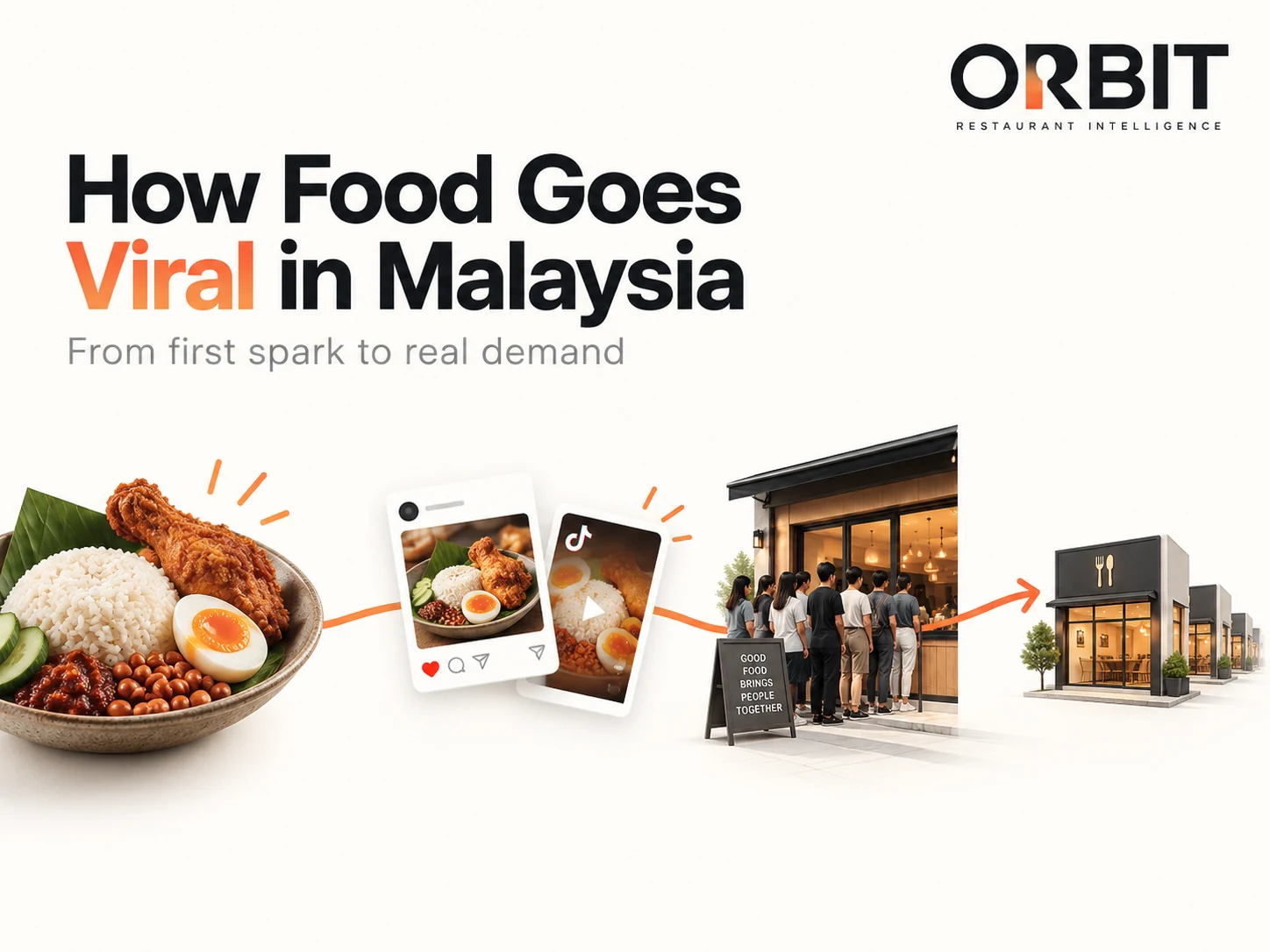
There is no defensible single “average lifespan” for viral food because several clocks are running at once. Attention can collapse while the product, outlet network or category remains commercially healthy for years. The right question is which clock is ending: hype, queue, seller entry, product demand or category relevance.
Key takeaways
- Hype life is not product lifeSocial urgency can disappear while routine demand survives.
- Different trends have different afterlivesSome vanish, some normalize, some mutate, some become chains.
- Late markets may have shorter windowsPhysical supply can arrive after digital novelty has already matured.
- Stage matters more than “still viral?”Operators should diagnose demand stage before expanding or entering.
There are at least four different lifespans
| Clock | What ends | Typical evidence |
|---|---|---|
| Attention life | People stop talking/searching urgently | Post/search decay |
| Queue life | Exceptional wait times disappear | Normalised service/walk-in access |
| Seller-entry life | New operators stop entering | Fewer new launches; closures begin |
| Category life | Consumers stop treating the category as relevant | Menu removal or long-term normalization |
These clocks can move independently. A product can have a short attention life but a very long category life. That is why “the hype died” is not the same statement as “the product failed.”
Fast-moving food crazes can have very different afterlives
Recent Korean trend retrospectives illustrate the variation: some crazes cooled within months while other products settled into ordinary bakery or snack life.1 Those exact durations should not be transplanted to Malaysia, but they show why one universal lifespan is not credible.
Japanese cheese tarts provide a Malaysian version of the same lesson. One Malaysian review documented almost no queue a week after an outlet opening despite the opening-week imagery, yet Hokkaido Baked Cheese Tart continues to operate multiple Malaysian stores years later.23
Bubble tea is even clearer. The intense SS15 “Boba Street” phase collapsed dramatically, with COVID a major confounder, but the broader beverage category survived and Malaysian operators such as Tealive continued scaling.46
| Trend outcome | What it means |
|---|---|
| Disappears | Novelty and demand both vanish |
| Normalizes | Hype fades; repeat demand remains |
| Mutates | Original object fades; successful traits migrate to new products |
| Consolidates | Weak sellers exit; stronger operators remain |
| Becomes infrastructure | Category becomes an ordinary choice rather than a trend |
Geography changes the clock
A 2026 study on culinary trend life cycles found that later-adopting regions experienced shorter and more volatile cycles in the case examined.5 The context is not Malaysia, but the implication is useful: digital attention can reach a place before physical supply does.
A Johor or Penang operator opening a trend eight months after a Klang Valley peak may be in “physical launch” while consumers are already in “digital maturity.” That mismatch can compress the commercial window.
- 1Origin market peaks
The visual and product script become known.
- 2Malaysia sees the content
Consumers gain awareness before local access exists.
- 3Early local sellers open
Curiosity converts into queues and coverage.
- 4Late sellers sign leases
Supply decisions lag attention.
- 5Market opens at scale
Consumers may already be moving from novelty toward comparison or boredom.
The operator question is not “is it still viral?”
Diagnose the stage instead
- Is branded/category search accelerating, flat or falling?
- Are new customer posts still increasing, or only established sellers posting?
- Are queues persistent at full price and ordinary days, or only launch events?
- Are consumers still asking “what is it?” or already asking “which one is best?”
- Are new competitors opening faster than consumer attention is growing?
- Has the product developed ordinary repeat occasions after the novelty phase?
- Is your local city early, late or already saturated relative to the national conversation?
Once those questions are answered, the practical decision becomes much clearer: enter, differentiate, consolidate, or avoid chasing a trend whose visible supply is responding to yesterday’s demand.
Consumer language can reveal lifecycle stage
One practical way to estimate maturity is to listen to the questions consumers are asking.
| Stage | Typical language | What it suggests |
|---|---|---|
| Discovery | “What is this?” | Low category familiarity |
| Early growth | “Where can I get it?” | Access becoming the constraint |
| Comparison | “Which one is best?” | Category is established; brands compete |
| Scepticism | “Overrated?” “Worth the queue?” | Hype being evaluated |
| Normalization | “My usual order is…” | Category may have become routine |
| Decline | “Do people still eat this?” | Attention and relevance are fading |
This is not a validated lifecycle classifier, but it is a useful qualitative indicator when combined with search, seller-entry and review data.
The biggest operator risk is supply lag
Restaurants respond slowly. A viral post can peak this week; a new outlet can take months to lease, renovate, staff and open. That delay means an operator can make a rational decision using visible demand today and still open into a market that has already moved on.
The safest response is to separate experiments from irreversible commitments. Pop-ups, limited menu tests, delivery-only launches and temporary collaborations can reveal whether the local market is still in discovery/growth before the operator commits to a full build-out.
Three entry scenarios with very different risk
Imagine the same trend in three different market stages.
| Scenario | Visible market | Risk |
|---|---|---|
| Early | Few sellers, rising search, customers still asking where to find it | Execution risk is high, but novelty window may be open |
| Growth | Search and customer posts rising, competitors entering | Best evidence of demand, but supply is accelerating |
| Late | Many sellers, heavy comparison/discounting, search flattening | Looks safest because category is visible, but opportunity may already be compressing |
The paradox is that late entry often feels psychologically safer because the trend is obvious. Commercially, it may be the most dangerous moment if the operator commits fixed costs just as consumer attention matures.
Research notes & sources6 sources
How this article was researched
We separate different lifecycle clocks rather than forcing all trends into one duration. Korean examples provide unusually clear chronology; Malaysian cases are used to show normalization and shock confounding.
- The Korea Times — rise and fall of Korea’s viral food trends
Documents several different hype windows: Dubai chocolate faded in Korea within months, tanghulu waned after roughly a year, while salt bread stayed after the frenzy ended. - Malaysian Flavours — Hokkaido Baked Cheese Tart one week after opening
A useful near-control: opening-day Facebook queue photos were followed by essentially no queue during a busy Sunday one week later. - Hokkaido Baked Cheese Tart — Malaysia store locator
Current locator lists 28 Malaysian stores, showing that disappearance of hype does not necessarily mean disappearance of commercial demand. - Tealive — About Us
Current company page reports more than 900 outlets across three continents, useful evidence that bubble tea outlived the 2019 queue craze as a category. - Choi & Yang — Spatiotemporal Product Life Cycle for culinary trends
2026 study using Korea’s tanghulu craze: late-adopting regions had compressed, more volatile life cycles and the trend moved geographically over time. - Malay Mail — How Subang Jaya’s Boba Street bubble burst
Retrospective on SS15’s boba cluster: 15–20 outlets on one stretch, roughly 40 bubble-tea shops in the wider neighbourhood and queues at the peak; COVID heavily confounds the subsequent closures.
What this research cannot proveLimitations
The examples do not establish a Malaysian median lifespan. COVID heavily confounds SS15 bubble tea, and survival of a brand does not prove the original viral SKU remained equally important. A true lifespan estimate needs a coded sample with explicit start/end rules.