Are Malaysia’s Viral Foods Usually Foreign?
Imported trends are highly visible, but local venue and category breakouts show that foreign origin is not a requirement.

No. Malaysian viral food is not always foreign. Imported formats are over-represented in trend coverage because a new category is easy to label as a “trend,” while familiar local foods often go viral at the venue, person or version level. Foreign trends do have one real advantage: many arrive after they have already been selected by another market, giving Malaysian operators proof and a ready-made content script.
Key takeaways
- Foreignness is not necessaryAkka Nasi Lemak and burger bakar are direct local counterexamples.
- Trend lists create selection biasNew imported categories are easier for media to classify as “food trends.”
- Imported ideas arrive pre-testedMalaysia often receives formats that already proved attention elsewhere.
- Malaysia also mutates importsLocal sellers adapt foreign formats into new flavours, forms and occasions.
Why trend lists look more foreign than the market really is
A year-end article titled “food trends Malaysians went crazy for” naturally selects things whose category changed: bubble tea, Japanese cheese tarts, cromboloni, Korean foods, Dubai chocolate.
But when a local nasi lemak stall becomes a destination, nasi lemak itself is not a new category. The trend is the venue or story. That event is less likely to appear in a “new food trends” list even if the queue and travel behaviour are dramatic.
| Imported category trend | Local venue/version trend |
|---|---|
| Easy headline: “new food craze” | Often framed as “this stall is suddenly packed” |
| The food itself needs explanation | The category is already understood |
| Media tracks category novelty | Media tracks story, owner, queue or “best version” |
| Looks like a food trend dataset | Can disappear from trend datasets despite real virality |
That means any dataset built from trend listicles alone will exaggerate foreign-origin food.
Local cases directly break the “foreign food” theory
Akka Nasi Lemak is a clear venue-virality counterexample. Sinar Harian reported a queue stretching more than 100 metres and customers travelling from outside the area, despite the stall having operated for years before the breakout.1
Burger bakar is a category-level Malaysian counterexample. Contemporary reporting in 2012 described two-to-three-hour waits, and later reporting described a broader burger boom with imitation and subsequent shakeout.2
These cases matter because they remove “foreignness” from the list of necessary conditions. A local food can create just as much social information when the distinctive object is the format, person, venue, scale, value or story.
Imported trends do have one real advantage: prior proof
An overseas viral format often arrives in Malaysia after someone else has already absorbed the experimentation risk. The product has a name, a visual script, known suppliers, example recipes and proof that consumers somewhere were interested.
Dubai chocolate is a good example: by the time Malaysian sellers began adapting the pistachio-kunafa idea into bars, croissants and cookies, the format already had global visibility.3 Round filled croissants were likewise documented in Klang Valley in 2022 as an adaptation of New York’s Lafayette Suprême before the later “cromboloni” naming wave.4
| Imported advantage | Hidden risk |
|---|---|
| Proven visual/content format | Malaysia may already be digitally overexposed |
| Known recipe/equipment path | Competitors can copy quickly too |
| Existing consumer curiosity | Local price or halal/access friction may differ |
| Foreign social proof | Late entry can shorten the novelty window |
The market also localises and mutates imports
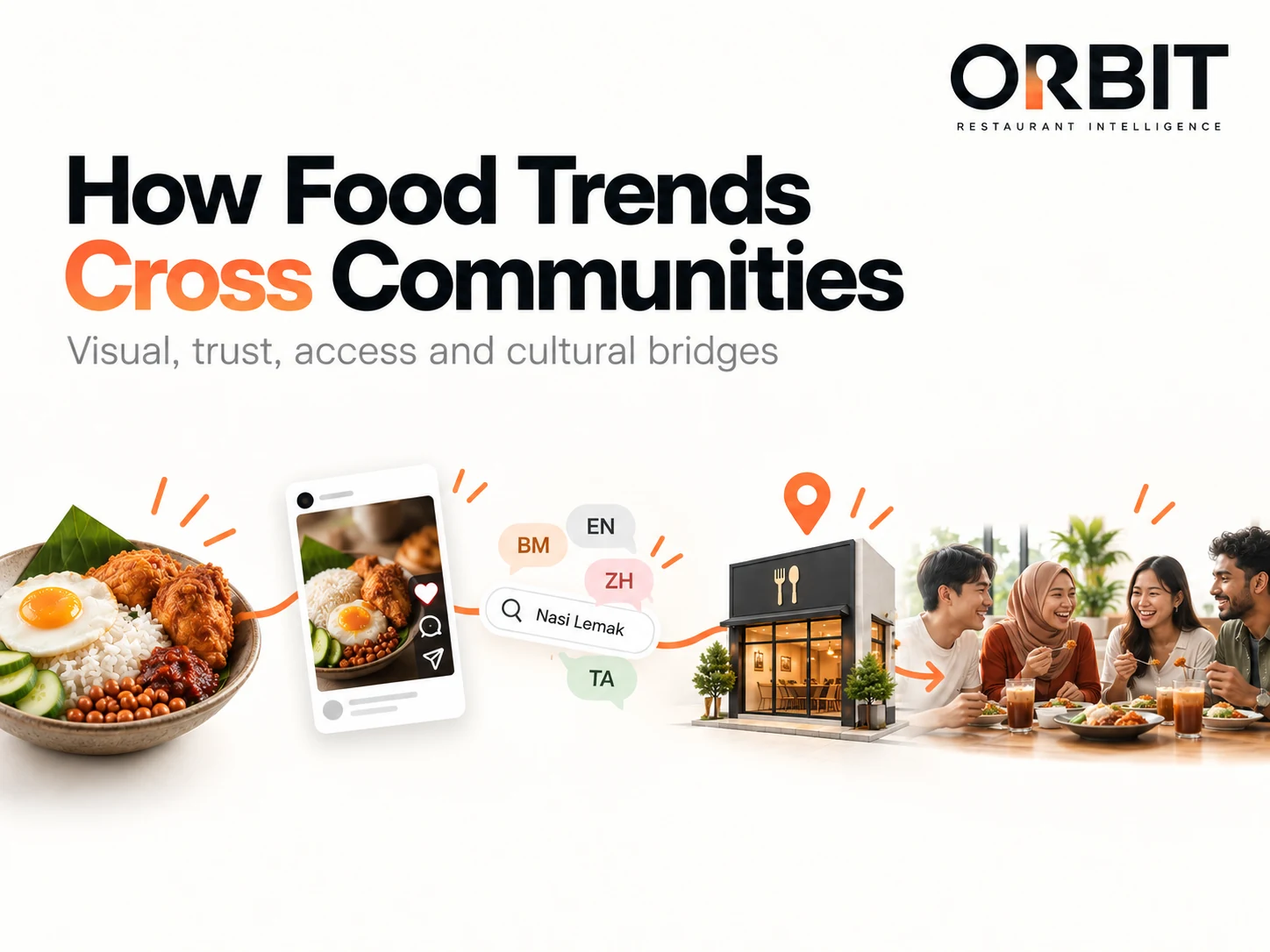
Malaysia is not only a receiving market. Foreign formats are routinely reinterpreted through local flavours, occasions and business models. That makes national origin a weak predictor by itself.
A more useful provenance system is:
| Type | Example question |
|---|---|
| Foreign import | Is the same format transplanted with little change? |
| Regional import | Does cultural proximity lower adoption friction? |
| Foreign format + local adaptation | Has the format been translated into local flavours/needs? |
| Malaysian remix | Are familiar local elements recombined into a new object? |
| Local venue phenomenon | Is the food ordinary but the venue/person suddenly viral? |
| Local category innovation | Did the category itself emerge and spread locally? |
This coding lets us ask a better question later: which provenance types are disproportionately represented among Malaysian breakouts after controlling for media-selection bias?
What to ask before importing a trend
A restaurant importing a foreign trend should verify:
- How long ago did the trend peak in the originating market?
- Has Malaysian social media already consumed the novelty before physical supply arrived?
- What is the familiar local reference that makes the product easy to understand?
- Which local participation gates could block trial: halal confidence, price, location, group suitability or ingredients?
- How easy is the format for competitors to copy?
- Is the product attractive because it is foreign, or because it offers a real relative advantage?
The SS15 boba case also reminds us that imported categories can create intense local clustering and then face abrupt shakeout, with COVID adding a major external shock in 2020.5 Foreign precedent reduces uncertainty; it does not remove lifecycle risk.
Country lag may matter more than country of origin
A foreign trend can reach Malaysia in several stages: people see it overseas, creators discuss it locally, early importers launch it, and only later does broad physical access arrive. That lag can be strategically important.
If Malaysian consumers have already watched the format for months before local supply exists, the first local seller benefits from accumulated curiosity. But late sellers may enter after consumers have already consumed the novelty digitally.
This suggests that “foreign or local?” may be less useful than three time questions: when did the product first become visible globally, when did Malaysians begin seeing it, and when did local supply become easy?
Why Malaysia may be a mutation market rather than just an import market
Malaysia’s food environment makes recombination unusually easy: familiar Malay, Chinese, Indian, Indonesian, Middle Eastern, Japanese, Korean and Western formats coexist in the same consumer market. That does not prove Malaysia has a higher mutation rate than other countries, but it makes local adaptation a serious research hypothesis.
For operators, the opportunity is not necessarily to import the foreign product unchanged. It may be to identify which part of the foreign format creates attention, then translate that trait into a locally compatible product or occasion.
That is a much more defensible strategy than simply copying whatever is currently popular overseas.
Country of origin is a descriptor, not yet a cause
Even if a future dataset shows that imported formats appear frequently among Malaysian viral categories, that would not prove foreignness itself causes virality. Foreign formats may differ on other variables: novelty, existing global proof, visual format, media interest or operator investment.
A proper statistical test would need to compare imported and local candidates while controlling for those factors. Until then, “foreign” should remain a provenance label, not an explanatory mechanism.
This distinction protects restaurant owners from a common copycat error: assuming that a product is attractive because it is Korean, Japanese, Taiwanese or Dubai-linked when the real driver may be a specific sensory, social or value proposition that could be recreated in a local format.
Research notes & sources5 sources
How this article was researched
We deliberately included both imported-category trends and local venue/category breakouts to avoid the selection bias created by “food trend” media lists. The current evidence supports rejecting the claim that Malaysian virality requires foreign origin.
- Sinar Harian — Beratur panjang dapatkan nasi lemak Sangeeta
2023 report: a 13-year-old nasi lemak business suddenly drew a queue over 100 metres after going viral; customers travelled from outside the area. - Free Malaysia Today — The burger joint you should go to
2012 report on Burger Bakar Kaw Kaw: social buzz, waits up to two hours and reportedly more than 1,000 burgers sold nightly. - Malay Mail — pistachio-kunafa fever in KL
2024 Malaysian market scan documenting local bars, croissants, cookies and other adaptations of the Dubai chocolate format. - Malay Mail — round filled croissants in Klang Valley, 2022
Important chronology correction: round filled croissants inspired by Lafayette were already in Klang Valley by September 2022, before the late-2023 ‘cromboloni’ naming wave. - Malay Mail — How Subang Jaya’s Boba Street bubble burst
Retrospective on SS15’s boba cluster: 15–20 outlets on one stretch, roughly 40 bubble-tea shops in the wider neighbourhood and queues at the peak; COVID heavily confounds the subsequent closures.
What this research cannot proveLimitations
We do not yet have a representative census of all Malaysian viral food events, so we cannot honestly state what percentage are foreign, regional or local. A quantified answer requires a defined sampling frame and coded case dataset.