Why Paying More Than Expected May Lower Restaurant Ratings
A 2026 study of Google Maps restaurant reviews found that ratings were lower when diners reported spending above the platform-listed reference price. The researchers used that listed price as an observable benchmark for expected price.

In this study, paying above the platform-listed reference price was associated with lower restaurant ratings. Paying below it was associated with higher ratings, but the positive effect was smaller.
For restaurant owners, the useful question is not only “Is my restaurant expensive?” It is also “What price did the customer expect before the bill arrived?”

What did the study actually find?
Researchers analysed Google Maps ratings from 2,000 restaurants in New York. They compared the price range reviewers said they paid with the price range displayed on each restaurant’s Google Maps profile. The researchers treated that platform-listed range as an observable external reference price, not as a perfect measure of every diner’s private expectation.
When the amount paid was above that reference price, ratings were about 0.19 stars lower on average. When the amount paid was below the reference price, ratings were about 0.10 stars higher.
That difference is the important part. Spending above the reference price was associated with a larger negative change in ratings than the positive change associated with spending below it. The authors interpret this asymmetric pattern as evidence of loss aversion, a core idea from prospect theory.
The negative price gap was stronger than the positive one.
The study analysed more than 160,000 Google Maps restaurant ratings from 2,000 New York restaurants and found a clear asymmetry around the platform-listed reference price.
The Google Maps price range is an observable proxy for a customer’s reference price. It cannot capture every person’s private expectation. The study is observational and based on New York data, so it should not be treated as a causal estimate for Malaysian restaurants.
“Is the customer reacting to the price itself, or to the gap between expectation and reality?”
ORBIT interpretation of the research
A simple restaurant example
Imagine a customer checks your menu, photos and Google listing before dinner. From everything they see, they mentally expect to spend around RM30 per person.
The meal is fine. Nothing is obviously wrong. Then the final spend comes to RM45 per person.
The customer may think, “That was more expensive than I expected.” The research suggests that this kind of price gap can be related to how the overall experience is rated, even though the study does not prove that a price surprise caused an individual review.
This RM30 to RM45 example is illustrative, not a number taken from the New York study. The study compared Google’s price categories rather than Malaysian ringgit amounts.
Why does the bad surprise matter more?
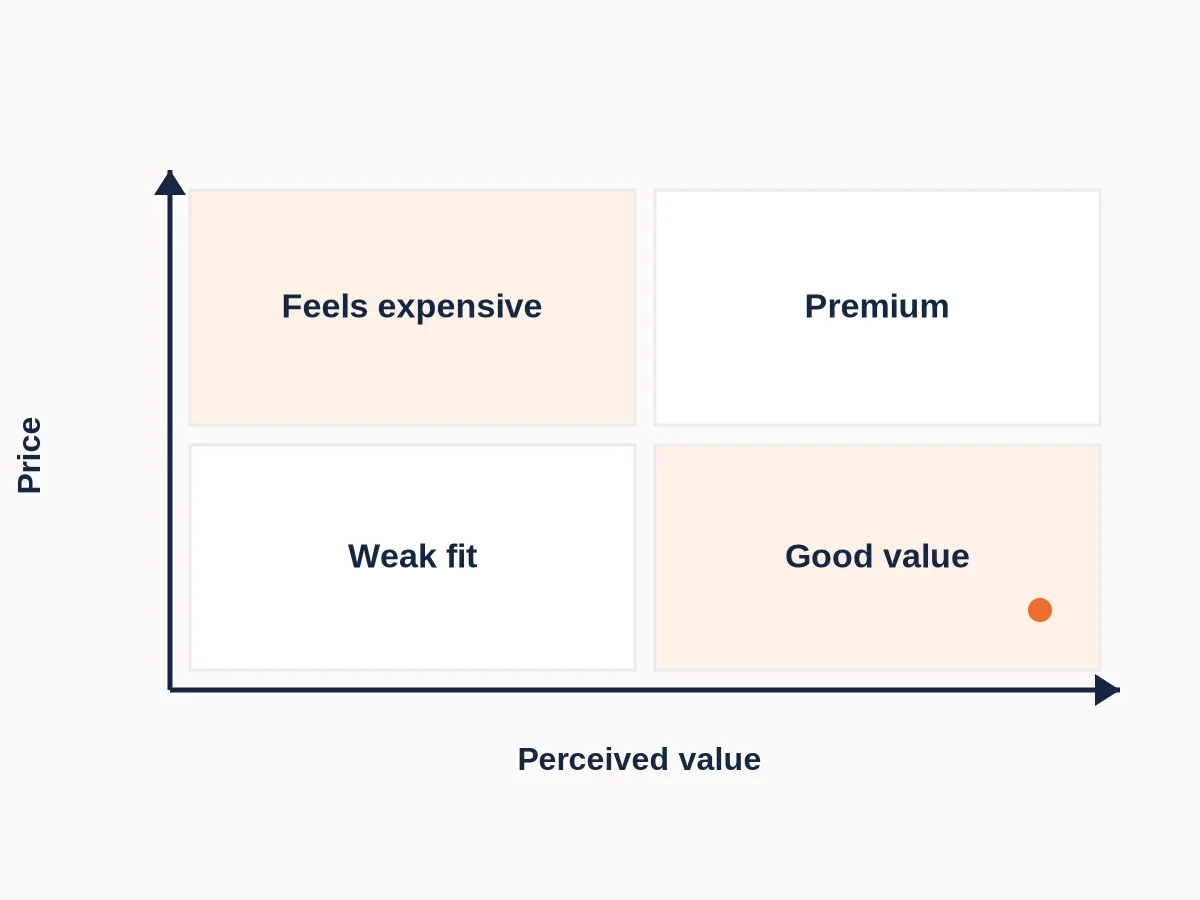
Prospect theory suggests people evaluate outcomes relative to a reference point. Going above the expected price feels like a loss. Paying less feels like a gain.
But the reactions were not equal. In this study, the negative association from spending above the reference price was larger than the positive association from spending below it. In simple terms, the downside of being above the benchmark was stronger than the upside of being below it.
The researchers also found diminishing sensitivity. As the price gap became larger, the total effect grew, but each additional step away from the reference point added less impact than the previous step.
The practical implication is that the same menu price can be judged differently when the reference point around that price changes.
This does not mean “just lower your prices”
The study is not evidence that cheaper restaurants automatically receive better reviews. It is about the relationship between the price customers appeared to expect and the price they reported paying.
For example, a RM50 meal may feel reasonable when the customer expected roughly that spend. The same RM50 may be judged differently if the restaurant’s visible signals led the customer to expect much less. This is an illustrative example, not a result measured in Malaysian ringgit by the study.
So before discounting, ask whether the problem is really the price or whether the restaurant is creating the wrong expectation around the price.
What should restaurant owners check next?
Practical ORBIT interpretation: the study did not test each of the items below individually. These are external signals an operator can inspect when looking for possible expectation gaps.
- Google price range: Does the displayed level still match what people commonly spend?
- Menu photos and online menus: Are current prices easy to find before the visit?
- Promotions: Does an attractive headline price create an expectation that changes once add-ons are included?
- Portions and presentation: Does the experience look like it will deliver the value implied by the price?
- Delivery platforms: Are customers seeing a noticeably different price from dine-in without understanding why?
- Competitor context: What does a similar spend buy at the alternatives customers are comparing?
The study also found stronger price-deviation effects in delivery and takeout than in dine-in. That does not tell us exactly why, but it is a useful reason to analyse these channels separately instead of assuming customers judge every service mode in the same way.
Experienced reviewers reacted differently
The relationship was weaker among Google Local Guides for small and moderate negative price deviations. The authors suggest that experienced reviewers may have broader comparison standards and rely less heavily on one reference price.
That matters when reading your own reviews. Two people can experience the same bill and judge it differently because they arrived with different expectations, comparison sets and experience.
What should a restaurant owner do with this?
Do not start by asking, “Should I cut the price?” Start by checking whether the market is receiving the price you intended to communicate.
- Compare your Google price range with your current menu and typical spend.
- Read reviews that mention “expensive”, “worth it”, “value”, “portion”, “hidden”, “extra” or “price”.
- Separate dine-in reviews from delivery and takeaway feedback where possible.
- Compare how nearby competitors frame a similar spend.
- Look for expectation gaps before deciding whether the solution is a discount, clearer communication, a stronger value proposition or something else.
What this study cannot tell us
The restaurants were in New York, not Malaysia. Customer expectations, spending levels, platform use and dining habits may differ here.
The displayed Google Maps price range is also only a proxy for the customer’s true internal expectation. The paper itself notes that internal reference prices may also depend on prior experience, advertising or social comparison. In practice, ORBIT would treat other visible price and value signals as hypotheses to investigate rather than findings proven by this paper.
And because the study uses observational review data, it shows a strong relationship rather than proving that a price surprise directly caused every rating change.
For a Malaysian restaurant, the useful takeaway is therefore a question to investigate: is there a gap between the price customers appear to expect and the price or value they feel they receive?
Quick answers
What did the restaurant price expectation study find?
Across the analysed Google Maps reviews, ratings were about 0.19 stars lower when reported spending was above the platform-listed reference price and about 0.10 stars higher when spending was below it. The negative association was significantly larger than the positive one.
What is a restaurant reference price?
In this study, the reference price was the price range displayed on the restaurant’s Google Maps profile. The researchers used it as an observable external benchmark that could help shape price expectations.
Does a higher restaurant price automatically cause lower ratings?
No. The study was about the gap between reported spending and a platform-listed reference price, not simply whether a restaurant was expensive. It also used observational data, so it should not be read as proof that a price gap caused every rating change.
Should a restaurant lower prices to improve ratings?
Not based on this study alone. Restaurant owners can also examine whether menu prices, Google price ranges, promotions and other value signals are setting expectations that match the eventual spend.
Does this prove the same effect in Malaysia?
No. The sample came from New York. The research gives Malaysian operators a useful mechanism to investigate, but the size of the effect should not be assumed to be identical here.
Source and research context
Nicolau, J. L., Anguera-Torrell, O. & Boto-García, D. (2026). When the check shapes the stars: Prospect-theory driven effects on online restaurant ratings. Annals of Tourism Research, 121, 104282. The study used public Google Maps restaurant data from New York and examined the relationship between consumer-reported spending, platform-listed reference prices and star ratings. Its findings should be interpreted within that setting and research design. The operator checks and Malaysian examples in this article are ORBIT interpretations built from the research, not variables individually tested by the paper.
Find the expectation gap around your restaurant
ORBIT looks beyond the average rating to examine pricing signals, review patterns, competitor context and the outside factors that may shape how customers judge your restaurant.