Should I Lower My Restaurant Prices When Sales Are Slow?
Price can absolutely affect restaurant choice. Slow sales still do not prove that your menu is too expensive.

Not yet.Slow sales are not enough evidence that your menu is too expensive. First separate absolute price from perceived value, competitor offers and problems that have nothing to do with price.
Cutting price before identifying the friction can reduce margin without improving the customer decision.
Price and perceived value are not the same thing
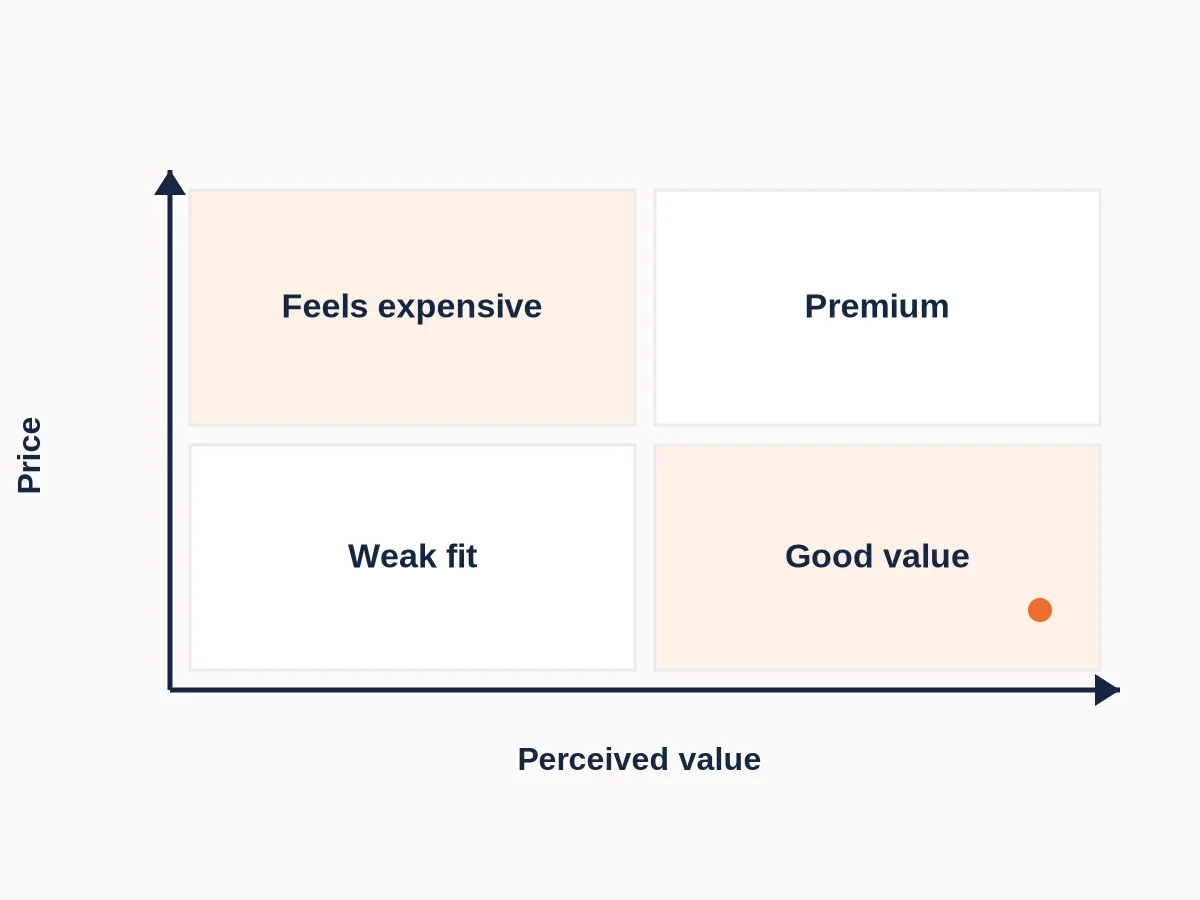
Absolute price asks, “How much does this cost?” Perceived value asks, “Does what I expect to receive feel worth that cost?” A customer may describe a meal as expensive because the portion feels small, the experience feels ordinary, the service feels weak or another restaurant appears to offer more for a similar amount.
The reverse can also happen. A restaurant can charge a higher price and still feel like good value when the product, experience, convenience or reputation supports the expectation.
Perceived value can also be shaped before the customer visits. A menu photo with unclear portion size, premium-looking imagery paired with a basic dining environment, or hidden add-on costs can create a value expectation that later works against the restaurant. Pricing is therefore partly about the number and partly about how the offer is framed.
Low demand does not automatically mean the menu price is wrong.
Customers respond to perceived value, not only the number on the menu. Price can be acceptable in one context and feel wrong in another.
Price matters, but the occasion changes how it is judged
A quick weekday meal and a celebration are not evaluated in exactly the same way. Customers may tolerate different prices, travel times and service expectations depending on why they are eating out. This makes blanket statements such as “customers are price sensitive” less useful than understanding the specific occasions you are trying to win.
Before cutting the menu, compare your offer with alternatives that compete for the same occasion and price expectation. A RM30 item can feel expensive in one comparison set and completely normal in another.
For example, RM45 per person may feel high for a routine weekday lunch and completely acceptable for a birthday dinner if the experience reduces risk for the organiser. A price comparison without the occasion can therefore produce the wrong conclusion about whether the restaurant is genuinely expensive.
Price is important, but value is broader than the menu number.
A 539-person Klang Valley study ranked menu price first overall among nine restaurant-selection factors. A separate Kuala Lumpur study of 170 respondents across five Malay upscale restaurants examined perceived value through monetary price, emotional response, behavioural price and reputation, showing that customers evaluate value through more than one dimension.
The two studies examine different questions and populations. They support a careful conclusion: price matters, while perceived value also includes how customers interpret the wider experience.
Source: Chua et al. (2020), Customer Restaurant Choice: An Empirical Analysis of Restaurant Types and Eating-Out Occasions; Abdul Raji & Zainal (2016), The effect of customer perceived value on customer satisfaction: A case study of Malay upscale restaurants
What would make price a stronger suspect?
Price deserves more attention when customers repeatedly mention value, portion or price in reviews and comments, when comparable alternatives offer visibly stronger bundles, when conversion weakens after customers reach the menu, or when a recent price change lines up with a meaningful behavioural change.
Price is a weaker explanation when discovery has collapsed, the restaurant is difficult to access, opening hours no longer match demand, the menu is unclear, the target occasion has changed, or repeat behaviour is weakening for reasons that do not consistently involve value.
Look for convergence rather than one comment. A few “expensive” reviews do not prove a broad pricing problem. Repeated value language across reviews, lower menu consideration after a price change, competitor bundles that are consistently easier to understand and customer questions about portion or inclusions together create a stronger case.
Discounting is an action. It should follow evidence that price or value is actually part of the decision friction.
What to check before changing the menu price
- Compare like with like: benchmark against restaurants competing for the same occasion, not every restaurant nearby.
- Separate item price from basket value: bundles, portions, add-ons and sharing behaviour can change perceived spend.
- Read the language around value: look for repeated themes such as “worth it”, “overpriced”, “portion”, “quality” and “experience”.
- Check the moment of drop-off: if customers disappear before they ever see the menu, a price cut may solve nothing.
- Protect the economics: model the margin impact before using discounting as a diagnostic experiment.
Sources and context
Chua et al. (2020), Customer Restaurant Choice: An Empirical Analysis of Restaurant Types and Eating-Out Occasions; Abdul Raji & Zainal (2016), The effect of customer perceived value on customer satisfaction: A case study of Malay upscale restaurants. These sources support the general explanation above. They do not diagnose any specific restaurant, and study findings should be interpreted within their sample, place and time period.
Find out whether price is really the issue.
ORBIT compares the external market around your restaurant to surface pricing, value and competitive signals that may deserve attention before you change the offer.