Why Are My Restaurant Sales Dropping?
A sales decline is a symptom, not a diagnosis. Before changing your marketing, pricing or promotions, work out which part of the commercial picture actually changed.

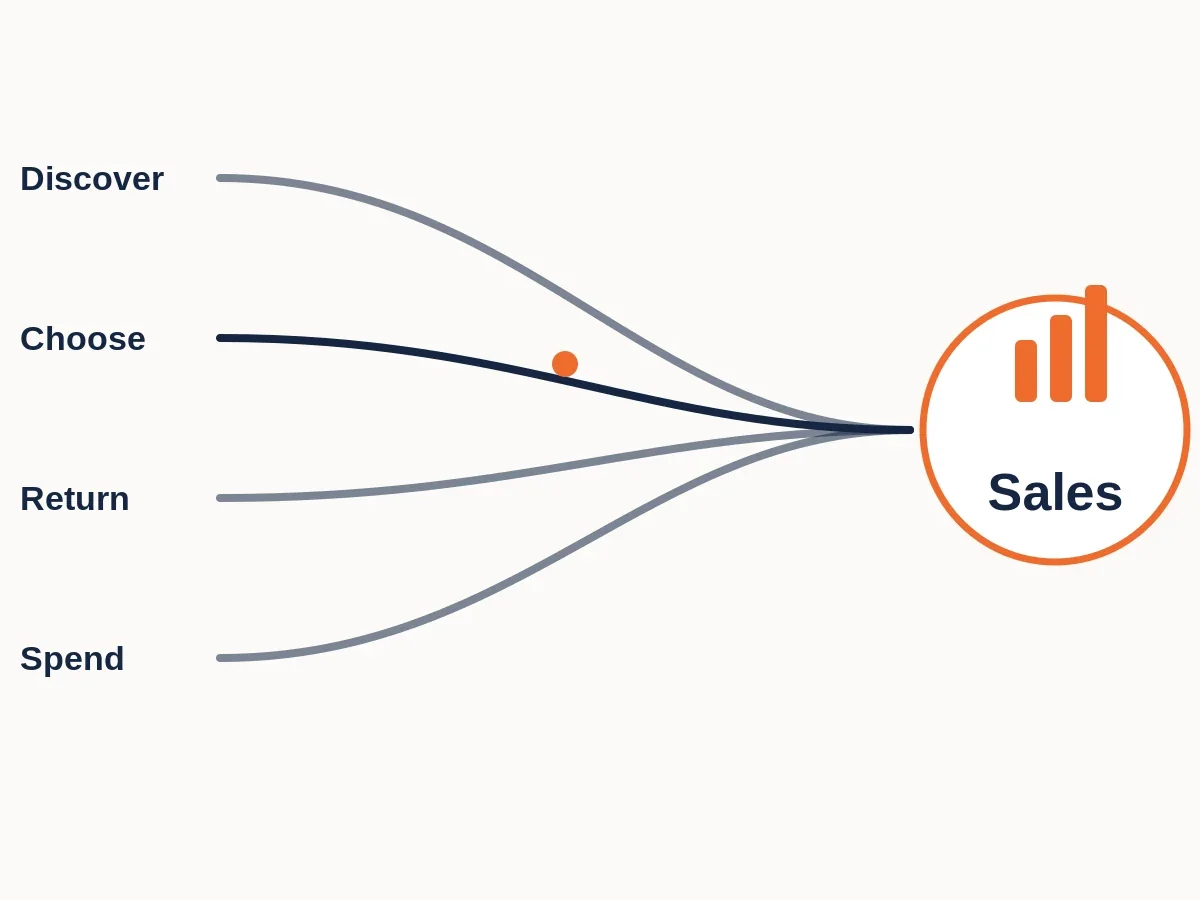
Restaurant sales usually fall because one or more of four things changed: fewer people discover the restaurant, fewer choose it after discovery, existing customers return less often, or customers spend less per visit.
The action depends on which one moved. A promotion may help weak conversion; more visibility may help discovery; neither fixes a repeat problem. Start by separating the symptom from the mechanism.
What exactly has fallen?
Revenue is the result of several behaviours happening together. If revenue is down but transaction count is stable, the issue may be average spend, purchasing mix or channel mix. If transactions are down, ask whether fewer people are discovering the restaurant, fewer are choosing it, or existing customers are returning less often.
This distinction matters because the intervention changes. Advertising can increase discovery. A clearer offer may improve consideration. A price change affects value perception and margin. A loyalty tactic targets repeat behaviour. Treating all four as the same “sales problem” makes it easy to spend money on the wrong lever.
For example, imagine weekday revenue is down 15%. If lunch transactions fell but average spend stayed almost unchanged, discounting every menu item would attack the wrong variable. If transactions are stable but customers are buying fewer add-ons or trading down, the investigation should move toward basket composition and value perception instead.
Has demand changed, or has conversion changed?
A restaurant can remain visible and still lose customer decisions. People may see it on social media, Google Search or Maps, then compare menu, price, reviews, location, convenience, familiarity or occasion fit and select another option. In that case the problem is not simply “not enough reach”. It is what happens after discovery.
The opposite can also happen. The restaurant may still convert people who consider it, but fewer suitable customers are encountering it in the first place. Those two situations can produce the same sales decline and require very different responses.
Look at timing as well. A sudden decline after a nearby opening, road change, parking restriction or menu-price adjustment suggests a different investigation from a slow six-month erosion. Seasonality and festive periods can also distort week-to-week comparisons, so compare like periods where possible rather than reacting to one weak week.
Restaurant choice changes with context, so one sales symptom can have several explanations.
A Klang Valley study surveyed 539 restaurant customers and asked them to rank nine restaurant-choice factors. Price ranked first overall, but the order changed by dining occasion. Price led for quick meals and social occasions, reputation led for business necessity, and word of mouth led for celebrations.
This is evidence that restaurant choice is multi-factor and situational. It does not identify the cause of any individual restaurant’s sales decline.
Do not turn the first visible problem into the cause
The most common reactions are “I need more marketing”, “my prices are too high” and “I should run a promotion”. Any of them could be right. None of them is proven by falling sales alone.
Before acting, ask what changed in the customer journey and what evidence supports that explanation. If Google profile views are stable but calls, directions or transactions fall, the issue looks different from a situation where discovery itself has collapsed. If repeat visits fall while new customer traffic is stable, acquisition may not be the main problem.
The strongest diagnosis usually comes from agreement between several signals. If sales fall, branded search weakens, Maps views fall and competitors become more visible, a discovery explanation becomes more plausible. If visibility remains healthy but menu actions and directions weaken while competitors hold steady, the problem may sit later in the decision.
Before changing anything, be able to say what evidence would show that your chosen action is solving the right problem.
A practical order to investigate the decline
Begin with your own sales and transaction data, then move outward. The purpose is not to collect every possible metric. It is to narrow the explanation before choosing the intervention.
- Separate revenue from transactions and spend. Determine whether fewer purchases, lower average spend or both are driving the decline.
- Compare new and repeat behaviour where possible. A repeat problem and a discovery problem require different responses.
- Check discovery signals. Look at search, Maps, social and other channels over the same period rather than relying on one platform.
- Compare the current choice set. Identify the alternatives customers can choose for the same occasion, not only restaurants that sell the same cuisine.
- Test the suspected friction. If you think price, reviews, location or menu fit is the issue, look for consistent evidence before changing it.
Sources and context
Chua et al. (2020), Customer Restaurant Choice: An Empirical Analysis of Restaurant Types and Eating-Out Occasions. These sources support the general explanation above. They do not diagnose any specific restaurant, and study findings should be interpreted within their sample, place and time period.
Make the question specific to your restaurant.
ORBIT examines the external market around your restaurant to identify the customer-choice, competitive and value signals that may deserve attention.