
ORBIT Research · Malaysian F&B Virality Series
How Food Trends Cross Communities
Visual, trust, access and cultural bridges.

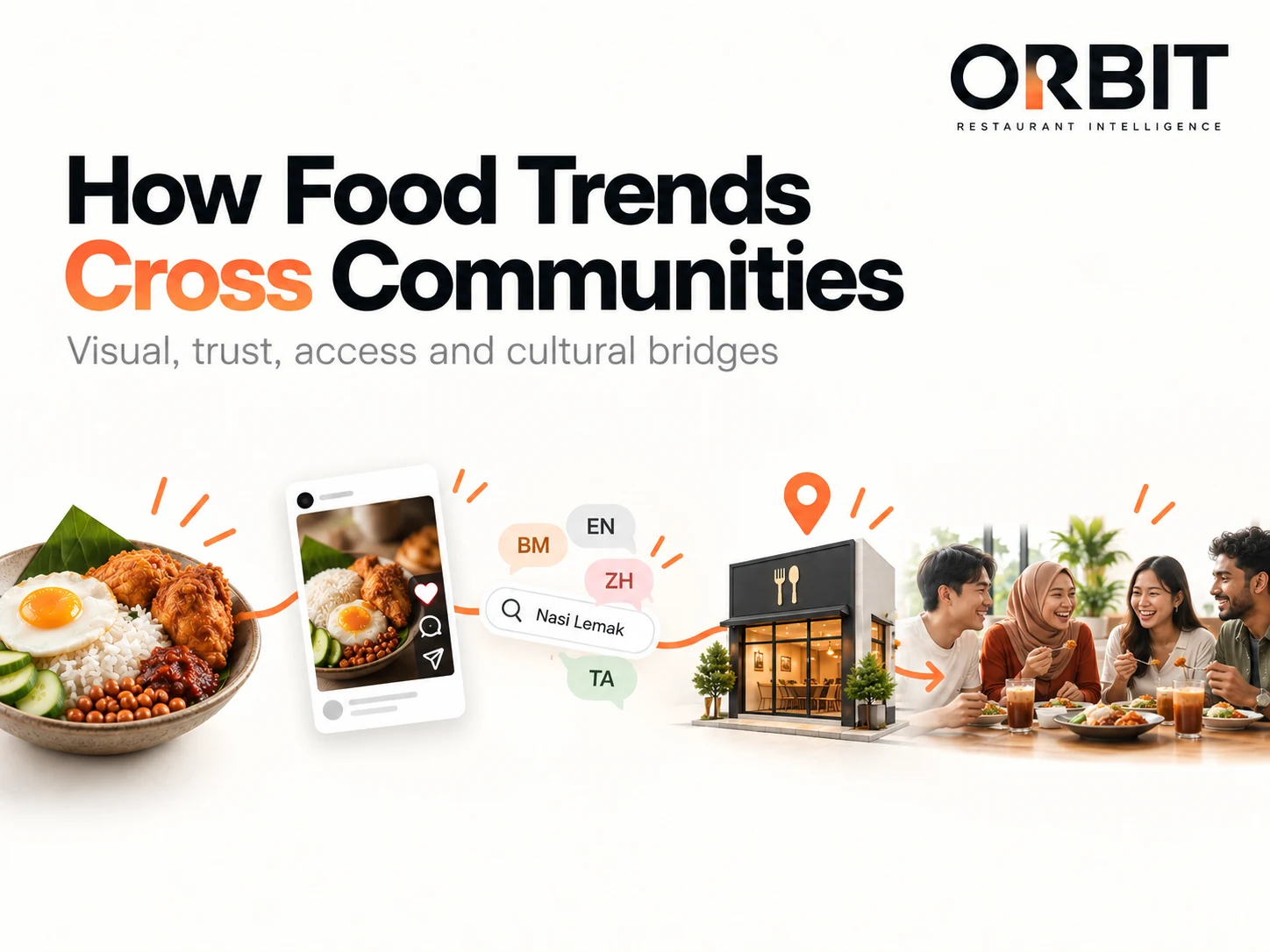
Food trends cross communities when the proposition can survive translation. The useful bridges are visual understanding, trusted reassurance, local access and cultural fit.
Malaysia is not one food audience, and it is not three sealed audiences either.
A person may discover a dish through a Tamil community page, see an English creator explain the experience, verify halal status in Bahasa Malaysia, save a location from Xiaohongshu or Maps, then visit with a mixed group. The channel sequence can cross language and trust networks before the customer ever reaches the restaurant.
The four bridges that help a trend escape its original network
Can I understand the appeal?
Steam, crunch, ooze, torching, portion size and unusual geometry travel without much narration. Dubai chocolate and cromboloni are strong examples.
Do I believe the recommendation?
A creator or customer already credible in the receiving network can answer “worth it?”, price, location and dietary questions.
Can I actually get it?
A nearby branch, local seller, mall, delivery listing or copy converts an admired object into a possible purchase.
Can I participate comfortably?
Halal assurance, language, familiar meal structure, spice level or group suitability can remove uncertainty that would otherwise block trial.
“Everyone uses TikTok” is not an explanation. The trend still has to become understandable, trusted, accessible and acceptable in another network.
Three media ecologies appeared in the eight trails, with many overlaps.
BM video plus halal confidence
In this sample, ayam gepuk and cromboloni gained legibility through Bahasa Melayu and Bahasa Indonesia proximity, Malay-language media such as TV3 and broad local food pages. Sensory video could travel quickly, while halal status could determine whether attention converted to a visit. [25] [21] [35]
Do not infer: that Malay consumers use only TikTok, or prefer only spicy or halal-labelled food.
Regional import plus search utility
Taiwanese boba, salted egg and café desserts appeared through Mandarin brand identities, English food blogs, Instagram and Facebook. The source report also notes that South China Morning Post reported more than 2.5 million Malaysian Xiaohongshu users in late 2024. [31]
Do not infer: that a Chinese-language origin keeps a trend inside one community.
Tamil trust plus place identity
SattiSorru’s early proof was tied to Brickfields, a Tamil culinary name, community word of mouth and repeat lunch crowds. An English-speaking global food creator later reframed the experience visually for audiences outside the original network. [17] [19]
Do not infer: that Indian food needs outside validation before it can succeed.
One customer can move between all three
Language, platform and identity are not one-to-one. Someone can discover in one language, verify in another, check dietary fit through an official source, and use Maps to finish the decision. The bridge is the sequence, not a demographic stereotype.
How the bridge works in practice
| Observable layer | Examples seen in the reconstruction | Bridge signal to monitor |
|---|---|---|
| Language | BM captions and shared Malay-Indonesian vocabulary; Mandarin plus English brand/review content; Tamil plus English restaurant/community posts. | The same dish appears in a second language without simply being a paid repost. |
| Platform role | TikTok/Reels for discovery; Facebook, SAYS or TV for validation; Xiaohongshu for search/save utility; YouTube and community pages for trust. | Creators with different audience clusters converge on one venue. |
| Geography | Gombak and suburban halal catchments; SS2, SS15 and Bukit Bintang café/retail clusters; Brickfields and branch networks. | A second postcode cluster appears before national media coverage. |
| Participation gate | Halal verification, price, family/group access, authenticity, novelty, trusted preparation and value. | Comments change from “what is it?” to “where / halal / price / branch?” |
| Crossing mechanism | Visual-first content → bilingual explanation → neutral/shared venue or delivery → credible dietary information → independent review in the receiving network. | People from outside the origin network show real visits rather than stitched reactions. |
Three cases show different kinds of translation.
Identity stayed specific while the explanation widened
Brickfields geography and Tamil culinary identity gave the concept immediate community meaning. The claypot cooking and banana-leaf service were also visually dramatic, which allowed an English-language creator to make the experience legible outside the initial network without erasing its origin. [16] [17] [19]
Regional familiarity lowered translation friction
Bahasa Indonesia and Bahasa Melayu proximity made the format easy to explain. The meal structure was familiar, while adjustable sambal created challenge and comparison behaviour. Formal JAKIM certification arrived later for an initial set of outlets, showing why “Muslim-friendly perception” and verified certification should not be treated as the same thing. [21] [24] [35]
The shape did much of the translation
The round laminated pastry and squeezeable filling were legible before a customer understood the full origin story. Regional feed proximity and Bahasa similarity helped the name travel, while café geography brought multiple food-media networks into the same physical queue. [25] [26] [27]
A sensory script crossed borders faster than distribution
The thick shell, bright pistachio centre and loud crunch worked as a language-light social script. Malaysian sellers did not need the original FIX bar to be widely available; they could translate the format into locally purchasable products. [28] [29] [30]
Platform scale matters, but it does not identify who caused the trend.
The report cites DataReportal’s early-2024 estimate of 28.68 million Malaysian social-media user identities. Advertising tools showed potential reach of 22.35 million for Facebook, 15.70 million for Instagram and 28.68 million adults for TikTok. The TikTok advertising figure exceeded the adult population, so it should not be read as unique active users. [32]
The implication is simple: cross-platform monitoring matters, but platform reach numbers cannot tell us which community originated a trend or why people converted.
People participate for different reasons, even inside the same trend.
Salted egg, burnt cheesecake, cromboloni and Dubai chocolate offer immediate camera payoff through ooze, contrast, layers or crunch.
Boba and bakery queues make popularity visible, but the queue only converts while expected quality and novelty outweigh waiting cost.
SattiSorru and ayam gepuk carry regional and community meaning that is different from dessert novelty.
Ayam gepuk’s adjustable heat invites comparison, bravado and repeat testing.
Boba brands, seasonal Sofuto and filled pastries encourage rankings, repeat posts and group sampling across variants.
FamilyMart and ayam gepuk became more durable because repeat availability and meal utility outlasted novelty.
Dubai chocolate’s scarcity made even a local dupe a participation token: “I tried the thing you saw.”
Salted-egg stock limits and queue frustration prolonged attention while also showing that engagement and goodwill are not equivalent.
Halal confidence is a participation gate, not an ethnicity shortcut.
The research repeatedly treats halal information as a practical decision barrier for some Muslim consumers, not as a claim about what every Malay customer wants. FamilyMart’s later certification and Pak Gembus’s 2025 certification illustrate how verified assurance can reduce uncertainty during scaling. [10] [24]
JAKIM’s Halal Directory is the appropriate verification source. Social hashtags, Muslim ownership assumptions and “pork-free” wording should not be substituted for certification. [35]
The strongest cross-community evidence is not a repost. It is the first real visit, review or recommendation from a network that was not part of the original trail.
Frequently asked questions
Do Malay, Chinese and Indian Malaysians have fixed food preferences?
This research does not support that conclusion. The observed trails are better understood as overlapping language, trust, access and cultural networks.
How does a food trend cross communities?
Through visual translation, trust translation, access translation and cultural translation.
What is visual translation?
It means the product’s appeal can be understood quickly without depending on one language, for example through crunch, steam, ooze, torching or shape.
Why does halal information matter?
For some customers, unresolved halal status can stop a visit even when the content creates interest. Verified information can remove that participation uncertainty.
Which platform matters most?
The source does not support one universal answer. Different platforms can play different roles in discovery, validation, search, saving and place verification.
Sources used in this analysis
Community labels in this article refer to observed language, media and geographic pathways, not customer ethnicity counts. The source report explicitly keeps that limitation visible.
- SAYS : “Overnight Hype For Salted Egg Yolk Croissants…”
30 Nov 2015 · Contemporary report. Dates Rebecca Saw’s post to 19 Nov; documents Facebook sharing, sell-outs, batch times, limits and complaints. - Rebecca Saw : three-bakery salted egg croissant comparison
29 Dec 2015 · Creator source. Records competitor response roughly three weeks after the initial uproar. - SAYS : Malaysia’s 2017 viral food trends
15 Dec 2017 · Retrospective. Evidence that salted egg had expanded into chips and remained culturally salient. - SAYS : SS15 Bubble Tea Street directory
3 May 2019 · Contemporary report. Lists 13 operating brands plus an upcoming store and notes waits up to two hours. - SAYS : Xing Fu Tang’s first Malaysian outlet
March 2019 · Contemporary report. Records 3 March opening, persistent crowd and roughly one-hour wait. - Malay Mail via Yahoo : Xing Fu Tang franchise dispute
23 Oct 2019 · Interview/report. Franchisor says first store opened 3 March and network would reach 39 outlets, nearly 500 staff, that week. - DiscoverKL : first FamilyMart in KL
11 Nov 2016 · Launch-day report. Identifies location, opening day and immediate crowd. - Mini Me Insights : inside the first Malaysian FamilyMart
15 Nov 2016 · Near-contemporaneous retail observation. Calls oden a crowd puller and notes category differentiation. - NACS : QL Resources’ FamilyMart franchise plan
13 Apr 2016 · Trade report. Establishes that market entry and rollout were planned before launch. - SoyaCincau : FamilyMart central kitchen halal certification
19 May 2019 · Contemporary report. 108 ready-to-eat branded products covered at the time. - BusinessToday : FamilyMart “food superstore” concept
9 Nov 2021 · Business report. Evidence of strategic evolution from novelty import to food-led convenience. - oh{FISH}iee : The Tokyo Restaurant cheesecake review
25 Aug 2017 · Creator source. Earliest detailed local record found; already calls it a hot topic and warns of queues. - Resy : How Basque burnt cheesecake took over the world
15 Sep 2021 · Reported retrospective. Traces La Viña origin and names The Tokyo Restaurant in the international diffusion story. - Teoh Zhi Hau : Instagram cheesecake post
12 Sep 2017 · Original social post. States partial inspiration from The Tokyo Restaurant; early imitation evidence. - Isetan KL : The Tokyo Restaurant listing
Current venue listing · Primary venue information. Explicitly “pork free” and “serves alcohol”; not evidence of halal certification. - Seni SattiSorru : operating announcement
12 Aug 2019 · Original brand post. Earliest indexed day-specific operating signal located. - The Food Ranger : Seni SattiSorru Reel
29 Sep 2020 · Original creator post. Indexed metadata shows 27K likes and 391 comments. - Seni SattiSorru Melaka opening notice
27 Nov 2020 · Public post. Describes Melaka as the third branch. - The Malaysian Reserve : Seni SattiSorru profile
8 Dec 2023 · Contemporary visit. Names founder, dates SS14 branch, documents crowds and reports 23 outlets. - Food Advisor Malaysia : Seni SattiSorru post
Creator/food-page source. Uses “halal” label; included as evidence of audience messaging, not official certification. - Ayam Gepuk Pak Gembus Malaysia : brand history
Primary brand claim. Reports Indonesia 2013; Gombak 2017; 9 outlets in 2018; 42 in 2019; 51 in 2021; 90+ currently. Not independently audited. - Melissa’s Blog : Pak Gembus Seremban 2
19 Dec 2019 · Local review. Gives the first Malaysian outlet date as 31 Aug 2017. - SETHLUI : Pak Gembus vs Top Global vs Pop Meals
Updated 7 Aug 2023 · Contemporary category comparison. Reports about 50 Pak Gembus outlets and 15 Top Global outlets. - Harian Metro : Pak Gembus receives JAKIM certification
Jan 2025 · Contemporary business report. Useful for separating prior halal perception from formal certification timing. - TV3 Malaysia : “Menu Viral: Donut Cromboloni”
25 Dec 2023 · Original broadcast upload. Earliest dated Malaysian mainstream artefact found. - Hungry Sam : KLCG cromboloni review
13 Jan 2024 · Original creator post; paired indexed Instagram result notes the long queue. - Monsieur Spoon : cromboloni TikTok
2 Dec 2023 · Original Indonesian brand post. Evidence of the near-market regional feed immediately before Malaysian uptake. - BBC Travel : how Dubai chocolate conquered the world
4 May 2025 · Reported retrospective. Dates FIX launch to 2022, explains founder story and reports 125m+ views on Vehera’s video. - Malay Mail : pistachio-kunafa fever in KL
4 Nov 2024 · Contemporary market scan. Dates Cocoraw’s local version to May and documents multiple sellers, formats and queues. - Maria Vehera : FIX tasting TikTok
18 Dec 2023 · Original social post. The global amplification event; commercial relationship was not established in consulted sources. - South China Morning Post : Xiaohongshu in Malaysia
8 Dec 2024 · Report. States 2.5m+ Malaysian users and describes heritage/tourism use; not an F&B adoption census. - DataReportal : Digital 2024: Malaysia
2024 · Aggregated platform advertising estimates. Useful for scale; explicitly not unique-user or active-user counts. - JAKIM : Malaysian Halal Directory guidance
Official source. Use for outlet/product verification; social tags, Muslim ownership and “pork-free” are not substitutes.
Research explains the pattern. ORBIT looks at your restaurant.
These findings describe how markets can move. ORBIT applies market, competitor, review, pricing and customer-choice signals to the specific restaurant and location you want to understand.