
ORBIT Research · Malaysian F&B Virality Series
How to Spot a Food Trend Early
Watch costly behaviour, not views alone.

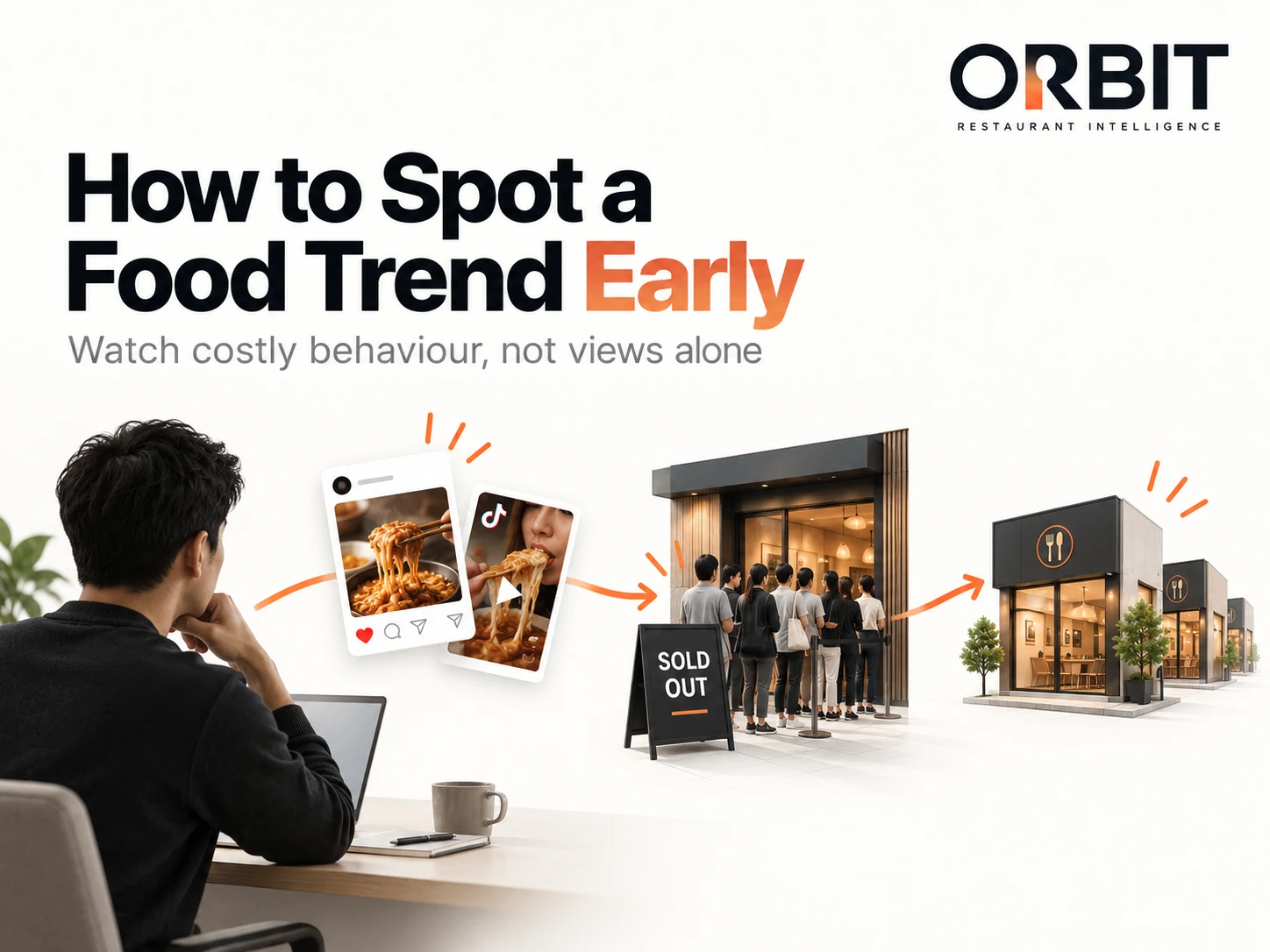
The strongest early pattern is not “one video is exploding”. It is independent online repetition plus real-world friction plus a supply response.
The biggest signal is often the easiest one to see and the least useful one to act on.
By the time television calls a dish viral or every lifestyle page publishes a “where to find it” list, the market has already become legible. Early detection means watching smaller changes that cost people something: travelling, waiting, reviewing, changing inventory or copying the format.
Start with behaviour that is harder to fake.
A view can be accidental. A like costs almost nothing. A restaurant competitor adding a new item, a customer travelling across town, or a queue reappearing on an ordinary weekday requires more commitment.
Monitor costly behaviour, not views alone.
The signal register: what to watch before the listicle
The report separates leading signals, bridge signals and lagging signals. No single row proves that a trend will become mass. The value comes from multiple signals beginning to agree.
| Stage | Signal | What change matters | What it may mean |
|---|---|---|---|
| Leading | Independent creator velocity | More unique, unrelated creators over seven days, not more posts from one campaign cohort. | Discovery is reproducing across networks. |
| Leading | Creator diversity | The dish moves into another language, food niche, age proxy or postcode. | A potential community bridge is forming. |
| Leading | High-intent comments | “Where?”, “price?”, “halal?”, “opening hours?”, “branch?” and tagged-friend comments increase. | Entertainment is turning into visit planning. |
| Leading | Supply friction | Repeated sold-outs, timed batches, purchase caps or reservation closure across different days. | Demand is pushing against current capacity. |
| Leading | Maps review acceleration | New reviews per week rise against the venue’s own recent baseline and reviewer mix broadens. | Online conversation may be converting into physical visits. |
| Leading | Unrelated first copy | A seller with no visible affiliation adopts the format or keyword. | Another operator sees enough demand to risk inventory and labour. |
| Bridge | Search-intent expansion | Queries move from the dish name into “near me”, “KL”, “halal”, “price”, “recipe”, “review” or spelling variants. | Awareness is becoming utility-seeking. |
| Bridge | Queue persistence | Queues recur on ordinary days, not only launch weekend or one celebrity visit. | Social proof is durable enough to create offline cost. |
| Bridge | Delivery and menu spread | More merchants, postcodes or hero placements appear for the same format. | Supply is scaling and access friction is falling. |
| Bridge | Geographic hops | A second independent cluster appears outside the origin neighbourhood, then another state. | The trend may be escaping local novelty. |
| Bridge | Halal-status resolution | Ambiguous comments are replaced by verifiable certification or outlet information. | A participation barrier may be falling. Social tags are not certification. [35] |
| Lagging | Listicles and national news | “Where to find” lists name many sellers or TV labels the item viral. | The category is already legible to the mainstream. |
| Lagging | Franchise race and branch count | Many openings or rival brands converge on the format. | Mass adoption or saturation risk, not an early spark. |
The first six signals deserve the most attention.
Independent creator velocity
One creator getting two million views can still be one event. Several unrelated creators finding the same venue over different days is evidence that discovery is reproducing. The source report recommends counting unique creator clusters, not simply post volume.
Comment intent changes
“Looks good” is attention. “Where?”, “How much?”, “Halal?”, “Which branch?” and “Still available?” indicate that viewers are resolving practical barriers to purchase.
Offline friction repeats
A sold-out launch day can be staged or predictable. Sold-outs across multiple days, timed batches, purchase limits and queue persistence are stronger evidence that current capacity is being tested.
Maps reviews accelerate
Review growth gives a rough bridge between conversation and physical visits. It is not a sales measure, but a venue whose review rate jumps above its own baseline is showing a different type of behaviour from one with only social impressions.
The first unrelated copy appears
This is a costly signal. Another operator is not merely reacting with a like. They are allocating ingredients, labour, training and menu space because they believe demand may exist.
The trend escapes its original cluster
A second postcode, language, creator niche or city matters because it shows the proposition can survive translation rather than depending on one local network.
Why Google Trends helps, but should not date the first spark
Google Trends is useful for checking when broad search interest accelerates. It is not an origin archive. The index is normalised from 0 to 100, small early signals may be suppressed, different spellings can split demand, and historical sampling can change values.
The report therefore treats Trends as corroboration. If a dish is already moving in creator posts, Maps reviews and stock signals, a later search rise strengthens the story. It should not be used to invent a precise “first viral day” when no reproducible archived series exists.
A useful trend record is one row per dish × venue
The report proposes storing the first-seen evidence rather than only a weekly screenshot. A practical record includes the canonical dish, spelling variants, venue, branch, postcode, source URL, creator identity, audience cluster, language, ad disclosure, engagement, intent comments, seven-day Maps reviews, queue or stock evidence, copycat count and delivery count.
That turns a vague social-listening exercise into a time-stamped market trail.
Velocity, independence, intent, offline conversion, supply reaction, geographic spread and community bridging can each be scored as a triage device.
The report explicitly does not support a universal numeric threshold from eight cases. Scores should be ranked against an eight-week baseline and back-tested against later visits, sales or menu adoption.
A practical weekly operating rhythm
Machine scan
Collect the prior seven days, expand multilingual keywords and spelling variants, then deduplicate reposts, chain branches and obvious campaign cohorts.
Analyst read
Watch the first and fastest-growing posts. Code the real hook, purchase-intent language, disclosure clues and creator-cluster diversity.
Join online to offline
Compare social movement with Maps review dates, queues, stock messages, delivery listings and new menu items. This is where talk becomes behaviour.
Community check
Search in BM, English, Mandarin and Tamil. Identify the origin network and whether a credible bridge into another network has appeared.
Rank and verify
Rank the strongest candidates, call or visit the top few, record operator comments as claims, and keep the evidence links attached.
Learn from the misses
Label outcomes such as no lift, talk only, venue hit, city trend and category adoption. Refit baselines from observed results rather than intuition.
The strongest candidate is not the item with the biggest video. It is the one showing independent creator clusters, rising purchase-intent questions, repeated offline friction, a first unrelated copy, and movement into another geography or language network.
What to monitor, and what to ignore
Search peaks, national media and franchise races are useful confirmation, but they are late. Likes and total views are useful context, but shallow without independence or behaviour. The research suggests combining social, search, place and supply signals as one graph, keeping first-seen timestamps and verifying the top alerts offline.
Frequently asked questions
What is the earliest sign that a food trend is forming?
Usually not one metric. Independent creator growth, high-intent comments, stock pressure, review acceleration or an unrelated first copy are more useful early clues than raw views.
Which comments signal purchase intent?
Questions about location, price, halal status, opening hours, branches and availability indicate that viewers are trying to turn attention into an action.
Can Google Trends show where a trend started?
Not reliably. It is better used as confirmation of broader search acceleration than as an origin archive.
Why do competitor copies matter?
Because copying requires operational commitment. Another restaurant must risk inventory, labour and menu attention.
Is there a proven virality score?
Not in this research. The proposed scoring system is a triage framework that needs prospective calibration and back-testing.
Sources and methodological context
This article is based on the source report’s early-warning section and the eight case trails used to derive it. General social-diffusion literature is context, not case-level causal proof.
- SAYS : “Overnight Hype For Salted Egg Yolk Croissants…”
30 Nov 2015 · Contemporary report. Dates Rebecca Saw’s post to 19 Nov; documents Facebook sharing, sell-outs, batch times, limits and complaints. - Rebecca Saw : three-bakery salted egg croissant comparison
29 Dec 2015 · Creator source. Records competitor response roughly three weeks after the initial uproar. - SAYS : Malaysia’s 2017 viral food trends
15 Dec 2017 · Retrospective. Evidence that salted egg had expanded into chips and remained culturally salient. - SAYS : SS15 Bubble Tea Street directory
3 May 2019 · Contemporary report. Lists 13 operating brands plus an upcoming store and notes waits up to two hours. - SAYS : Xing Fu Tang’s first Malaysian outlet
March 2019 · Contemporary report. Records 3 March opening, persistent crowd and roughly one-hour wait. - Malay Mail via Yahoo : Xing Fu Tang franchise dispute
23 Oct 2019 · Interview/report. Franchisor says first store opened 3 March and network would reach 39 outlets, nearly 500 staff, that week. - DiscoverKL : first FamilyMart in KL
11 Nov 2016 · Launch-day report. Identifies location, opening day and immediate crowd. - Mini Me Insights : inside the first Malaysian FamilyMart
15 Nov 2016 · Near-contemporaneous retail observation. Calls oden a crowd puller and notes category differentiation. - NACS : QL Resources’ FamilyMart franchise plan
13 Apr 2016 · Trade report. Establishes that market entry and rollout were planned before launch. - SoyaCincau : FamilyMart central kitchen halal certification
19 May 2019 · Contemporary report. 108 ready-to-eat branded products covered at the time. - BusinessToday : FamilyMart “food superstore” concept
9 Nov 2021 · Business report. Evidence of strategic evolution from novelty import to food-led convenience. - oh{FISH}iee : The Tokyo Restaurant cheesecake review
25 Aug 2017 · Creator source. Earliest detailed local record found; already calls it a hot topic and warns of queues. - Resy : How Basque burnt cheesecake took over the world
15 Sep 2021 · Reported retrospective. Traces La Viña origin and names The Tokyo Restaurant in the international diffusion story. - Teoh Zhi Hau : Instagram cheesecake post
12 Sep 2017 · Original social post. States partial inspiration from The Tokyo Restaurant; early imitation evidence. - Isetan KL : The Tokyo Restaurant listing
Current venue listing · Primary venue information. Explicitly “pork free” and “serves alcohol”; not evidence of halal certification. - Seni SattiSorru : operating announcement
12 Aug 2019 · Original brand post. Earliest indexed day-specific operating signal located. - The Food Ranger : Seni SattiSorru Reel
29 Sep 2020 · Original creator post. Indexed metadata shows 27K likes and 391 comments. - Seni SattiSorru Melaka opening notice
27 Nov 2020 · Public post. Describes Melaka as the third branch. - The Malaysian Reserve : Seni SattiSorru profile
8 Dec 2023 · Contemporary visit. Names founder, dates SS14 branch, documents crowds and reports 23 outlets. - Food Advisor Malaysia : Seni SattiSorru post
Creator/food-page source. Uses “halal” label; included as evidence of audience messaging, not official certification. - Ayam Gepuk Pak Gembus Malaysia : brand history
Primary brand claim. Reports Indonesia 2013; Gombak 2017; 9 outlets in 2018; 42 in 2019; 51 in 2021; 90+ currently. Not independently audited. - Melissa’s Blog : Pak Gembus Seremban 2
19 Dec 2019 · Local review. Gives the first Malaysian outlet date as 31 Aug 2017. - SETHLUI : Pak Gembus vs Top Global vs Pop Meals
Updated 7 Aug 2023 · Contemporary category comparison. Reports about 50 Pak Gembus outlets and 15 Top Global outlets. - Harian Metro : Pak Gembus receives JAKIM certification
Jan 2025 · Contemporary business report. Useful for separating prior halal perception from formal certification timing. - TV3 Malaysia : “Menu Viral: Donut Cromboloni”
25 Dec 2023 · Original broadcast upload. Earliest dated Malaysian mainstream artefact found. - Hungry Sam : KLCG cromboloni review
13 Jan 2024 · Original creator post; paired indexed Instagram result notes the long queue. - Monsieur Spoon : cromboloni TikTok
2 Dec 2023 · Original Indonesian brand post. Evidence of the near-market regional feed immediately before Malaysian uptake. - BBC Travel : how Dubai chocolate conquered the world
4 May 2025 · Reported retrospective. Dates FIX launch to 2022, explains founder story and reports 125m+ views on Vehera’s video. - Malay Mail : pistachio-kunafa fever in KL
4 Nov 2024 · Contemporary market scan. Dates Cocoraw’s local version to May and documents multiple sellers, formats and queues. - Maria Vehera : FIX tasting TikTok
18 Dec 2023 · Original social post. The global amplification event; commercial relationship was not established in consulted sources. - Mønsted et al. : Evidence of complex contagion in social media
PLOS ONE, 2017 · Controlled Twitter-bot experiment. Supports multiple-source reinforcement as a general diffusion mechanism; not Malaysia- or food-specific. - García-León & Teichert : Food and social media research-stream analysis
Management Review Quarterly, 2023 · Scholarly review. Maps e-WOM, reviews, UGC and restaurant performance literature; used as context, not causal proof for these cases. - JAKIM : Malaysian Halal Directory guidance
Official source. Use for outlet/product verification; social tags, Muslim ownership and “pork-free” are not substitutes.
Research explains the pattern. ORBIT looks at your restaurant.
These findings describe how markets can move. ORBIT applies market, competitor, review, pricing and customer-choice signals to the specific restaurant and location you want to understand.