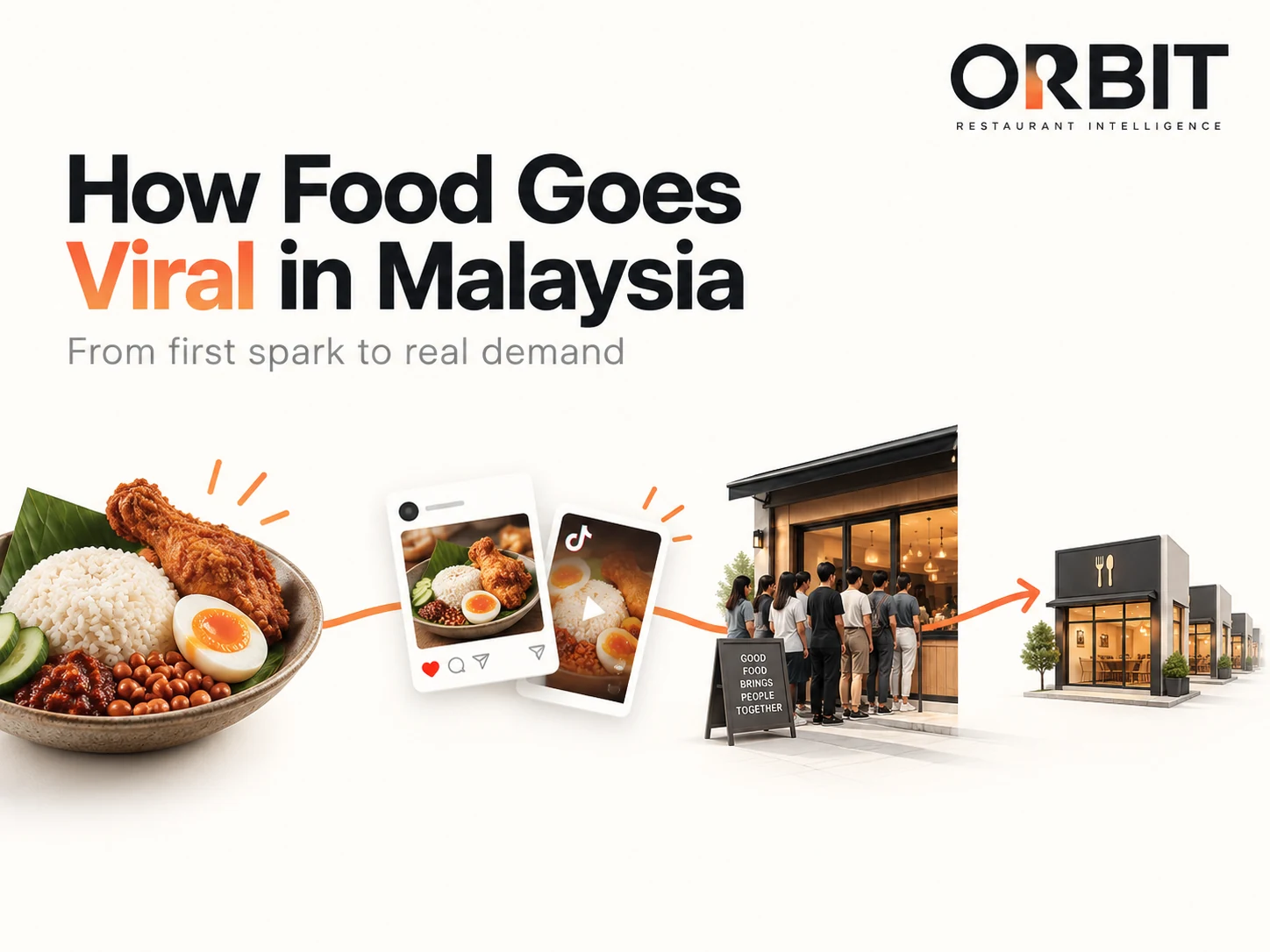
What Does “Viral Food” Actually Mean?
A million-view post, a three-hour queue and an entire food category spreading are not the same thing.

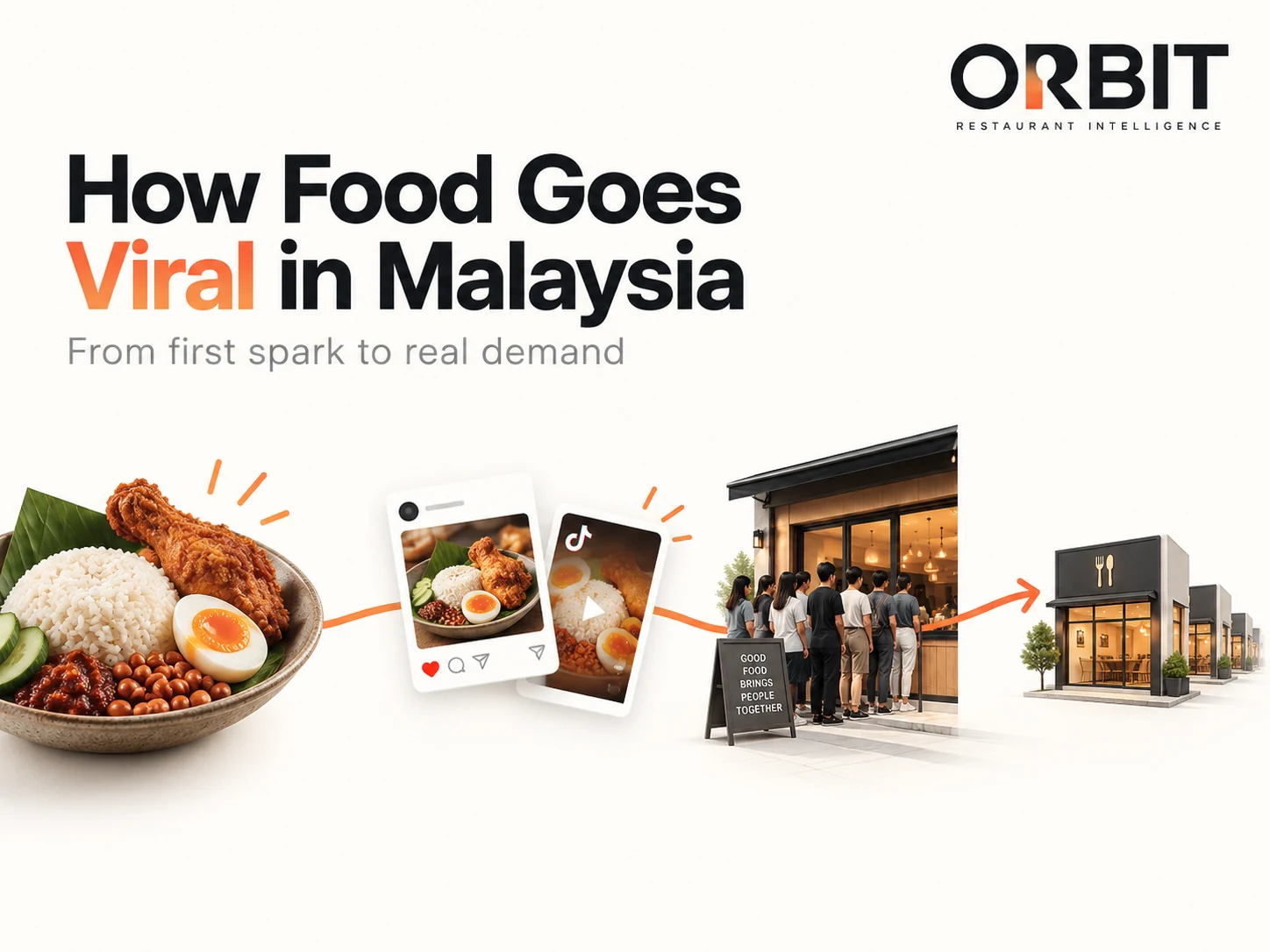
For a restaurant owner, “viral” should not mean “a post got a lot of views.” A useful definition separates what is spreading, how it is spreading, and whether attention is turning into active behaviour. A viral post can remain only a media event. A viral venue produces visits. A viral product creates demand for one item. A viral category changes what multiple sellers offer.
Key takeaways
- Views are reach, not proof of contagionA large creator can create enormous reach without much person-to-person reproduction.
- Name the viral object firstPost, product, venue, category and eating behaviour require different evidence.
- Look for escapeA stronger breakout moves beyond the original account or audience into independent sources and networks.
- Look for costly behaviourSearch, directions, queues, purchases, reviews and imitation are stronger evidence than passive impressions.
The word “viral” hides several different outcomes
Food coverage often compresses very different events into one label. A TikTok with two million views, a stall with a 100-metre queue, a recipe copied by thousands of households and a new category adopted by dozens of restaurants may all be described as “viral.” That is convenient language, but it is poor diagnosis.
For ORBIT’s research, the first step is to identify the viral object. A post can spread without the restaurant spreading. A venue can become famous while the underlying dish remains ordinary. A product can break out at one or several sellers. A category becomes larger than any single brand. An eating behaviour spreads when people reproduce the act itself, as happened with home-made Dalgona coffee during the pandemic.4
| Viral object | What is spreading | Useful evidence |
|---|---|---|
| Post | One piece of media | View velocity, shares, repost depth, audience reach |
| Venue | One restaurant or stall | Branded search, Maps activity, visits, queues, review velocity |
| Product | One dish or SKU | Product searches, order demand, customer posts, sell-outs |
| Category | A food format across sellers | Copycats, menu adoption, comparison content, supplier response |
| Behaviour | An act people reproduce | Remakes, challenges, home participation, user-created variations |
This distinction prevents a common analytics mistake: using a content metric to answer a market question. A restaurant owner who wants to know whether the business is experiencing a breakout should not stop at impressions. The owner needs evidence from search, navigation, reviews, queues, ordering and independent customer activity.
Popularity and virality are different questions
Goel and colleagues analysed roughly one billion Twitter diffusion events and formalised . Their work shows that a very popular event can be created by one huge broadcast, by multi-generation diffusion, or by a mixture of both.1
For restaurants, this means a celebrity or mega-creator can be commercially useful without proving that the restaurant has developed a self-propagating market. The post may have done the distribution work itself. Once that push stops, the attention may stop too.
| Pattern | What it looks like | What it tells you |
|---|---|---|
| Broadcast | One or two large accounts create most of the reach | High awareness; weak evidence of independent reproduction |
| Cascade | Customers and smaller sources keep producing the next wave | Stronger evidence that attention is reproducing |
| Hybrid | A large initial push is followed by independent customer/network activity | Often the most commercially interesting pattern |
The distinction is especially important when comparing campaigns. Ten million views from one account and ten million views accumulated across thousands of independent posts are not equivalent market signals.
A practical definition for restaurant research
ORBIT therefore uses a stricter working definition:
A food phenomenon becomes meaningfully viral when attention or adoption accelerates beyond its originating audience, reproduces through additional people or networks, and begins producing observable behaviour beyond the original source.
This is not presented as a universal academic definition. It is an operating definition designed to separate media popularity from market propagation.
There are three important parts. First, the signal should accelerate relative to its previous baseline. Second, it should escape the originating source. Third, it should create some form of active response: people look it up, visit, review it, reproduce it, compare it, or imitate it.
- 1Exposure
People encounter the object through a creator, friend, media story, algorithm or offline cue.
- 2Reproduction
Other people begin creating their own posts, recommendations, comparisons or versions.
- 3Pull
Some viewers switch from passive exposure to active information seeking: price, location, halal status, opening hours or “is it worth it?”.
- 4Behaviour
Search becomes navigation, queueing, purchase, review, remake or competitor imitation.
- 5Feedback
Those behaviours create new social evidence that can stimulate another round of exposure.
What a restaurant owner should measure instead of “viral or not”
A binary label is less useful than a small set of separate indicators. Research on product diffusion also shows that active information seeking can create a very different diffusion pattern from ordinary social spread.2 Malaysian restaurant evidence suggests that reviews and perceived crowding can influence purchase intention, making offline proof part of the feedback system rather than a separate world.3
| Question | Weak signal | Stronger signal |
|---|---|---|
| Did awareness increase? | Views | Views from multiple independent sources |
| Did the idea escape? | More posts from the same circle | New languages, audience types, cities or communities |
| Did intent increase? | Likes and generic comments | “Where?”, “price?”, “halal?”, branded search, Maps lookups |
| Did behaviour change? | Saves | Visits, reviews, orders, queues, sell-outs |
| Did the market respond? | Competitors talking about it | Competitors copying, suppliers reacting, new sellers entering |
A quick diagnostic for operators
- Name the object: is the post viral, the restaurant viral, the dish viral, or the whole category viral?
- Separate total reach from independent reproduction.
- Track search and location intent, not just engagement.
- Compare review and customer-post velocity with the restaurant’s normal baseline.
- Look for network escape: new communities are stronger evidence than more of the same creators.
- Do not call a one-day queue a trend until you know why the queue exists and whether it persists.
The practical value of a stricter definition is simple: it lets an operator decide whether the right move is to amplify a promising signal, improve conversion, increase capacity, or ignore a media spike that is not becoming market demand.
A simple example: one post, three possible realities
Imagine a Klang Valley restaurant receives a TikTok review that reaches 2.5 million views in 48 hours. On the surface, the event looks the same in all three scenarios below. Operationally, they are very different.
| Scenario | What happens after the post | Best interpretation |
|---|---|---|
| A | Views surge; search and review activity barely move | Viral content, weak restaurant conversion |
| B | Search, Maps and weekend queues surge, then fall back within a week | Strong venue event, uncertain persistence |
| C | Search rises, customer posts multiply, unrelated communities pick it up, competitors start comparisons | Emerging self-propagating breakout |
If the owner only looks at the original post, the three scenarios are indistinguishable. The distinction only appears when the owner observes what the market does next.
This is why ORBIT treats virality as a sequence of evidence rather than a status badge. The definition should help an operator decide what to do next: convert traffic, fix information gaps, increase capacity, or avoid overreacting to attention that is not escaping the original source.
Where this working definition could fail
The definition is deliberately conservative. It could miss cases where a single broadcaster creates so much direct demand that no meaningful secondary diffusion is needed. A celebrity launch can be commercially transformative even if the event is structurally closer to broadcast than contagion.
That does not make the definition useless. It means the word “viral” should not replace the more precise business description. If one account produces RM300,000 of sales, the restaurant has a successful broadcast-driven demand event. If the market keeps reproducing the story after that source disappears, it has something closer to a viral breakout.
For research purposes, keeping those outcomes separate is valuable because it lets us compare which one is more durable, predictable and transferable to other restaurants.
Research notes & sources4 sources
How this article was researched
We combined large-scale diffusion research with restaurant-specific behavioural evidence and Malaysian examples. The definition is an ORBIT working definition designed to separate content popularity from market behaviour; it is not a universal academic standard.
- Goel et al. — The Structural Virality of Online Diffusion
Management Science, 2015. Analyses roughly one billion Twitter diffusion events and separates large broadcast from multi-generation diffusion. - Product diffusion through on-demand information-seeking behaviour
Large field experiment seeded 70,000 vouchers into a network of about 43 million people; active information seeking produced distinctive winner-take-all diffusion. - Online reviews and crowd cues in Malaysian restaurant choice
Malaysian restaurant study (N=200). Review ratings and perceived crowding positively affected purchase intention. - Malay Mail — Malaysians’ top recipe searches in 2020
Dalgona coffee was Malaysia’s most-searched recipe in 2020, illustrating viral participation without a restaurant visit requirement.
What this research cannot proveLimitations
There is no universally accepted numeric threshold for when a restaurant becomes “viral.” Public data also cannot reveal every private share, deleted post, paid relationship or actual transaction. The useful goal is classification and evidence strength, not a fake universal cutoff.