Why Does an Empty Restaurant Feel Risky?
What a crowd tells us before we taste the food.

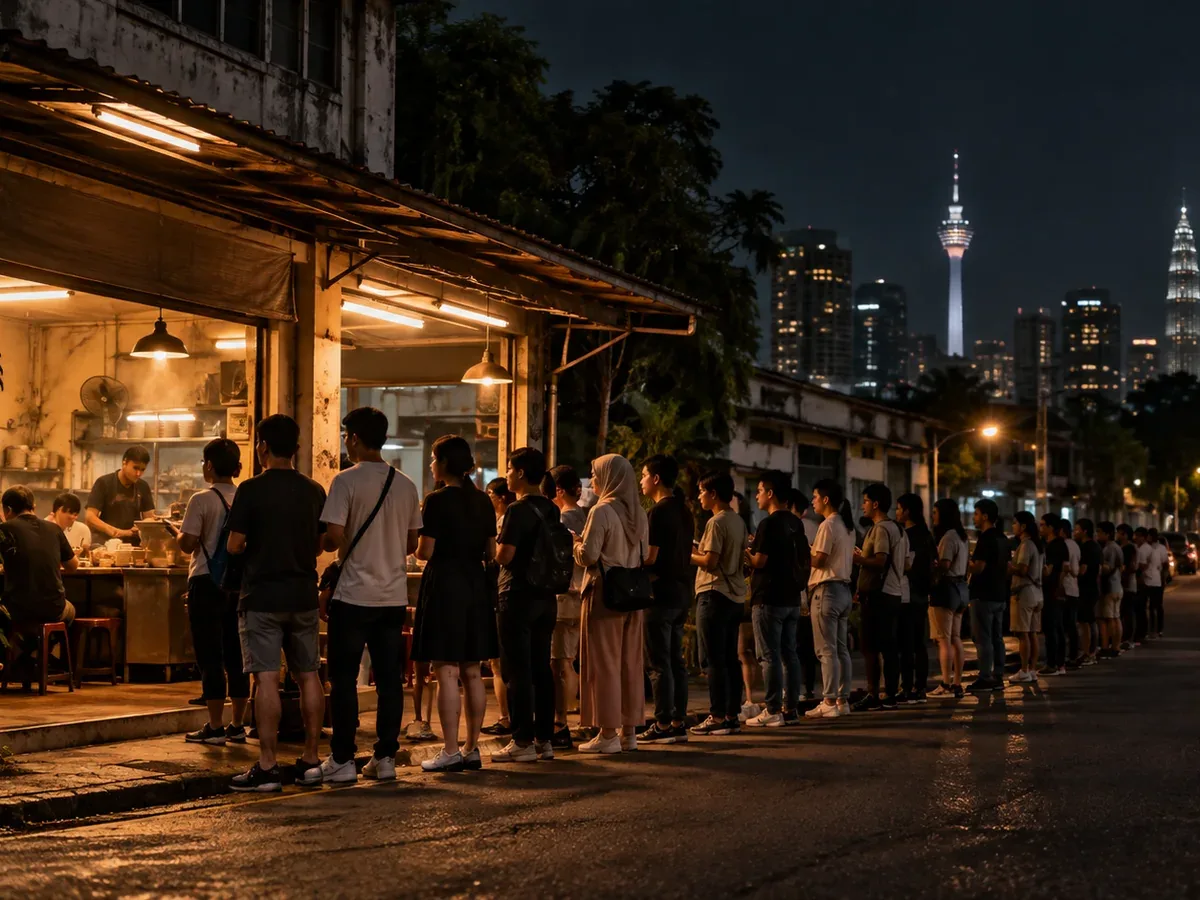
Picture a row of restaurants at 7.30pm.
At one place, somebody is carrying an extra plastic chair from inside because a table of six has become a table of seven. Two delivery riders are waiting near the counter. A family is standing beside the door, looking over people's shoulders to see whether anyone is about to finish.
The restaurant next door is open too. The lights are on, the tables are set, the staff are there. There is no queue because there is nobody to queue behind.
If you knew absolutely nothing about either restaurant, which one would you look at first?
The crowded restaurant is giving you information that the empty one cannot. You have not tasted the food or compared the prices, but quite a lot of other people independently decided to eat there, and some appear willing to wait.
The empty restaurant may have an innocent explanation. Perhaps it just opened. Perhaps everyone comes later. Perhaps twenty diners left ten minutes ago. A person walking past does not know any of that. They see empty chairs, and empty chairs are very easy to interpret.
Short answer: when customers do not know much about a restaurant, other customers can become information. Research has found that very crowded restaurants may be associated with better food quality, stronger reputation and lower prices, while Malaysian research links perceived crowding with restaurant-choice intention. A visible wait line can also signal popularity. But the effect has limits: longer waits reduce the benefit, and dense seating can make the physical environment less pleasant.
Three hundred people judged food they had never eaten
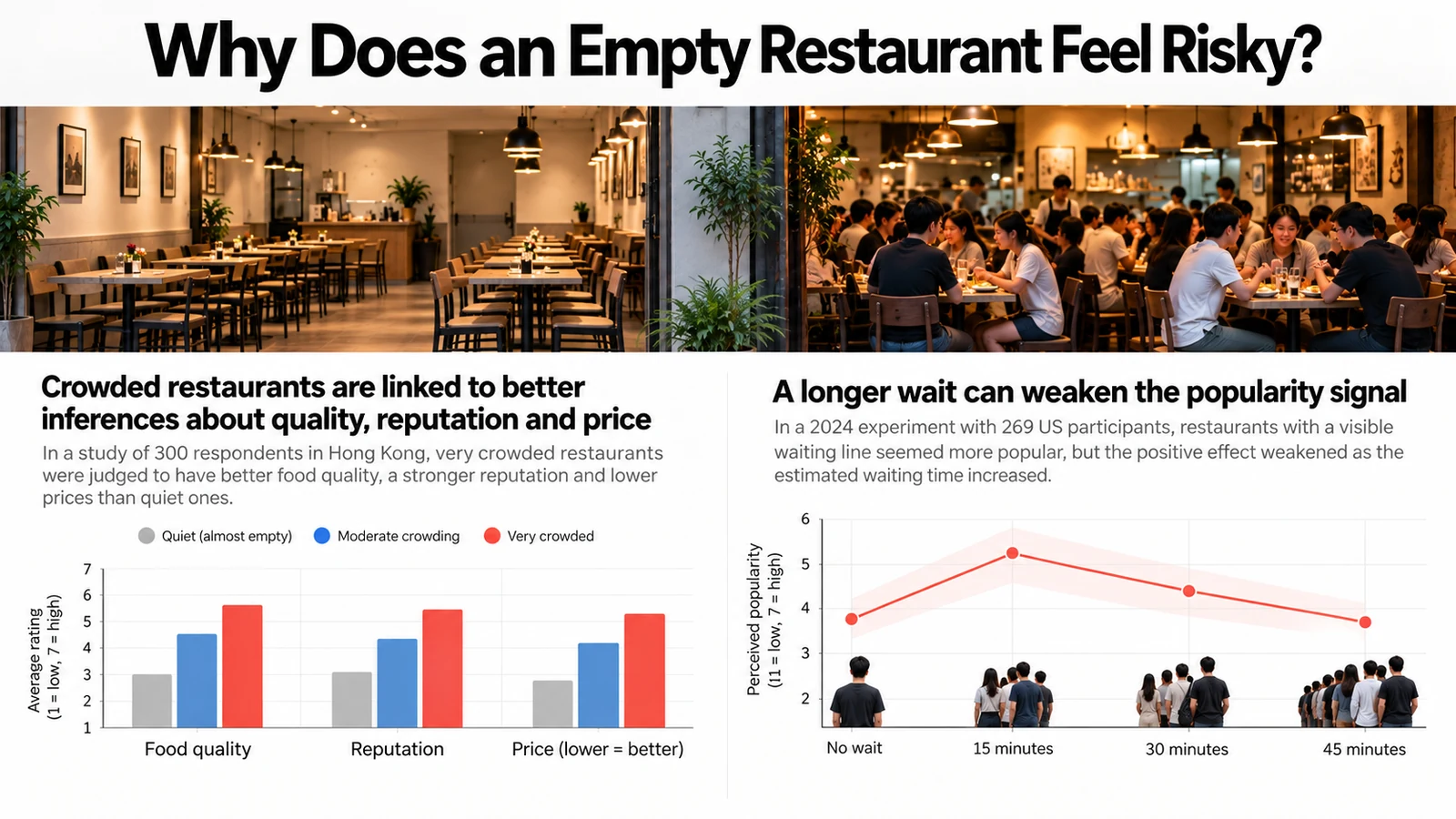
An older Hong Kong study gives us an unusually clean version of the effect. Researchers recruited 300 respondents and asked them to evaluate restaurant conditions with different levels of crowding.1
When the restaurant appeared very crowded, respondents were more likely to attribute that crowd to high food quality, a good reputation and lower prices. When it appeared quiet, they associated the restaurant with lower food quality, poorer reputation and higher prices.1
Nobody needed to taste anything before these judgments began. The room filled up and the explanation changed.
There is a sensible thought process underneath it. If twenty other groups chose this restaurant, perhaps they know something. Maybe they have eaten here before. Maybe somebody recommended it. You are borrowing information from people you have never met.
Very crowded restaurants were associated with better food quality, stronger reputation and lower prices; quiet conditions produced the opposite pattern.
The crowd becomes more useful when you know less
Your favourite chicken-rice shop being empty at 3.40pm on a Tuesday probably does not frighten you. You already know the food, the price and when the lunch crowd normally arrives.
Now imagine choosing between two restaurants in a place you do not know. One has local families eating inside. The other is empty. The customers in the first restaurant suddenly matter because you have very little information of your own.
A Malaysian study collected 200 usable responses through a mall-intercept survey. Both online review ratings and perceived crowding had positive relationships with purchase intention. Perceived crowding also strengthened the relationship between review ratings and intention, particularly in the unfamiliar-restaurant situation the authors were studying.2
A rating tells you that other people liked the restaurant previously. A crowded room tells you that people are choosing it now. Those cues can reinforce one another.
A queue says something stronger than a full dining room
The person already eating inside may not have known there would be a wait. Someone standing outside knows there is one and has apparently decided not to leave.
Breffni Noone and Michael Lin studied this in two experiments using fictitious casual-restaurant scenarios. In Study 1, the mere presence of a pre-process wait line increased perceived brand popularity, and that popularity signal carried over into expectations about the quality of the future experience.3
The everyday version is familiar: “Got queue. Must be good.” It is not rigorous restaurant analysis, but it is not irrational either. Everyone remaining in line is publicly accepting a cost in exchange for what they expect the restaurant to deliver.
Fifteen minutes is not forty-five minutes
The same researchers then changed the length of the wait. Study 2 involved 269 US participants and compared conditions involving no wait and estimated waits of 15, 30 and 45 minutes, together with a popularity-statement manipulation.3
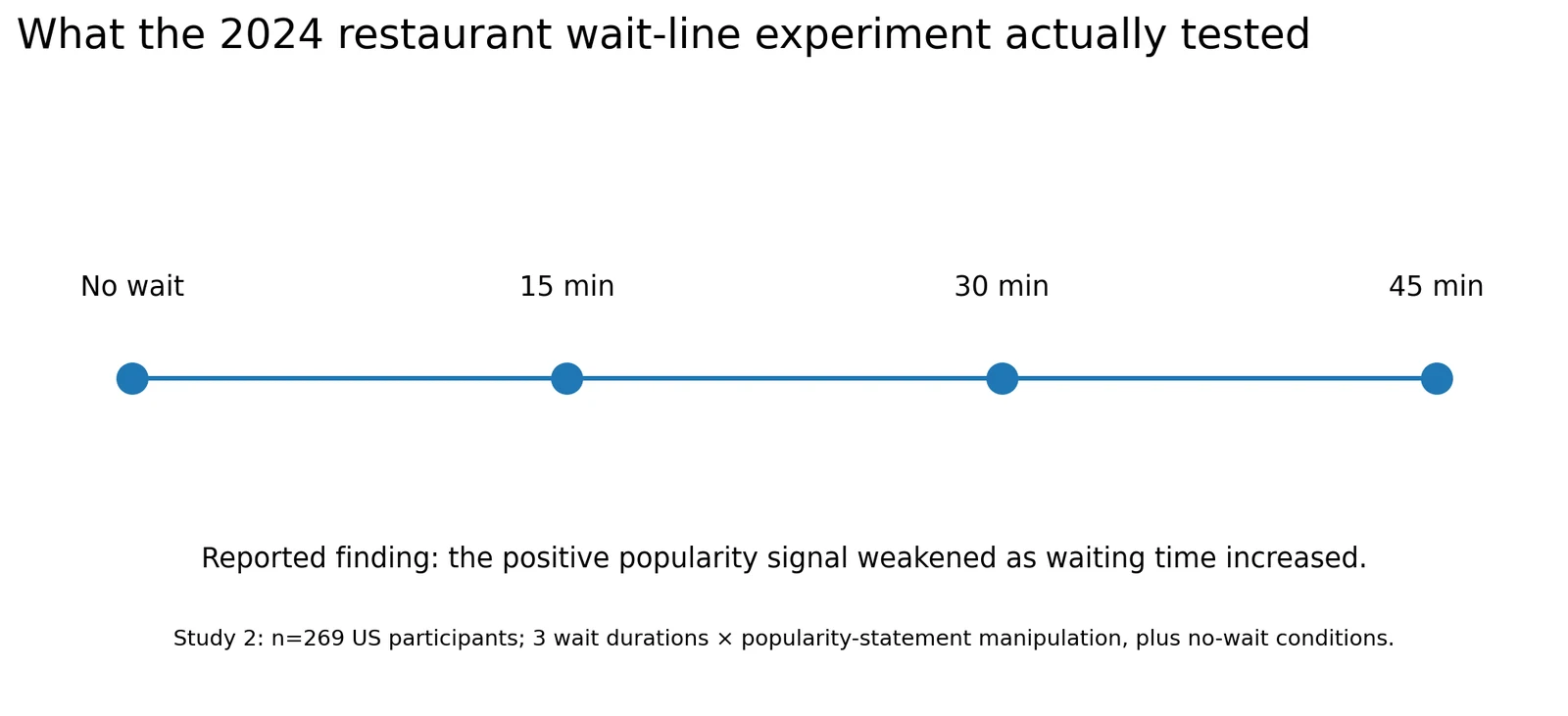
View the experimental conditions
| Study 2 wait condition | Participants | Reported direction |
|---|---|---|
| No wait | n=269 total | The positive popularity effect diminished as waiting time increased. |
| 15 minutes | ||
| 30 minutes | ||
| 45 minutes |
This is why “queues create social proof” is incomplete advice. A queue can say that other people think the restaurant is worth choosing. It also says that you cannot eat yet.
For somebody who drove forty minutes specifically to try a restaurant, that cost may be acceptable. For lunch before a meeting, it may end the decision immediately.
The same visible line creates information and friction at the same time.
Full is not the same thing as cramped
The word crowded hides two different experiences. A restaurant can be full of people while still giving tables reasonable space. A café can have fewer customers but arrange them so tightly that you can hear the stranger beside you explaining their divorce.
A café/restaurant study involving 465 participants changed the density of seating elements. Respondents evaluated the environment more positively when the seating layout was less dense.4
That separates two useful ideas. Human crowding can provide evidence of popularity. Spatial crowding can make the room uncomfortable. A restaurant can feel lively without trying to fit another table into every gap in the floor plan.
Sometimes other customers are part of the atmosphere
Picture a bar at 9pm with beautiful lighting, good music and three customers sitting forty metres apart. Now fill half the seats. Same bar, very different evening.
Other customers create sound, movement and a feeling that something is happening. A Malaysian full-service restaurant study received 300 surveys and analysed 200 properly completed responses. It found that perceived crowding positively moderated the relationship between the overall servicescape and customer satisfaction.5
The authors explicitly note that crowding can behave differently in a full-service restaurant than in environments where density is mainly experienced as stress. That does not mean more bodies are always better. It means the presence of other people can form part of the service environment.
A completely empty nightclub is strange. A completely empty private dining room may be exactly what you paid for. The desirable number of strangers depends on what the room is for.
The decision can happen before the restaurant knows you were considering it
This is easy for restaurants to miss because most operational data starts after somebody walks in.
The person who sees the queue, looks through the window and leaves does not become a transaction. Neither does the person who sees an empty room and keeps walking. No cancellation appears. No one-star review arrives. The decision happened outside.
Suppose one hundred people walk past. Some enter because the restaurant looks busy. Some reject it because the queue looks ridiculous. Others avoid the empty competitor because the room feels suspicious. The POS system sees only the group that eventually ordered.
The rest of the demand disappears from the restaurant's line of sight.
An empty restaurant can become more empty because it is empty
Imagine a newly opened restaurant has a weak first week. At 7pm only two tables are occupied. A couple walks past, glances inside and chooses the busier place. Ten minutes later another group does the same.
Low demand is now doing two jobs. It is an outcome, and it has become visible information that can influence the next decision.
The crowded restaurant can experience the opposite loop. People see customers. Customers imply popularity. More people become curious. The crowd gets easier to see.
This becomes particularly interesting after a viral post. Online attention can create a physical queue; the physical queue then attracts people who never saw the original post. At some point the loop can turn against the restaurant as waiting time, service pressure and expectations rise.
I would not ask how to make a restaurant look busier
I would ask what the crowd is actually doing to the decision.
When people see a queue, how many continue inside to ask about the wait? At what estimate do they leave? Does Friday behave differently from Tuesday? When reviews say “too crowded”, are customers complaining about noise, seating, waiting, parking or slow service?
Those are different problems hiding inside the same word.
A quiet restaurant also has more honest options than manufacturing a fake queue. If it is new, reviews and recommendations can provide some of the social evidence the dining room does not yet have. If demand starts later, current social content can show that reality. If delivery is busy while dine-in is quiet, the empty room may simply be a poor representation of what the kitchen is doing.
The goal is not to trick people into believing demand exists. It is to understand what visible demand communicates when the customer has little else to go on.
What the research does not prove
The Hong Kong study found clear attribution patterns, but it does not prove that adding bodies to every restaurant will causally improve evaluations in the real world.1 The Malaysian crowd-cue study measured purchase intentions rather than observing thousands of actual visits.2
The wait-line studies used hypothetical restaurant scenarios with US participants. They give experimental evidence that a line can signal popularity and that longer waits erode the benefit, but standing outside a fictitious restaurant on a screen is not the same as standing outside an actual shop in Malaysian heat.3
The seating-density study tells us something useful about spatial crowding, not an exact formula for table spacing.4 And the Malaysian servicescape study was cross-sectional, so its authors explicitly call for further work before causal conclusions are made.5
There is no universal occupancy percentage at which social proof peaks.
What the research supports is narrower: when customers lack information, the presence of other customers can influence what they infer about a restaurant, while the costs created by crowding and waiting can eventually push in the opposite direction.
The chairs are saying something even when nobody is
Before a customer speaks to a waiter, scans a QR menu or tastes a dish, the room has already started communicating.
Ten occupied tables might say: people come here. A short queue might say: people think this is worth waiting for. A room packed so tightly that nobody can hear one another says something else.
And an empty dining room at 7.30pm asks a question that the owner may never hear.
The customer looks through the glass for two seconds.
Then walks next door.
Research notes & sourcesView sources
Sources and context
- Tse, A. C. B., Sin, L., & Yim, F. H. K. (2002). How a crowded restaurant affects consumers' attribution behavior. International Journal of Hospitality Management, 21(4), 449–454. DOI ↗
- Ali, M. A., Ting, D. H., Ahmad-ur-Rahman, M., Ali, S., Shear, F., & Mazhar, M. (2021). Effect of Online Reviews and Crowd Cues on Restaurant Choice of Customer: Moderating Role of Gender and Perceived Crowding. Frontiers in Psychology, 12, 780863. DOI ↗
- Noone, B. M., & Lin, M. S. (2024). Exploring the upside of waiting: The positive effects of waiting as a cue to brand popularity. International Journal of Hospitality Management, 118, 103691. DOI ↗
- Yıldırım, K., & Akalın, A. (2007). Perceived crowding in a café/restaurant with different seating densities. Building and Environment, 42(9), 3410–3417. DOI ↗
- Ali, M. A., Ting, D. H., Salim, L., & Ahmad-Ur-Rehman, M. (2021). Influence of servicescape on behavioural intentions through mediation and moderation effects: A study on Malaysia's full-service restaurants. Cogent Business & Management, 8(1), 1924923. DOI ↗
Crowding research separates several related ideas: the number of other patrons, perceived popularity, waiting time and physical seating density. ORBIT keeps those mechanisms separate rather than treating “crowded” as one universal condition.
Understand what customers infer before they walk in.
ORBIT studies the signals around your restaurant, including the ones that affect a decision before a customer appears in your data.