Why Can One Person Decide Where the Whole Group Eats?
Vetoes, compromise, social influence and the psychology of choosing a restaurant together.

Choosing a restaurant for yourself is not especially complicated.
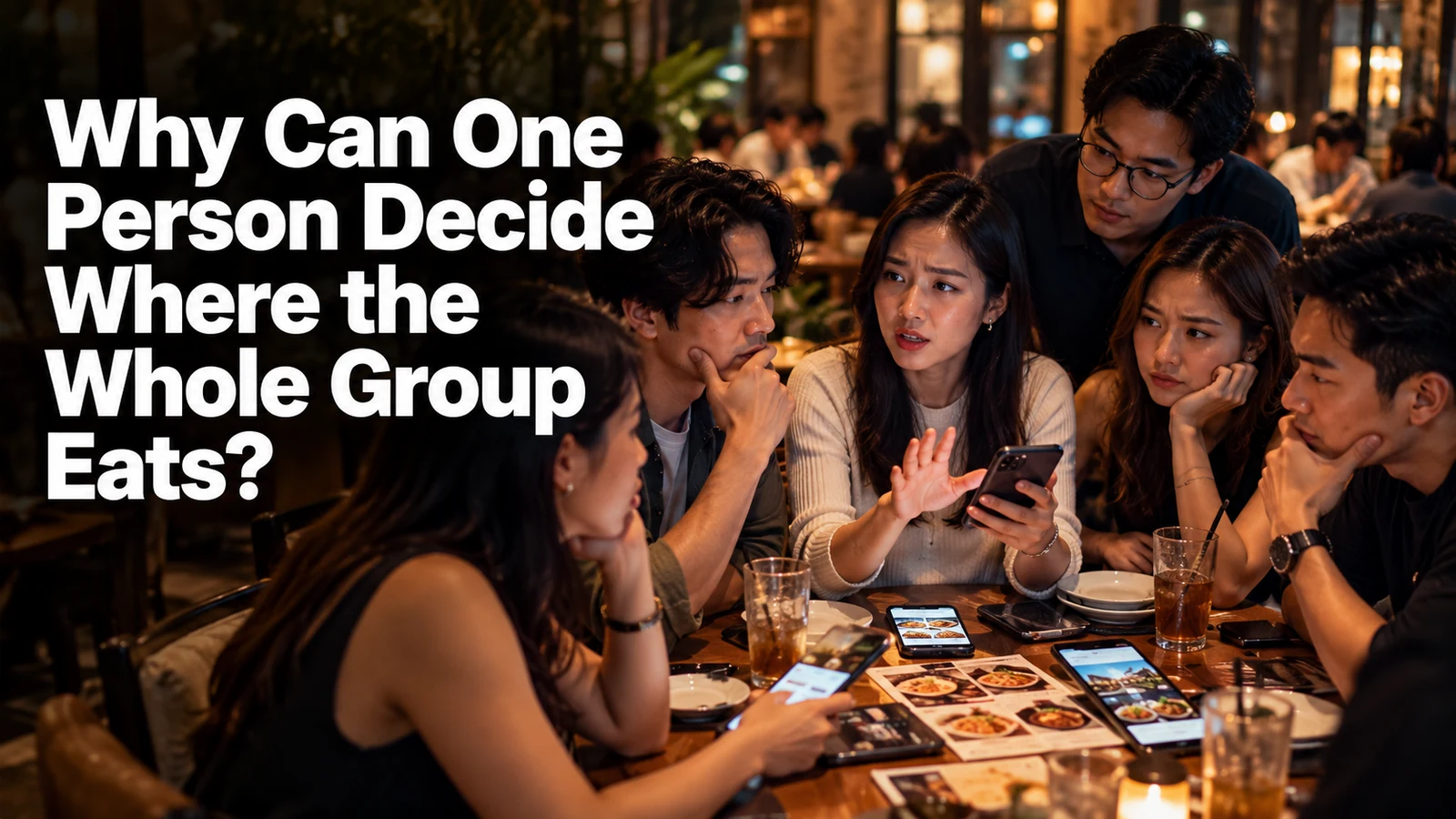
Choosing one for six people can somehow require forty-seven WhatsApp messages.
Someone suggests Korean barbecue. One person asks whether it is halal. Another says Cheras is too far. Someone else sends a restaurant in PJ but nobody can find the menu. The person who has contributed nothing for twenty minutes finally types, “Anything lah.”
Three suggestions later, that same person rejects all of them.
Eventually the group ends up somewhere nobody originally suggested.
When restaurants think about customer choice, they often imagine one person looking at several options and deciding which restaurant they prefer. But a large amount of eating out happens with other people, and the question changes completely once another person joins.
Short answer: groups do not simply average everyone's individual restaurant preferences. Research on couples, friendship groups and joint eating-out decisions shows negotiation, travel constraints, different levels of bargaining power and the need to accommodate other people's preferences. A restaurant that one person strongly likes can therefore lose to another restaurant that creates fewer problems for the group. Social influence continues after arrival: real restaurant sales data show diners' orders are related to what companions choose, and group size can affect how much food people order.
The best restaurant for one person can be impossible for the group
Imagine six friends considering four restaurants.
Five people love Restaurant A. The sixth person cannot eat anything there.
Restaurant B is everyone's second choice, but all six can eat.
If we simply counted enthusiasm, Restaurant A might appear stronger. At dinner, Restaurant B probably wins.
That is why I think the word veto is useful, even though the studies in this article do not establish a universal scientific “restaurant veto effect.” A veto is just a constraint strong enough to remove an option from the discussion.
It can be dietary. It can be religious. It can be price. It can be transport. A parent may need somewhere suitable for a child. Someone using a wheelchair may need an accessible entrance. One friend may finish work in KLCC while everybody else is in PJ.
The important point is that preferences and constraints behave differently. “I would prefer Japanese” is negotiable. “I cannot eat there” is not.
Recent work on joint eating-out decisions in Tokyo found that models based only on one person's preferences and travel burden did a worse job of explaining destination choice than models that incorporated the group as a whole. Group-level travel times and the degree to which members agreed on restaurants both mattered.1
The restaurant is also competing with everybody's journey
A lot of restaurant discussion treats location as though it belongs to the restaurant: good location, bad location, near MRT, inside a mall.
For a group, location is relational.
A restaurant in Bangsar can be extremely convenient for one person and irritating for four others. Somewhere geographically central may still be terrible if half the group needs two train changes or the driver knows parking there will be a nightmare.
A 2025 study estimated how much extra travel individuals were willing to accept in order to reduce the travel burden on the rest of their group. In the eating-out context, participants were on average estimated to be willing to travel one additional minute themselves to reduce other members' harmonic mean travel time by about 0.43 minutes. That willingness changed as the travel-time imbalance between one person and the rest of the group grew.2
I would not transport that 0.43-minute figure directly to Kuala Lumpur and pretend Malaysians make the same trade-off. Tokyo's transport system, geography and sample are obviously different.
What is interesting is the behaviour underneath it: people sometimes accept inconvenience so their friends have less of it.
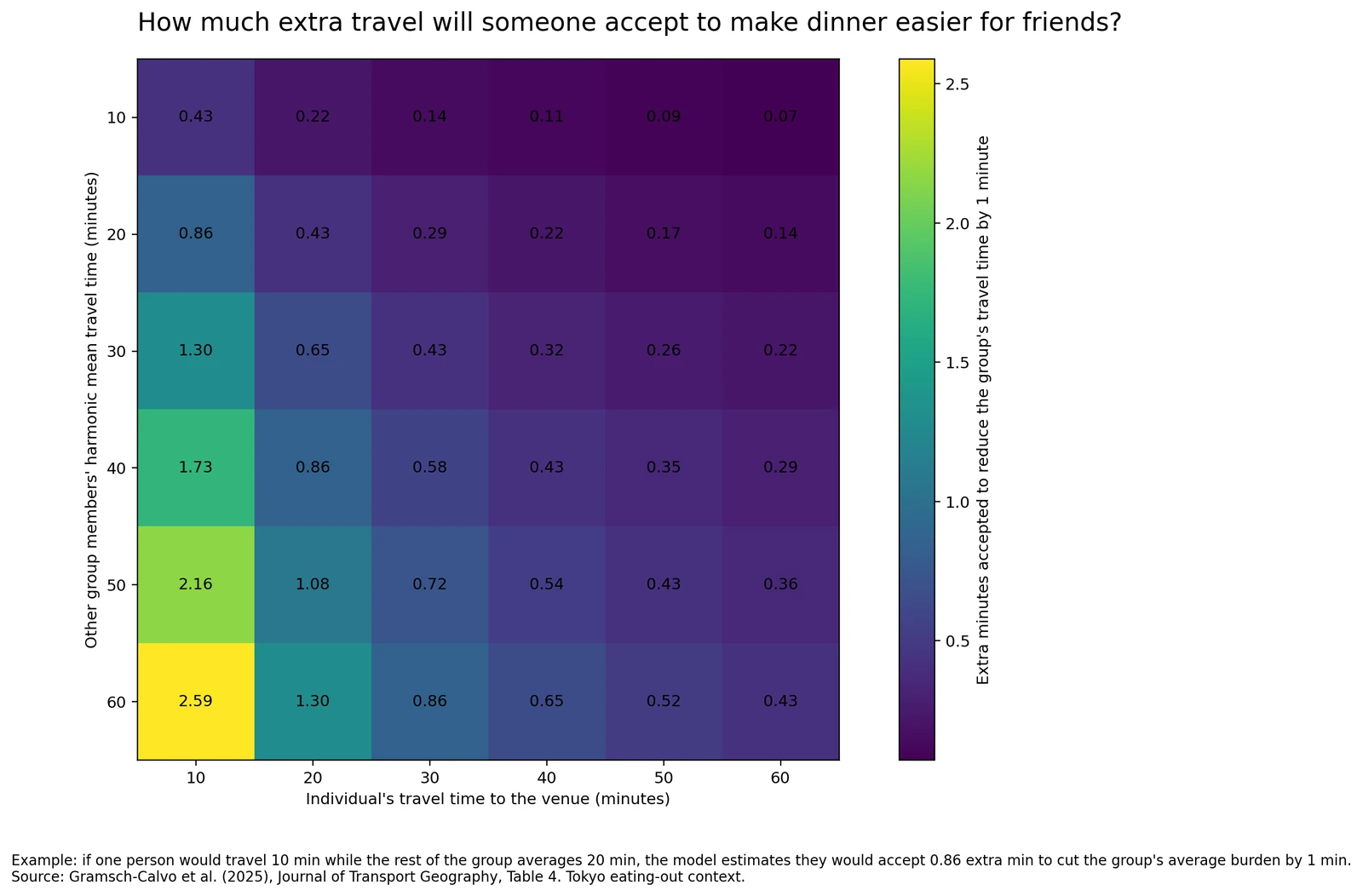
View the model estimates
| Others' mean travel time | Individual 10 min | 20 min | 30 min | 40 min | 50 min | 60 min |
|---|---|---|---|---|---|---|
| 10 min | 0.43 | 0.22 | 0.14 | 0.11 | 0.09 | 0.07 |
| 20 min | 0.86 | 0.43 | 0.29 | 0.22 | 0.17 | 0.14 |
| 30 min | 1.30 | 0.65 | 0.43 | 0.32 | 0.26 | 0.22 |
| 40 min | 1.73 | 0.86 | 0.58 | 0.43 | 0.35 | 0.29 |
| 50 min | 2.16 | 1.08 | 0.72 | 0.54 | 0.43 | 0.36 |
| 60 min | 2.59 | 1.30 | 0.86 | 0.65 | 0.52 | 0.43 |
Anyone who has watched friends argue over whether dinner should be in Subang, Mont Kiara or KL already knows the non-academic version.
Researchers have actually watched groups negotiate where to eat
Studying group decisions is difficult for a fairly obvious reason. If you survey one person afterwards and ask, “Why did your group choose that restaurant?”, you are getting one person's reconstruction of a conversation involving several people.
Researchers at the University of Tokyo developed the Text-aided Group Decision-making Process Observation Method, or x-GDP, to capture the actual group conversation while people coordinated a real joint activity. Participants discussed the activity through a group-chat interface and then had to carry out the plan.3
A 2026 study using the x-GDP data analysed 47 LINE group chats documenting real-time restaurant-choice negotiations among groups of three to five friends. The dataset captured the complete sequence from proposals through preference negotiation to the final restaurant, and groups had to execute the outing and verify it with photographs and transaction records.4
The useful part is the middle of the decision: alternatives proposed, accepted, resisted and abandoned before the winning restaurant appears.
Traditional restaurant analytics normally see the restaurant that won. The chat contains the restaurants that died along the way.
One place was too far. Someone did not like the cuisine. Another option had poor access. One person pushed a suggestion harder. Another person quietly conceded.
That middle part of the decision is normally invisible to the restaurant.
Couples do not simply combine two restaurant preferences either
There is useful evidence from much closer to our region.
Researchers studying 68 families in a major metropolitan area in southern India gave husbands and wives hypothetical restaurant choices based on seven restaurant attributes. Each partner chose separately first, and then the couple made restaurant choices together.
The final joint preferences were not simply identical to either person's individual preferences. The couples negotiated, and each partner tried to preserve attributes that mattered personally while arriving at a joint choice. Differences in entertainment budgets also entered the negotiation. Couples in which both partners had outside income tended to show more balanced bargaining power; patterns were more variable in single-breadwinner households.5
The study is older, the sample is small, and married couples are obviously not the same thing as six friends choosing supper. But the mechanism is useful.
People enter a group decision with individual preferences and leave with something else. There is a negotiation in between.
Sometimes the outcome looks like compromise. Sometimes one person concedes on price so another can keep their preferred cuisine. Sometimes one person cares deeply about the restaurant while the other barely cares at all, which makes the bargaining unequal before anyone says a word.
Maybe groups are often minimising objections
This is where I think restaurant choice becomes particularly interesting.
An individual can choose by maximising preference: “I really want sushi, so I will go to the sushi place.” A group may have to operate differently.
Suppose five people score two restaurants like this:
Restaurant B: 7, 7, 7, 7, 7
Restaurant A creates more excitement. Restaurant B creates less resistance. The numbers are illustrative, not study data.
There is no universal law saying groups always choose the least objectionable restaurant. Different groups use different decision processes. But it gives us a useful way to think about what a restaurant is competing for.
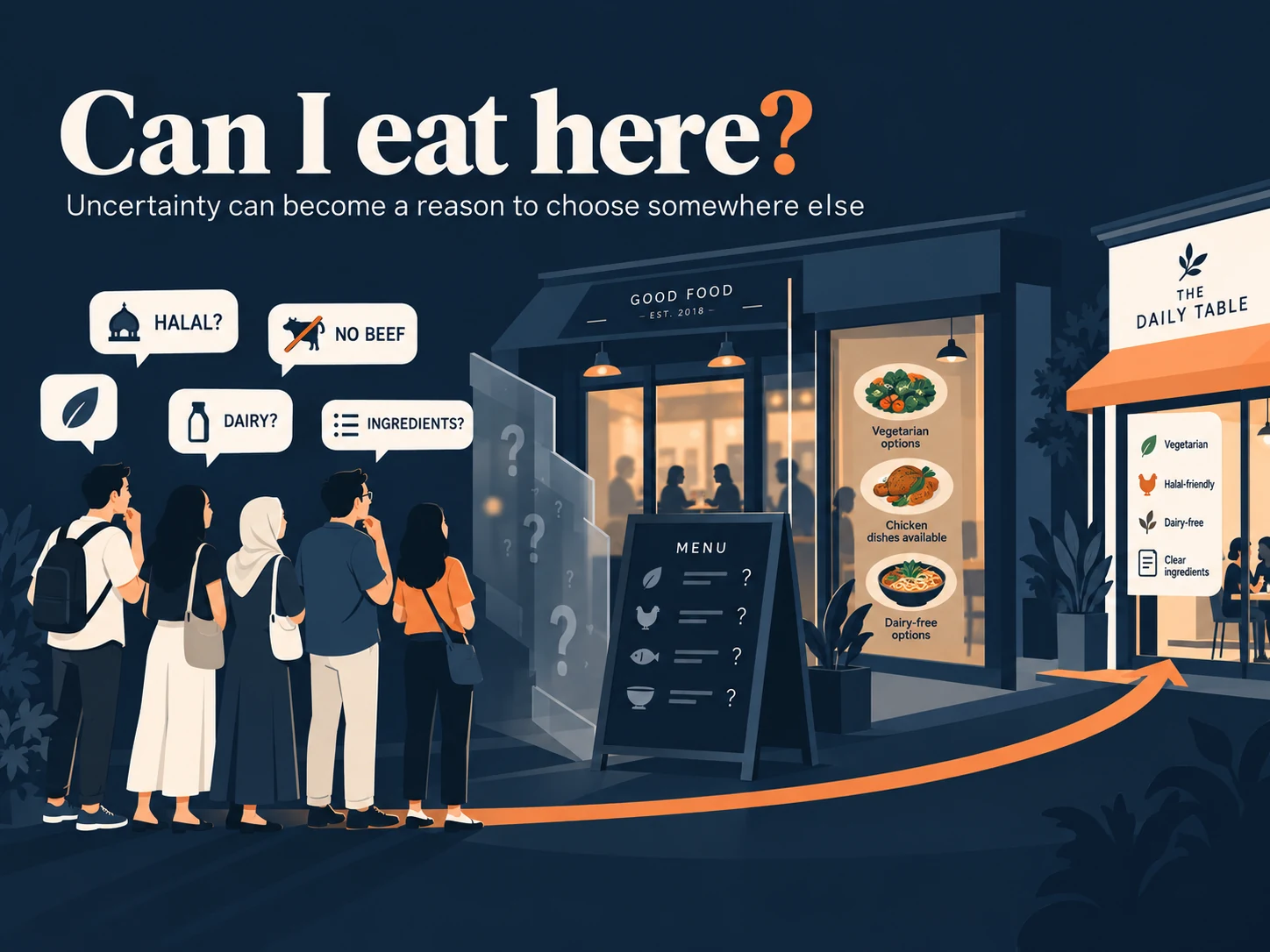
This is where ordinary pieces of restaurant information suddenly become psychologically important. One person wants to know whether the place is halal. Another wants to see prices. Somebody is bringing a toddler and wants to know whether a high chair exists. The organiser wants to know whether a table for eight can be booked.
For a solo diner, uncertainty can be tolerated personally. For an organiser, uncertainty has to be tolerated on behalf of everyone else.
The organiser may be solving a risk problem, not a taste problem
There is usually someone who ends up doing most of the work. They send the links. They check Google. They ask, “Okay 7.30pm can?” They call the restaurant.
If dinner goes well, nobody congratulates them. If the restaurant is terrible, somehow it becomes: “Who chose this place?”
That little social risk probably matters more than restaurant marketing gives it credit for.
A person choosing a restaurant for a group is not only deciding what they personally want to eat. They may also be trying to avoid making a choice the group regrets.
This can push the organiser toward restaurants that are easy to defend: good reviews, clear pricing, a menu broad enough that nobody will complain, an obvious reservation process, a familiar location.
This is partly interpretation rather than a result directly isolated by one restaurant experiment. But it fits what the collective-choice research shows: restaurant selection needs to incorporate other people's constraints and preferences, not merely the organiser's own utility.1
A restaurant can lose a group without being disliked by anyone. Nobody says, “That restaurant is bad.” They say, “Maybe somewhere else easier?”
Social influence does not stop once everybody sits down
Eventually the group survives the WhatsApp discussion and arrives at the restaurant. Now another strange thing happens.
They start affecting one another's orders.
Brenna Ellison examined lunch receipts from a full-service restaurant in Oklahoma over 19 weeks. After solo diners were removed, 1,459 observations remained for the group-ordering analysis.6
The pattern was more subtle than simple copying. Diners appeared to want some variety in the exact item they selected, but they were more likely to stay within a similar menu category to their companions. The modelling also suggested that diners received more utility from an entrée when somebody else at the table ordered an entrée from the same category.6
So one person orders a burger. The second does not necessarily order the same burger. They may order another sandwich.
They are different, but not too different.
Bigger groups can change how much people order before the food arrives
Another restaurant study asked whether social facilitation begins earlier, during the ordering stage.
Researchers observed 1,685 customers across 509 tables over four months in an Italian restaurant. The tables included solo customers, couples and groups as large as 30 people.7
As group size increased, the number of dishes ordered per person increased. A second study using a simulated restaurant scenario again found that the number of dining companions affected how much participants intended to order.7
You may behave differently at dinner with seven friends than you do eating alone, before the first plate reaches the table.
But people do not copy everyone equally
Social influence sounds simple until you ask an important question: whose behaviour are we influenced by?
A 2024 experiment with 179 female university students used an online café menu. Participants saw either a healthier or less healthy ordering norm, coming from either their own university or a rival university.
Participants exposed to the healthier norm selected a larger proportion of healthier menu items than those exposed to the unhealthy norm, but the effect appeared when the norm came from the participant's in-group. The same pattern was not significant when the source represented the rival university.8
That study was online and involved only young women. Still, it raises a useful point: social proof is not simply “other humans did this.” Who the other human is can matter.
And even putting a social cue directly on a restaurant menu does not automatically work. A 2025 field experiment observed 1,540 dishes sold while researchers labelled vegetarian dishes as either “Chef's choice” or “Guests' choice”. The less familiar lentil dish became more popular when recommended by the chef, while the “Guests' choice” label did not produce the same effect.9
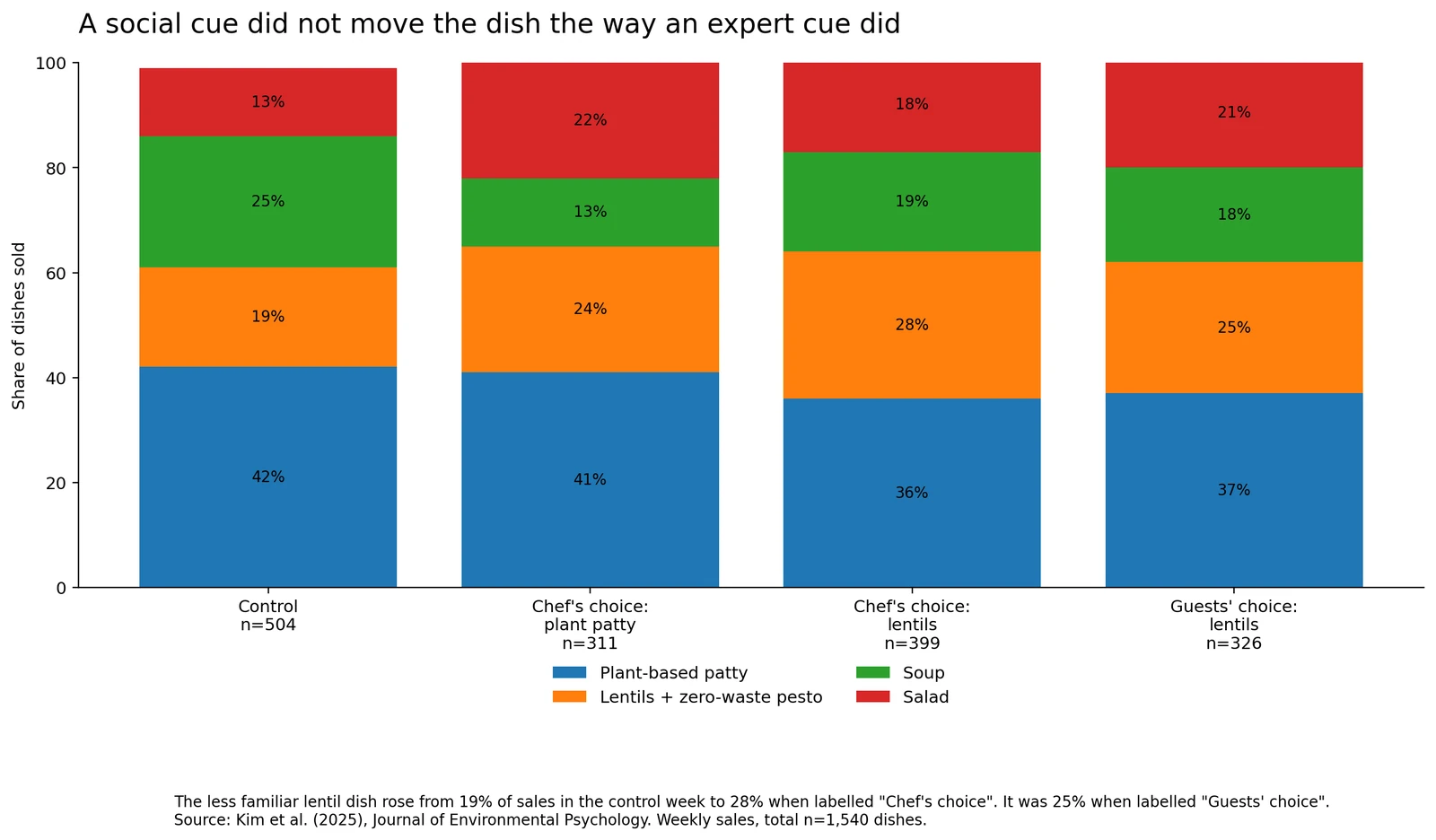
View the weekly dish shares
| Condition | Plant patty | Lentils + pesto | Soup | Salad |
|---|---|---|---|---|
| Control (n=504) | 42% | 19% | 25% | 13% |
| Chef's choice: plant patty (n=311) | 41% | 24% | 13% | 22% |
| Chef's choice: lentils (n=399) | 36% | 28% | 19% | 18% |
| Guests' choice: lentils (n=326) | 37% | 25% | 18% | 21% |
People can be influenced by other people. That does not mean writing “most popular” beside a dish will make everyone order it.
What this could mean for restaurants
I would not turn this research into “seven psychological tricks to attract groups.” The evidence does not justify that.
But it changes the questions I would ask about a restaurant.
Those answers may be completely different.
Perhaps the restaurant is attractive but nobody knows the price until they arrive. Perhaps groups like the food but avoid the area on Friday because parking is painful. Perhaps the menu photographs beautifully but the restaurant does not clearly show that vegetarian dishes exist. Perhaps a table of ten is possible, but the information is buried and nobody wants to call to check.
Different restaurants are meant for different occasions, and an intimate counter restaurant should not redesign itself for twelve-person family dinners.
The useful question is narrower: for the groups you actually want, what creates the first objection?
Group suitability may be an attribute in its own right. Not whether the restaurant advertises itself as group-friendly, but whether organising dinner there creates trouble.
Can everyone find something to eat? Can eight people sit together? Can we hear each other? Will the bill become awkward? Does everyone know the price before agreeing? Can the late person still join? Can we park?
These questions do not always belong to the food. Yet together they may determine whether the food is ever tasted.
What the research does not prove
Group psychology is particularly easy to oversimplify.
The evidence in this article comes from different kinds of groups and different places: married couples in India, friends in Tokyo, restaurant customers in the United States and Italy, and university students in controlled experiments.
A married couple choosing dinner is not psychologically identical to eight colleagues arranging a company meal. The Tokyo transport findings should not be copied numerically into Kuala Lumpur. Public transport, car dependence, geography and social norms are different.
The Ellison study used restaurant receipts and a statistical model to infer peer relationships in ordering; it did not record diners explaining every thought behind every dish. The Italian group-size study found that people ordered more dishes as group size increased within its setting, but that does not mean every restaurant should expect spending per person to rise whenever a table gets larger. The online social-norm experiment involved female university students, so it tells us something interesting about identity and food norms, not a universal rule about every diner.
Most importantly, there is no single rule saying the most difficult person always gets their way or that every group chooses the least objectionable restaurant.
Groups have histories. Some have organisers. Some have dominant personalities. Some take turns choosing. Some vote. Some argue. Some have one friend who says “I don't mind” and actually means it.
What the evidence supports is broader: restaurant choice made with other people involves negotiation, social influence and group-level constraints that cannot always be understood by studying one diner at a time.
Restaurants spend enormous effort understanding the people who walk through the door. But in a group decision, the most influential person can occasionally be the one who made sure nobody came.
They did not complain to the restaurant. They did not bounce from the website. They are not recorded as a lost customer.
Maybe they simply wrote: “Too far lah.”
The conversation moved on. And six dinners went somewhere else.
Research notes & sourcesView sources
Sources and context
- Okamura et al. (2024). Modeling collective decisions on eating-out location choice. Journal of the City Planning Institute of Japan. Joint-destination modelling incorporating group preferences and spatiotemporal constraints.
- Gramsch-Calvo et al. (2025). Going the extra mile: Estimating the willingness to travel to meet with friends using a joint destination choice model. Journal of Transport Geography. Estimates how individual travel time trades against the burden on other group members.
- Parady, Oyama & Chikaraishi (2025). Text-aided Group Decision-making Process Observation Method (x-GDP). Transportation. Method for observing real-time group negotiation and executed joint activities.
- Can large language models interpret unstructured chat data on dynamic group decision-making processes? Evidence on joint destination choice. (2026). Uses 47 LINE group chats from the x-GDP restaurant-choice dataset, with groups of three to five friends.
- Adhikari & Rao (2013). Individual Preference and Bargaining Behavior in Families’ Buying Decisions of Restaurant Service. Cornell Hospitality Quarterly. Discrete-choice study of 68 families in southern India.
- Ellison (2014). “I’ll have what he’s having”: Group ordering behavior in food choice decisions. Food Quality and Preference. Full-service restaurant sales-receipt study of group ordering behaviour.
- Cavazza, Graziani & Guidetti (2011). Looking for the “right” amount to eat at the restaurant: Social influence effects when ordering. Social Influence. Four-month observational study of 1,685 customers at 509 tables, plus a simulated follow-up study.
- Gleaves et al. (2024). I’ll have what She’s having (but not what They’re having). Appetite. Online experiment with 179 female university students on in-group versus out-group food norms.
- Kim et al. (2025). A field experiment on expert- versus social-based cues on dish selection in a restaurant. Journal of Environmental Psychology. Four-week restaurant field experiment covering 1,540 dishes sold and 524 survey participants.
The studies use different group types, cultures, transport systems and research designs. Tokyo travel estimates are not treated as Kuala Lumpur travel rules, and findings about couples, university students or one restaurant are not generalized to every dining group. The repeated pattern is that group choice contains negotiation and social constraints that individual-only models can miss.
Which group objection is costing you the table?
ORBIT studies the customer, competitor and market signals around your restaurant so you can see which friction is actually changing the decision.