Can I Eat Here? Food Restrictions Shaping Restaurant Choice in Malaysia
Before taste, price or reviews matter, some diners first need to know whether the restaurant fits their food rules. Recent research shows why unclear information can become a decision barrier.

A restaurant can have suitable food and still lose the customer if the customer cannot confidently tell that it is suitable.
In Malaysia, that question can involve halal status, pork, beef, vegetarian or vegan food, dairy, gluten or a specific ingredient. For groups, one person's hard restriction can shape the choice for everyone.
What did the 2026 menu study actually find?
A new Food Control study examined how food-hypersensitivity information was communicated across 1,034 restaurant menus in 18 Brazilian cities. The sample included 323 physical menus and 711 online menus. The researchers also spoke with 18 adults living with food allergy, intolerance or coeliac disease, or caring for children with these conditions.
Most menus gave some information, but it was usually just an ingredient description. Ingredient-only information appeared in 76.2% of physical menus and 88.0% of online menus. Clear warning messages were much rarer, appearing in 11.1% of physical menus and only 0.1% of online menus.
Local regulation was associated with more explicit information on physical menus, 24.5% in regulated cities versus 12.7% in cities without that local regulation. The same regulatory effect was not observed online. In the focus groups, hidden ingredients in sauces and composite dishes, incomplete information and inconsistent staff guidance were recurring barriers.
Information was common. Decision-ready information was not.
The useful distinction is between having information somewhere and making it clear enough for a customer to decide.
This study focused on food hypersensitivity in Brazil. It does not measure Malaysian restaurant choice directly. We use it here as evidence for a broader mechanism: unclear food-suitability information can leave customers unable to decide confidently.
“The food may fit the customer. The information may still fail the decision.”
ORBIT interpretation of the research
Malaysia makes the question much wider than food allergy
Malaysia's population is estimated at 34.4 million in 2026. Those customers do not enter restaurants with one shared set of food rules. For some people the first filter is halal status. For others it may be beef, vegetarian or vegan food, dairy, gluten or another ingredient.
The numbers below come from different sources, years and study designs. Some are national population statistics. Others are survey or clinical-study results. They should be read as separate signals, not added together.
| Food decision factor | What Malaysian data shows | How to read it |
|---|---|---|
| Halal / pork | 63.5% of Malaysia's population, about 20.6 million people, were Muslim in the 2020 Census. | This is the latest nationwide religion census used here. Halal suitability can be a first-stage restaurant filter for a large market segment. |
| Beef | 6.1% of the population, about 2.0 million people, were Hindu in the 2020 Census. | Religion is not a direct measure of beef avoidance. The figure is context for why beef suitability can matter to some diners, not a national beef-avoidance rate. |
| Plant-based | In a 2025 Rakuten Insight online survey of 7,706 Malaysian respondents, 5% said they only consume plant-based food. | This is an online survey result, not an official population prevalence estimate. Malaysia's Ministry of Health also notes a lack of national data on vegetarian dietary patterns. |
| Vegetarian / vegan motivation | In the same 2025 survey, 29% cited following a vegetarian or vegan diet as a reason for choosing plant-based alternatives, while 21% cited allergies, intolerance or dietary restrictions on certain animal-based products. | These are reasons given within a consumer survey about plant-based alternatives. They are useful signals, not population shares that should be added to other rows. |
| Lactose | A clinical study of 248 young Malaysian adults found 19.8% experienced lactose-intolerance symptoms after a lactose test, while 87.1% were lactase deficient. | The sample was young and relatively small. Do not use 19.8% as a national Malaysia prevalence estimate. |
| Gluten / coeliac disease | A study of 562 healthy young adults found coeliac-related serological evidence in 1.25%, roughly 1 in 100 in that sample. | Again, this is a specific study sample, not a full national prevalence survey. |
| Halal-label uncertainty | In a 2026 Miri study of 465 respondents, 42.4% were not sure whether labels such as “Muslim Friendly”, “No Pork No Lard” or “Serve No Pork” meant the premise was halal. 28.0% assumed yes and 29.7% did not. | This is direct evidence that food-suitability language can be familiar yet still leave customers uncertain. |
Important: do not add these percentages together. The groups overlap, the sources use different populations and several rows are not national prevalence estimates.
Malaysia in 2026 gives us a live example of uncertainty
A 2026 study in Miri, Sarawak examined the phrases “Muslim Friendly”, “No Pork No Lard” and “Serve No Pork”. Respondents were generally familiar with the labels, but understanding was not the same as certainty.
When asked whether a premise carrying those labels should be assumed to be halal, 42.4% were not sure. That is useful for restaurant operators because it shows how a label can communicate something while still failing to answer the customer's actual question.
These informal descriptions are also not the same as formal halal certification. JAKIM maintains the Malaysian Halal Directory for checking certified products and food premises.
Another Malaysian study, available online in August 2026, surveyed 603 Muslim consumers around Kuala Lumpur, Putrajaya, northern Malaysia and the East Coast. In the researchers' model, halalness was positively associated with restaurant image, perceived price fairness and revisit intention for non-halal-certified international restaurant outlets. That does not mean halalness is the only factor, but it reinforces that food suitability can influence more than the first visit.
For some customers, “Can I eat here?” comes before “Is the food good?”
A simple Malaysian group-dining example
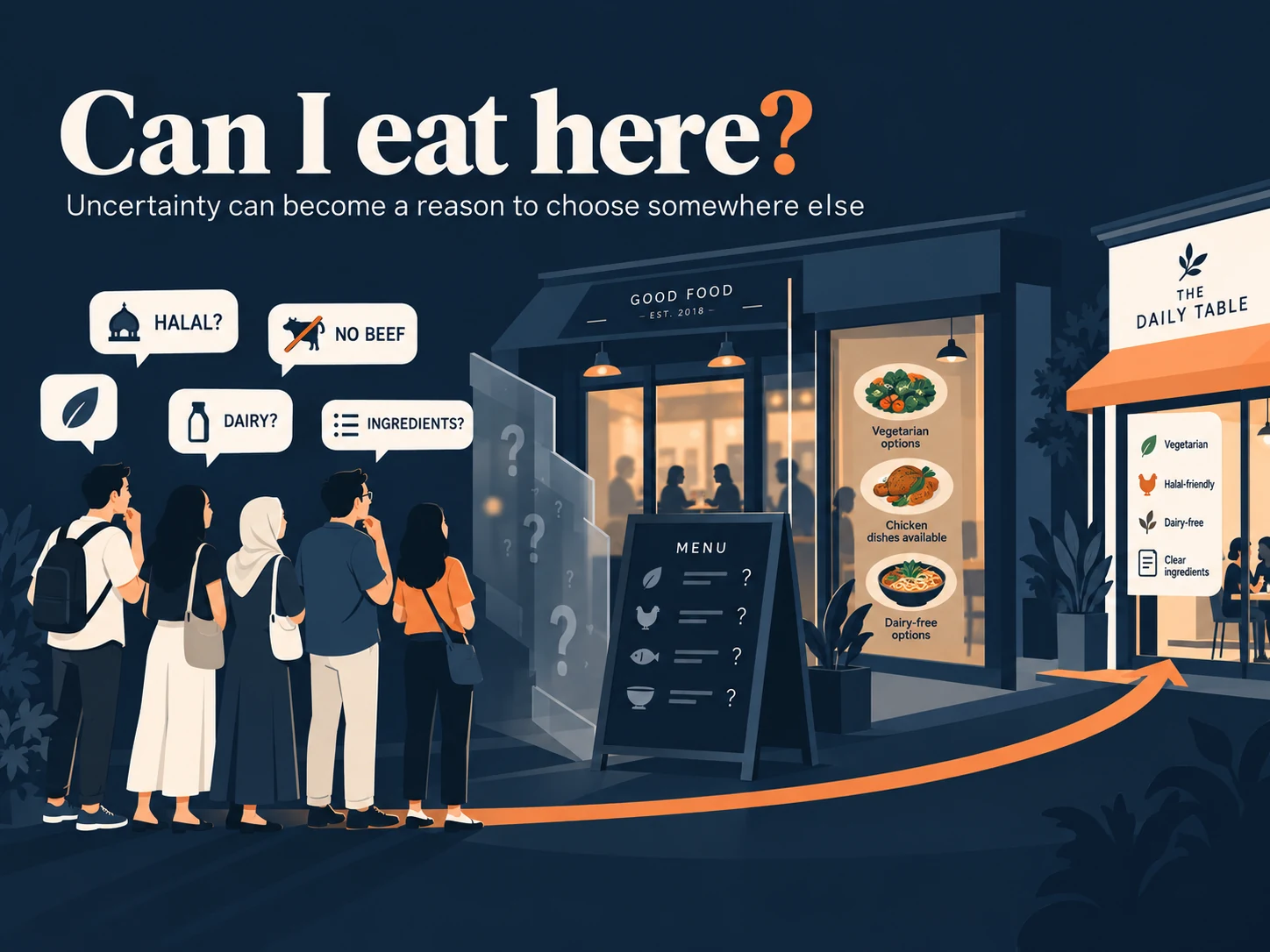
Imagine five friends choosing dinner. One wants a halal-certified option. One avoids beef. One is vegetarian. One is sensitive to dairy. The fifth person has no restriction.
Restaurant A actually has dishes that could work for everyone, but its Google listing and online menu do not make that clear. The vegetarian items are mixed into the menu, sauces are unexplained and the restaurant's halal status is ambiguous.
Restaurant B clearly states its certification status, identifies vegetarian dishes and makes key ingredients easier to understand.
The group may choose Restaurant B without ever deciding that Restaurant A is bad.
This five-person example is illustrative. It is not a scenario measured by any one study in this article. It shows how one person's hard food filter can become a group-level restaurant decision.
The hidden problem may be uncertainty, not availability
Restaurant operators naturally think about what is available in the kitchen. Customers can only choose from what they can understand before ordering.
A vegetarian dish that is impossible to identify online may as well not exist during the discovery stage. A restaurant that uses no pork may still be rejected if the customer needs formal halal assurance and cannot verify it. A dairy-free option hidden behind an unexplained sauce can create the same type of hesitation.
This is where the Brazil study and the Malaysian evidence connect. They are different studies in different contexts, but both point toward the same practical question: does the information remove enough uncertainty for the customer to act?
What should restaurant owners check?
Practical ORBIT interpretation: the research did not test every recommendation below as a causal intervention. These are decision points restaurant operators can audit.
- State halal information precisely: distinguish formal certification from informal descriptions and avoid making one sound equivalent to the other.
- Make dish-level suitability visible: clearly identify vegetarian, vegan or other relevant options instead of expecting customers to decode ingredients themselves.
- Explain composite ingredients where it matters: sauces, broths, seasoning and prepared components can hide the ingredient a customer is trying to avoid.
- Check the digital menu, not only the printed one: many restaurant decisions happen on Google, delivery apps and social platforms before customers reach the door.
- Keep staff answers consistent: unclear or conflicting answers can turn a possible order into a hard no.
- Think about groups: one customer's food rule can eliminate a restaurant for the entire table.
What we still do not know well enough in Malaysia
There is an important data gap. Malaysia's Ministry of Health explicitly notes a lack of data on vegetarian dietary patterns in Malaysia. We also do not have one robust 2026 national dataset telling us exactly how many Malaysians reject restaurants because of pork, beef, vegan requirements, dairy, gluten or food allergy.
That means we should resist turning a collection of different studies into one dramatic percentage. The more useful next question is behavioural: how often does unclear food suitability cause Malaysians to remove a restaurant from consideration?
That is the kind of question worth measuring directly in the Malaysian restaurant market.
Quick answers
What food restrictions can affect restaurant choice in Malaysia?
Halal status, pork, beef, vegetarian or vegan requirements, dairy, gluten and specific ingredients can all matter depending on the diner. The relative importance varies by person, occasion and dining group.
What percentage of Malaysians are Muslim?
The 2020 Census recorded 20.6 million Muslims, or 63.5% of Malaysia's population. Malaysia's total population is now estimated at 34.4 million in 2026, but the 2020 Census remains the latest national religion breakdown cited here.
How many Malaysians are vegetarian or vegan?
There is no strong official national prevalence estimate. The Ministry of Health says local vegetarian dietary-pattern data are limited. A 2025 Rakuten Insight online survey found 5% of 7,706 Malaysian respondents said they only consume plant-based food, but that should not be treated as an official population percentage.
Does “No Pork No Lard” mean halal-certified?
No. It describes the absence of pork and lard, not formal halal certification. Customers can verify certified premises through JAKIM's Halal Directory.
Can unclear menu information lose customers?
The evidence here does not give one Malaysian causal percentage. However, the Brazil menu study documented communication gaps and customer barriers, while the 2026 Miri study found substantial uncertainty around informal halal-related labels. That makes clarity a reasonable decision factor for operators to investigate.
Sources and research context
- Vicentini et al. (2026). Food hypersensitivity communication across physical and online foodservice menus in Brazil: fragmented regulation and consumer experiences in a mixed-methods study. Food Control.
- Department of Statistics Malaysia. Current Population Estimates, Malaysia, 2026.
- Department of Statistics Malaysia. Key Findings, Population and Housing Census of Malaysia 2020.
- Shahriman et al. (2026). Consumer Perceptions of Unauthorised Halal Signage: A Study of “Muslim-Friendly”, “No Pork No Lard” and “Serve No Pork” Labels in Miri, Sarawak.
- The role of Halalness, perceived authenticity and food quality for Muslims to revisit international chain restaurants (available online 2026).
- Rakuten Insight. Plant-based food alternatives survey, 2025.
- Ministry of Health Malaysia. Malaysian Dietary Guidelines for Vegetarians 2023.
- Lactase deficiency and lactose intolerance in a multiracial Asian population in Malaysia.
- Prevalence of Serum Celiac Antibodies in a Multiracial Asian Population.
The studies above use different methods, samples and populations. ORBIT has kept those limitations visible instead of combining the results into one national dietary-restriction estimate. The Malaysian group example and operator checks are ORBIT interpretations, not findings from a single study.
Find the food filters around your restaurant
ORBIT looks at the outside signals customers see before they choose, including menu information, reviews, competitor context and the reasons a restaurant may be removed from consideration.