Why Do We Keep Going Back to the Same Restaurant?
Familiarity, habit, risk, boredom and the psychology behind repeat restaurant choice.

I think new restaurants are slightly overrated.
Not because they are bad. Trying somewhere new is one of the nice things about living in a place with too many restaurants. But that enthusiasm disappears surprisingly quickly when it is 7.30pm, everyone is hungry and the group chat has already spent twenty minutes deciding where to go.
Say you are in PJ and somebody suggests the new place everyone has been posting about. The food looks good. Google says 4.6. Then somebody notices it does not take reservations. Another person asks whether seven people can sit together. Someone else checks the menu and discovers the only thing he wants is RM42.
At some point somebody says, “Aiya, just go the usual place lah.”
The usual place might not even be anyone's favourite restaurant. It just has fewer unanswered questions. You already know dinner will be around RM25 or RM30, and you know not to waste time looking for parking directly outside because there is usually space behind the pharmacy. Your friend who cannot take spicy food already has an order there. Nobody needs to study anything.
Calling all of this “loyalty” feels a little generous.
Sometimes people genuinely love a restaurant. They know the owner, crave a particular dish and would cross town for it. But there is another kind of repeat customer who returns for a much less romantic reason: going somewhere else sounds like work.
Short answer: people return to familiar restaurants for more than satisfaction or loyalty. Previous experience can make a restaurant easier to evaluate because customers already know what to expect from the price, food, menu and experience. Malaysian restaurant-choice research has found personal or past experience to be an important selection factor, while recent meal-choice research shows familiar or habitual dishes are among the common ways people choose what to order. Familiarity can also reduce some of the perceived risk around an unfamiliar meal. But repetition has a limit: boredom and satiation can push satisfied diners toward other restaurants.
The usual restaurant has already answered questions you no longer notice
Think about how much information is missing when you see a restaurant for the first time.
The photos might tell you what the food looks like, assuming the photos are recent. Google tells you where the restaurant is, but not whether finding a parking space at 8pm will make you regret going. A menu tells you what dishes cost, although sometimes you have to search through Instagram highlights, Google photos and somebody's two-year-old review just to find one.
You might want to know whether it is noisy, whether portions are large enough to share, whether the queue moves quickly, whether the restaurant accepts reservations, whether your parents will enjoy it, whether the air-conditioning is freezing, whether the “spicy” noodles are Malaysian spicy or tourist spicy.
Nobody consciously writes all of these questions down. But the questions exist.
At a restaurant you have visited twenty times, many of them disappeared a long time ago.
A 2024 review looked across 111 restaurant studies and identified 117 factors related to restaurant choice, patronage and satisfaction. The factors ran across food, service, atmosphere, price and value, behavioural intentions, beliefs, experiences and company. Food appeared particularly important overall, but the authors also warned that importance changes with situations such as lunch versus dinner and weekdays versus weekends.1
That sounds obvious until you think about what it means. There is probably no permanent list in your head that says Restaurant A is your number one restaurant, Restaurant B is number two and Restaurant C is number three. The ranking keeps changing.
The place you would choose for an anniversary may be completely wrong for lunch before a 2pm meeting. The restaurant you would happily drive forty minutes to on Saturday might lose to the kopitiam downstairs on Tuesday.
Malaysian diners put past experience surprisingly high on the list
One of the more useful studies for this question was conducted in Malaysia.
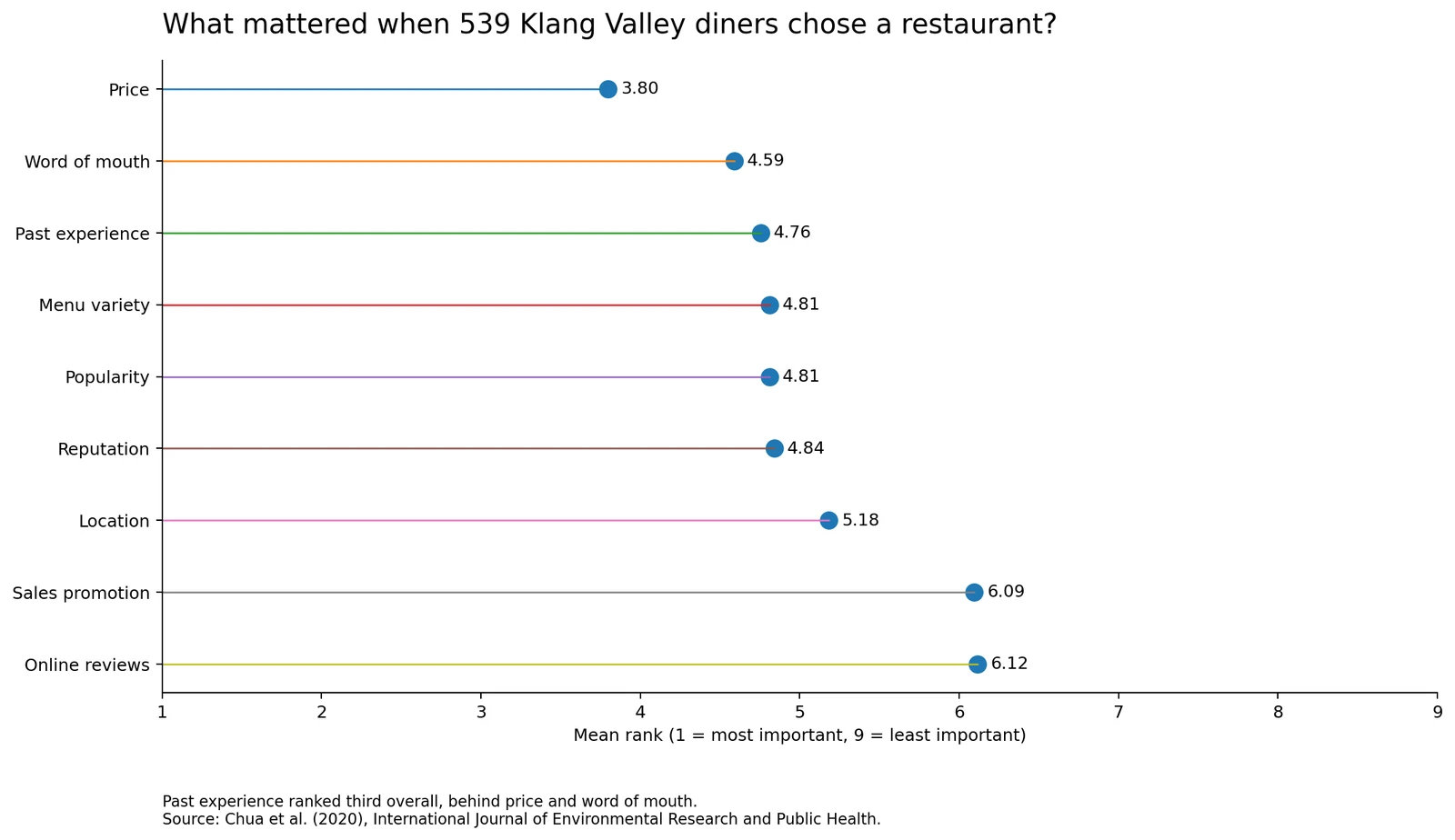
Researchers surveyed restaurant customers and obtained 539 usable responses. Participants ranked nine factors that could influence restaurant choice: price, word of mouth, personal or past experience, menu variety, popularity, reputation, location, promotions and online reviews.
In that sample, personal or past experience ranked third overall, behind price and word of mouth.2
View the underlying ranking data
| Factor | Mean rank |
|---|---|
| Price | 3.798 |
| Word of mouth | 4.588 |
| Past experience | 4.757 |
| Menu variety | 4.811 |
| Popularity | 4.811 |
| Reputation | 4.839 |
| Location | 5.182 |
| Sales promotion | 6.095 |
| Online reviews | 6.115 |
That is worth sitting with for a moment. An owner's instinct may be to look outward when trying to understand why somebody chose the restaurant. Maybe it was the Instagram post. Maybe they saw a review. Maybe there was a promotion.
Yet one of the strongest pieces of information a diner can possess is much simpler: I've been there before.
The same study also found that the ranking changed with the reason people were dining out. Price mattered most for quick meals or convenience and for social occasions. Brand reputation rose to the top for business dining. Word of mouth mattered most for celebrations.2
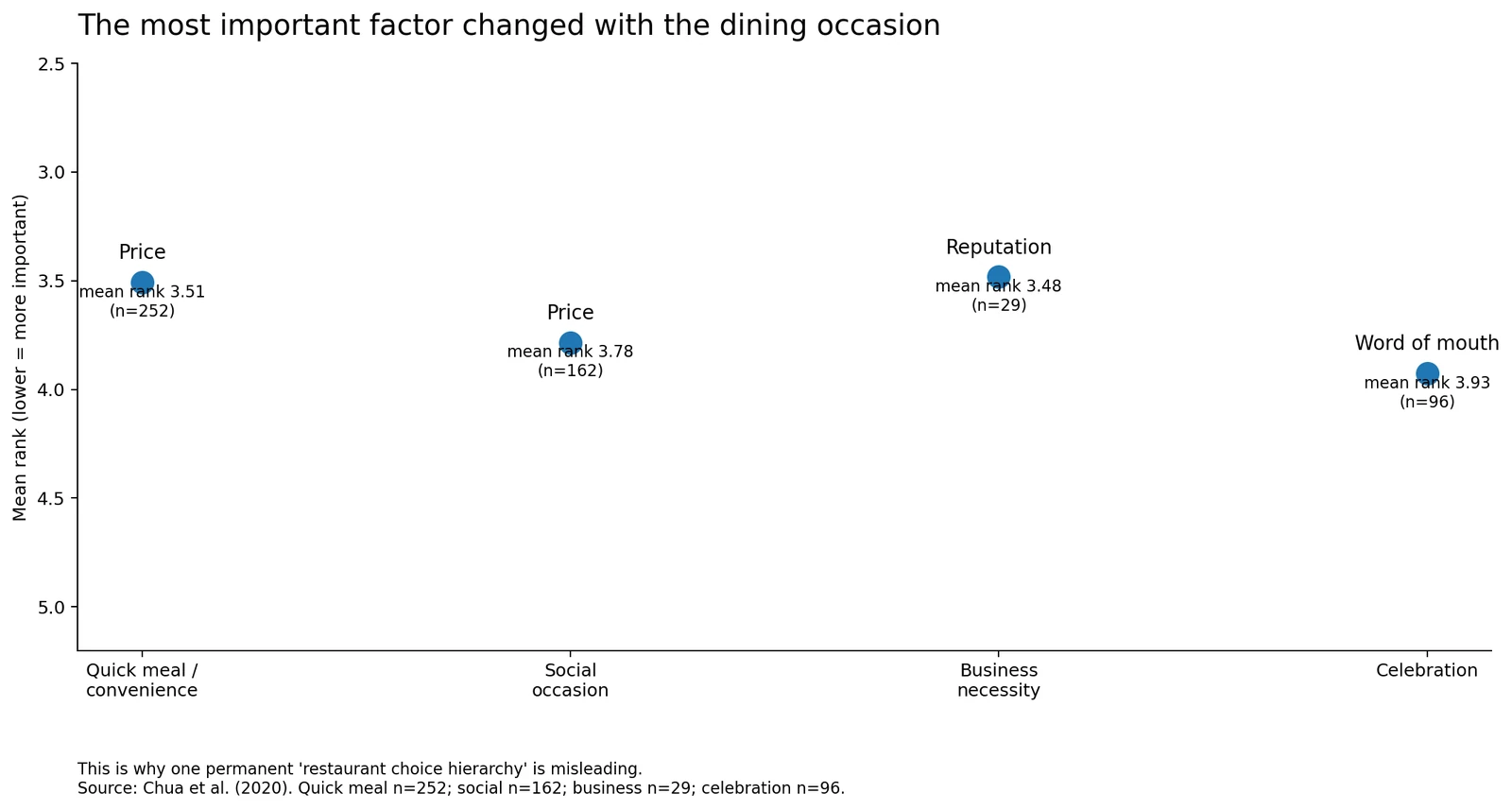
View the occasion data
| Dining occasion | Top-ranked factor | Mean rank | n |
|---|---|---|---|
| Quick meal / convenience | Price | 3.508 | 252 |
| Social occasion | Price | 3.784 | 162 |
| Business necessity | Reputation | 3.483 | 29 |
| Celebration | Word of mouth | 3.927 | 96 |
This stops us from turning “past experience matters” into another universal rule. There are nights when familiarity is extremely valuable and nights when the job of the meal changes.
If I am taking an important client out, perhaps I care more about reputation than whether I know the best place to park. If I am having lunch between meetings, the opposite may be true.
The same customer can behave like a different customer three hours later.
There is also an important limitation in the Malaysian study. Participants were asked to recall a recent visit to a restaurant that was different in some way from restaurants they commonly patronised. It was a descriptive ranking study, not an experiment where researchers randomly changed familiarity and watched restaurant choice happen. The sample also leaned toward younger working adults.2
So “past experience ranked third” should not become “past experience is always the third most important reason Malaysians choose restaurants.” The defensible conclusion is narrower: previous experience is clearly part of the restaurant decision, and the decision changes with context.
Trying something unfamiliar can involve a small amount of risk
“Risk” sounds dramatic when talking about dinner. Most of us are not standing outside a restaurant thinking we are about to make a dangerous financial decision.
But you can lose RM42 on a meal you hate. You can waste an evening. You can choose badly for the group. You can order something that arrives looking nothing like what you imagined.
Research in an authentic Chinese-restaurant context found that risk-taking behaviour significantly predicted menu choice. Menu choice was then connected with whether the experience confirmed or disappointed expectations, which in turn affected satisfaction.4
Another experiment used a 2 × 2 design involving dish names and ingredient familiarity. Among 221 usable participants, unfamiliar ingredients increased both perceived authenticity and perceived risk. An unfamiliar dish could therefore become more attractive in one way and less attractive in another at exactly the same time.5
Imagine seeing sea cucumber on a menu when you have never eaten it. The unfamiliar ingredient could make the restaurant feel more authentic. You came here for something you cannot cook at home, after all. But you might also wonder whether you will hate it.
Those two reactions can coexist.
This is why I hesitate to call every repeat customer loyal
A restaurant sees the same person six times and naturally thinks it has created loyalty. Maybe it has. But behaviour alone cannot tell us why the behaviour happened.
Imagine someone works three doors away from a restaurant and eats there twice a week. They know the lunch set is RM16.90 and comes out quickly. The food is decent. Then that person changes jobs. They never return.
Were they loyal? Or was the restaurant simply the easiest acceptable answer to lunch?
There is no insult in that distinction. Convenience is real value. Familiarity is real value. Predictability is real value. But calling all repeat behaviour “loyalty” can hide what is actually holding the relationship together.
The Malaysian choice study gives us one reason to be careful. Personal experience mattered, but so did price, word of mouth, menu variety, reputation and the occasion.2 The 2024 meal-choice study gives us another. Habitual choices were common, but so were enjoyment and budget-driven choices.3
A repeat customer can therefore be returning for several reasons that look identical at the cashier.
Then the whole familiarity argument starts to break
If familiarity is so useful, why don't we eat at the same restaurant forever?
Because knowing exactly what will happen can eventually become the problem.
The same dish that once felt reassuring can become boring. The room you used to like stops being interesting. Nobody has anything left to discover on the menu.
Researchers surveyed 617 respondents while investigating variety-seeking in restaurant choice. Among the significant drivers of variety-seeking intentions were overall boredom and boredom with atmospheric attributes.6
The definition of variety seeking in that study is especially useful. Leaving your last restaurant does not necessarily mean hunting for somewhere completely unknown. It can mean switching to another restaurant you already know.
In other words, somebody can have several “usual places.” Maybe Monday lunch is Restaurant A. Friday dinner is Restaurant B. Family night is Restaurant C.
Restaurant loyalty may be less like marriage and more like a small portfolio.
Researchers have actually measured diners becoming satiated with repeat visits
A second study went directly after the repetition problem.
Researchers examined 493 customers of casual and upscale restaurants in the United States. They wanted to know whether repeated restaurant visits produced satiation, meaning that the experience became less enjoyable through repetition.
Satiation increased as revisit frequency increased over the two- and six-week periods they studied. The pattern was not identical everywhere either: customers of upscale restaurants showed faster satiation than casual-dining customers when revisiting more frequently.7
If I eat at the same neighbourhood noodle shop twice in one week, repetition might not bother me very much. I may actually want consistency. If I spend RM250 on a special dinner and return three days later for exactly the same experience, novelty may matter more.
The study does not establish a universal ideal revisit frequency. It does show why “get customers to return as often as possible” is psychologically less simple than it sounds.
Klang Valley diners give us the other half of the story
The desire for something new is not merely an American restaurant phenomenon.
Another study surveyed customers at shopping malls in the Klang Valley and used 588 responses in its analysis. The researchers separated variety seeking into intrinsic and extrinsic motivations.
Intrinsic variety seeking can come from inside the customer: repetition has become boring and the person wants stimulation or change. Extrinsic variety seeking can be triggered by something outside the person, such as a new option or changes in the environment.
Both forms of variety-seeking motivation played a role in how respondents evaluated new restaurants. Satisfaction with the new restaurant was then connected with revisit intention, word of mouth and attachment.8
There is something slightly funny about this. A customer gets bored, tries somewhere new, and if the new restaurant succeeds, it starts trying to turn that customer into a regular.
The novel restaurant wants to become familiar. The familiar restaurant wants to become interesting again.
The same person can want certainty and novelty at the same time
At first, familiarity and variety seeking sound like opposite behaviours. I think they are better understood as two needs that keep adjusting against one another.
Some evenings we want certainty. I am hungry. I am tired. I have forty-five minutes. Please do not make dinner another research project.
Other evenings we want discovery. I have nowhere to be. Someone sent me this place yesterday. Apparently they smoke the duck themselves. Let's go.
The interesting part is that a restaurant can offer both. A regular customer may want the same signature noodles but try a seasonal drink. A diner may choose the familiar neighbourhood restaurant because dinner itself needs to be predictable, then order a dish they have never tried.
People are not “familiarity customers” or “novelty customers” forever. Context moves them.
So what should a restaurant actually do with this?
The easy conclusion would be to write “five ways to build familiarity without becoming boring.” I don't think the evidence is strong enough for that.
None of these studies randomly assigned restaurants to change one dish every six weeks and discovered the perfect novelty schedule.
What the research gives us is a better question:
Those are not necessarily the same things.
A person may love that your signature chicken never changes while being bored by the rest of the menu. They may want the food to stay exactly as it is but wish the lunch specials changed more often. A customer may be bored with the restaurant atmosphere rather than the food; the variety-seeking study is particularly interesting because boredom with atmospheric attributes, not merely food, was associated with variety seeking.6
On the other side, changing something can destroy familiarity that was quietly doing a lot of work.
Imagine a family that has visited the same restaurant for years because the father always orders one claypot fish. The restaurant redesigns the menu. Claypot fish disappears. Most of the food is still there. Quality has not collapsed. Prices have barely changed.
But next Sunday, somebody asks the question the family has not needed to ask for years: “Then what is Dad going to eat?”
Now another restaurant can enter the conversation.
What the research does not prove
There is a temptation with psychology to find a study, give the effect a name and start explaining everybody. We should resist that.
The studies in this article come from different countries, restaurant types, years and methods. Some are surveys asking people to recall or rank decisions. Some examine intentions rather than observing an actual purchase. The unfamiliar-food study manipulated information in an experimental setting, but that does not mean every unfamiliar ingredient raises risk by the same amount. The Malaysian studies are especially useful because they involve local consumers, but neither sample represents every diner in Malaysia.
The 539-person Malaysian restaurant-choice study did not experimentally prove that familiarity causes repeat visits.2 The 2024 meal-choice research tells us habitual meal strategies are common, but it does not tell us that habit dominates every restaurant decision.3 The satiation study found a relationship between repeated visits and satiation within its sample and periods, not a universal countdown after which customers become bored.7
And none of these papers tested my example about parking behind a pharmacy in Petaling Jaya.
That example is there because research becomes useful when we can recognise the behaviour it is describing, but recognising ourselves in a finding is not the same thing as proving why we behaved that way.
The defensible conclusion is narrower. Past experience and habitual choices are real parts of restaurant decision-making. Unfamiliarity can introduce both attraction and perceived risk. Repeated restaurant experiences can produce satiation and boredom, while variety seeking gives customers reasons to explore other options.
There is a restaurant people tell others is their favourite. Then there is the restaurant they actually ate at three times this month. They may be the same place. Often they are not.
Being someone's favourite sounds powerful. Being the restaurant that six hungry people can agree on at 7.30pm might be even more valuable.
You already know the food. You know what it costs. You know Dad will eat there. You know where to park. Nothing needs explaining.
Until one day it does. And once the group has to think about dinner again, the new restaurant finally gets its chance.
Research notes & sourcesView sources
Sources and context
- Zanetta et al. (2024). How does the consumer choose a restaurant? An overview of the determinants of consumer satisfaction. Food Research International. Integrative review of 111 studies identifying 117 factors related to restaurant choice and experience.
- Chua, Karim, Lee & Han (2020). Customer Restaurant Choice: An Empirical Analysis of Restaurant Types and Eating-Out Occasions. International Journal of Environmental Research and Public Health. Malaysian study with 539 usable responses.
- Greene, Nguyen & Dolnicar (2024). How do you choose your meal when you dine out? Appetite. Mixed-method research identifying 16 restaurant meal-choice strategies.
- Ryu & Zhong (2012). Antecedents and Consequences of Customers’ Menu Choice in an Authentic Chinese Restaurant Context. Journal of Hospitality Marketing & Management. Examined familiarity, risk-taking behaviour, menu choice, satisfaction and behavioural intentions.
- Youn & Kim (2018). Is unfamiliarity a double-edged sword for ethnic restaurants? International Journal of Hospitality Management. 2 × 2 experiment with 221 usable participants on unfamiliar dish names, ingredients, authenticity and perceived risk.
- Ha & Jang (2013). Variety seeking in restaurant choice and its drivers. International Journal of Hospitality Management. Survey of 617 respondents on quality, satisfaction, boredom, loyalty and variety-seeking intentions.
- Park & Jang (2014). Revisit and satiation patterns: Are your restaurant customers satiated? International Journal of Hospitality Management. Study of 493 casual and upscale restaurant customers.
- Lee, Chua & Han (2020). Variety-seeking motivations and customer behaviors for new restaurants. Journal of Hospitality and Tourism Management. Analysis of 588 respondents surveyed in Klang Valley shopping malls.
The studies use different countries, restaurant types and methods. ORBIT has not combined them into one universal “familiarity effect”. Malaysia-specific findings are identified separately, and experimental, observational and survey evidence are treated according to what each design can support.
What keeps your regular customers choosing you?
ORBIT looks at the outside signals, alternatives and decision friction around your restaurant so you can see what is worth protecting, changing or testing.