How Much Does Parking Affect Restaurant Choice?
Parking can change where people eat. But the real issue is usually not the number of bays. It is the time, money and uncertainty customers expect before they reach your door.

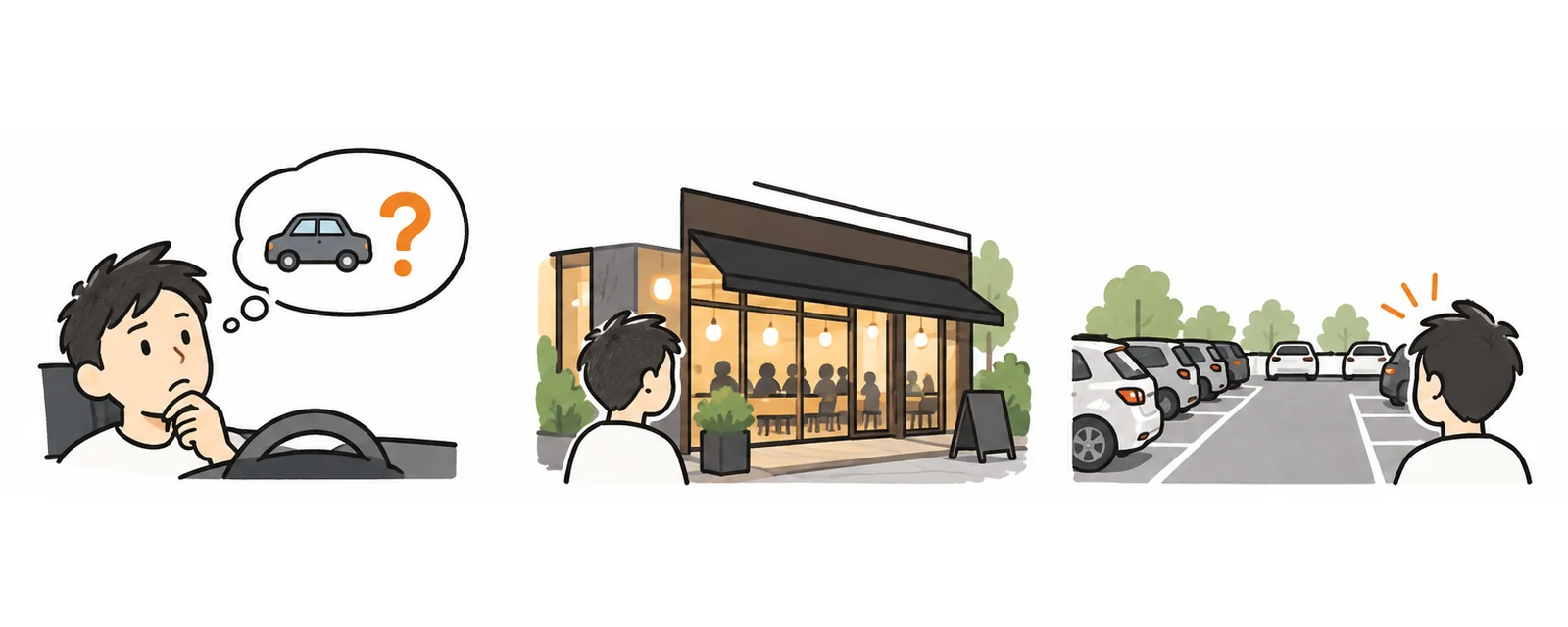
It is Friday night. Someone likes your menu, sends your location to the group, starts the car and then hears one question: “Parking there easy or not?”
Sometimes that question changes the restaurant. Sometimes people circle for 15 minutes and still go in because they really want the food. Research supports both behaviours.
Short answer: parking can materially reduce restaurant visits when customers need to drive and parking adds enough cost, search time or uncertainty. But there is no universal “bad parking loses X% of customers” rule. The effect depends on the occasion, alternatives, transport options and how badly the customer wants that restaurant.
Can we put a number on the parking effect?
We can put numbers on some parking changes. We cannot turn them into one universal parking percentage.
A 2026 Chicago working paper used high-frequency geolocation data around a parking-fee increase. Visits to restaurants without dedicated customer parking fell 6.6%. The loss came from fewer driver visits. Some customers switched to public transport, but not enough to replace all of the lost visits.1
An older quasi-experiment in Southern California found a much bigger local effect. When parking meters charged US$0.50 per hour during periods when spaces were still available, customer entries at two Starbucks locations fell by roughly 25% to 30%.2
Then the same study found something useful: when parking was already full later in the day, changing the fee had little effect on customer traffic.
Same business. Same street. Different parking conditions. Very different result.
That is why 6.6% and 25–30% should not be averaged. They measured different changes in different places under different conditions.
Parking is not one variable
Restaurant owners often ask one question: “Do we have enough parking?”
Customers experience something much messier.
- Will I find a space?
- How long will I need to circle?
- How much will it cost?
- How far do I need to walk?
- Is the entrance obvious?
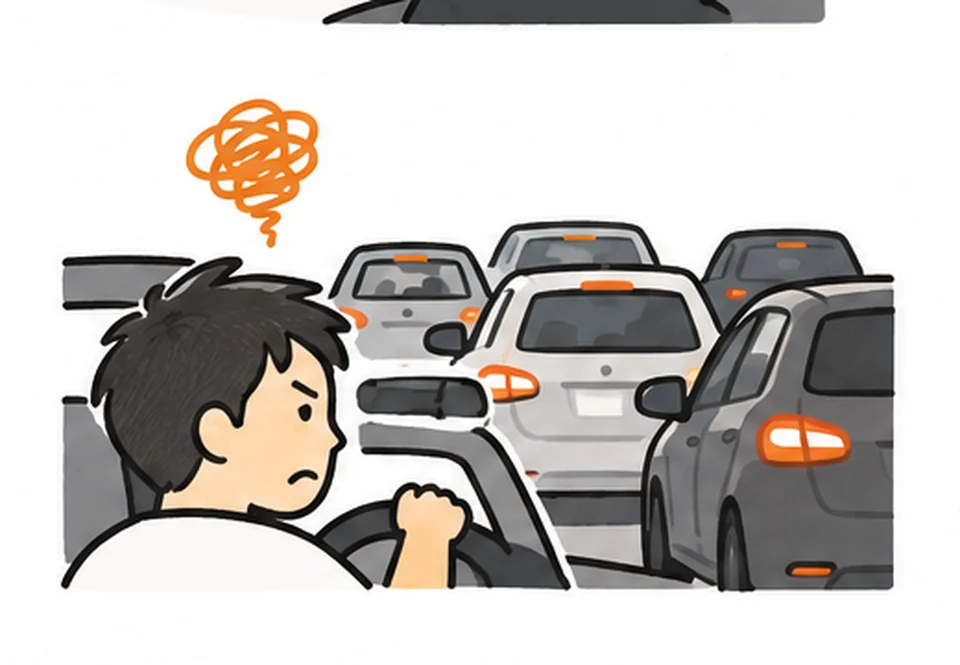
- Will I get stuck in traffic trying to enter or leave?
- Is parking easy at 3pm but impossible at 8pm?
A restaurant can technically have plenty of parking nearby and still feel difficult to visit.
Imagine Restaurant A has 50 spaces, but the basement entrance is hidden, Google Maps sends drivers to the wrong side and everyone expects the first lot to be full. Restaurant B has 25 spaces, but customers know exactly where to go and usually park within two minutes.
The raw parking count says A is better. The customer experience may say B.
The fear of parking can matter before the customer arrives
A stated-choice experiment with 397 drivers found that expected parking availability mattered strongly. The probability of finding a space after eight minutes of searching ranked as the second-most-important factor in the parking decision.3
That makes one familiar sentence much more interesting:
“Don't go there tonight. Parking impossible.”
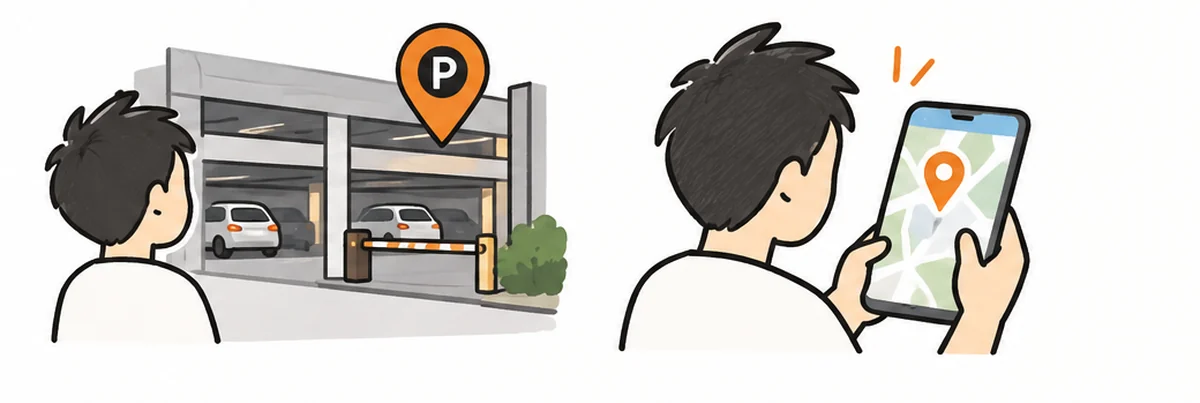
The restaurant may actually have spaces nearby. But if customers expect trouble, some of them may reject the trip before they leave home.
Restaurant-area research in Brisbane has also found a gap between what people believe about parking and what researchers observe on the ground. That does not prove that better parking instructions will automatically increase sales. It does show why parking supply and parking perception should be treated as different problems.
When does parking become a deal-breaker?
Research does not give us a magic threshold such as “seven minutes of searching makes 40% of diners leave.” That number does not exist.
Parking is more likely to change the decision when the customer is committed to driving, expects a difficult search, has several acceptable restaurant alternatives and does not want your restaurant badly enough to tolerate the hassle.
This is why parking can behave like a veto rather than a normal preference.
You slightly prefer Restaurant A. Restaurant B is almost as good. A is known for terrible parking. B is easy.
The decision may not become a careful scorecard. It can simply become:
“Don't want lah. Parking there very hard. Go B.”
A Malaysian restaurant-choice study gives a useful clue about occasions. Among 539 respondents, location mattered more for a quick meal than for social, business or celebration occasions.4 The study did not isolate parking, so this is not proof that lunch diners are more parking-sensitive. But it fits the idea that convenience friction has less room to be tolerated when the meal itself is convenience-driven.
People also tolerate terrible parking
If parking difficulty always killed demand, some famous city restaurants would be empty.
A 2024 review of 111 restaurant studies identified food, service, atmosphere and price/value as the established core categories in restaurant choice and experience, with food appearing most important overall.5
Parking competes with those reasons.
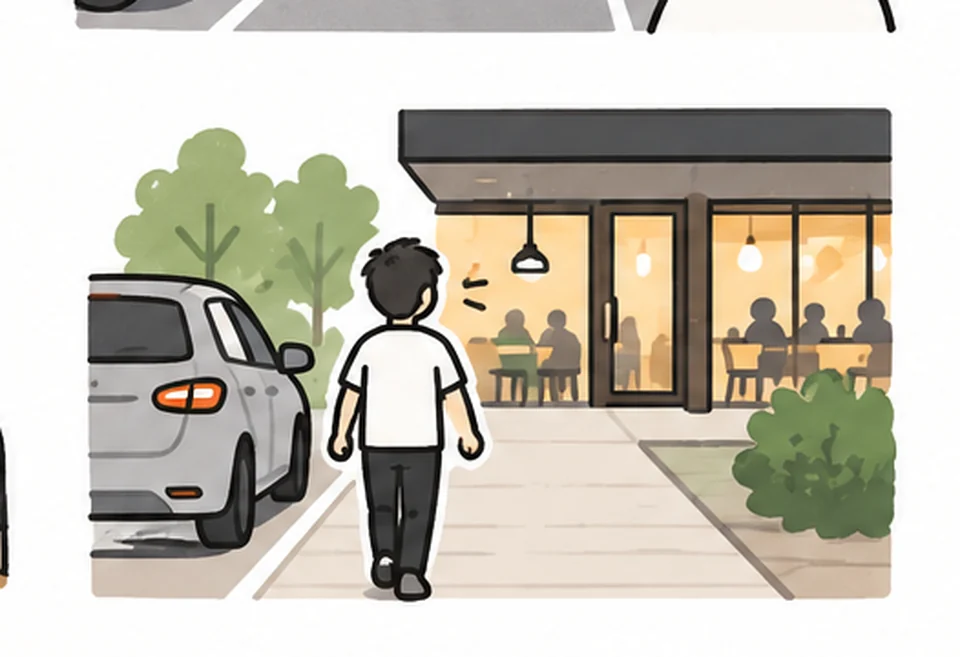
If you are choosing between two similar cafés for lunch, easy parking can break the tie. If one restaurant sells the exact dish you crossed town to eat, you may circle, walk and complain the whole way in, then still eat there.
So bad parking does not automatically mean a lost customer. It raises the amount of motivation the restaurant needs to overcome.
And less parking does not always hurt business
Researchers studying pedestrianisation across 14 Spanish cities found higher retail sales in pedestrianised areas, with positive effects concentrated particularly in cafés and restaurants.6
Toronto provides another useful counterexample. In 2016, 136 on-street parking spaces were removed from a section of Bloor Street for a bike lane. A case-control, pre/post study found no negative local economic effect; monthly customer spending and customers served increased during the pilot.7
Neither study proves that removing parking helps every restaurant. Pedestrianisation and bike lanes change the whole street environment. Nearby parking and other transport options also matter.
They do show why “fewer parking spaces = fewer customers” is too simple.
What does the evidence say for Malaysia?
The Malaysia-specific evidence is useful, but still thin.
A 2025 study in Ipoh asked diners to rate restaurant-selection factors on a five-point importance scale. Parking space scored 3.80. Accessibility scored 4.03, price affordability 4.11, hygiene 4.15, and menu/cuisine variety 4.24.8
So parking mattered in that sample. It did not dominate the decision.
The study also has reporting and sampling limitations, so those scores should not be treated as a national Malaysian ranking.
For Kuala Lumpur and Selangor, the safest conclusion is even narrower. A shoplot restaurant in a car-dependent commercial area is not the same transport environment as an inner-city restaurant beside rail and heavy foot traffic. We should not take a Brisbane or Toronto result and pretend it is a Klang Valley effect size.
What we can reasonably carry across markets is the mechanism: customers react to the total friction of reaching the restaurant, and the available alternatives determine how much that friction matters.
For restaurant owners, there are four different parking problems
| Problem | What is actually happening | What to investigate |
|---|---|---|
| Supply | There genuinely are not enough spaces when customers arrive. | Peak-hour occupancy, overflow lots, nearby alternatives. |
| Perception | Parking exists, but customers expect it to be impossible. | Directions, entrance visibility, old reputation, Maps information. |
| Friction | Spaces exist, but searching, paying, entering, exiting or walking is annoying. | Search time, fee, access route, payment, walk and traffic. |
| Timing | Parking works most of the day and collapses during a specific period. | Friday dinner, lunch peak, nearby events, office changeover. |
This distinction changes the solution.
If the problem is perception, showing the exact entrance and two nearby alternatives may help. If the problem is the parking fee, validation may remove a real cost. If Friday at 8pm is the only failure point, a promotion that pushes even more customers into that hour may make the experience worse.
Valet, nearby-lot partnerships, ride-hailing information and pickup zones all have plausible mechanisms. But the research does not give us a universal ROI for any of them.
The useful first step is less exciting: find out which parking problem you actually have.
Quick questions restaurant owners ask
Does parking affect restaurant choice?
Yes, especially when the customer expects to drive. But the size of the effect changes by place, occasion, restaurant desirability and available alternatives.
How much can bad parking reduce restaurant visits?
There is no universal percentage. The strongest direct estimates we found range from a 6.6% restaurant-visit effect in one Chicago parking-fee setting to roughly 25–30% lower customer traffic at two Starbucks locations under a different parking condition. Those results should not be averaged.
Is parking more important than food or price?
Not as a general rule. Restaurant-choice research repeatedly finds food, service, atmosphere and price/value among the main factors. Parking can still become the deciding friction when restaurants are close substitutes.
Does perceived parking difficulty matter?
Yes, parking-choice research supports a role for expected availability and search time. What we cannot yet say is exactly how much restaurant revenue increases when that perception is corrected.
What is the first thing an owner should measure?
Observe the actual customer arrival window. Check occupancy, search time, obvious alternatives and what customers believe about the area. A parking problem at Friday 8pm can disappear completely at Tuesday 3pm.
Research notes & sourcesView sources
Sources and context
- Roy Chowdhury, Rossi & Zhu (2026). The Effect of Parking Fees on Local Businesses: Evidence from Restaurant Visits in Chicago. SSRN working paper. Uses geolocation data and a parking-fee change; reports a 6.6% visit decline for restaurants without dedicated parking.
- Hymel (2014). Do parking fees affect retail sales? Evidence from Starbucks. Economics of Transportation. Regression-discontinuity study; small meter fees reduced customer traffic by roughly 25–30% at two Starbucks locations when parking was not saturated.
- Chaniotakis & Pel (2015). Drivers’ parking location choice under uncertain parking availability and search times: A stated preference experiment. 397 respondents; expected availability after eight minutes ranked second among parking-choice factors.
- Chua et al. (2020). Customer Restaurant Choice: An Empirical Analysis of Restaurant Types and Eating-Out Occasions. Malaysian sample of 539 usable responses; location importance differed by eating-out occasion.
- Zanetta et al. (2024). How does the consumer choose a restaurant? An overview of the determinants of consumer satisfaction. Food Research International. Integrative review of 111 studies and 117 factors.
- Yoshimura et al. (2022). Street pedestrianization in urban districts: Economic impacts in Spanish cities. Cities. Difference-in-differences analysis across 14 Spanish cities; positive sales effects were concentrated particularly in cafés and restaurants.
- Arancibia et al. (2019). Measuring the Local Economic Impacts of Replacing On-Street Parking With Bike Lanes. Journal of the American Planning Association. Toronto case-control and pre/post study after 136 on-street parking spaces were removed.
- Salim, Izmi & Sallehuddin (2025). Beyond the Menu: Unravelling the Factors Behind Restaurant Selections. Malaysian Journal of Sustainable Environment. Ipoh survey; parking space mean importance 3.80 on a five-point scale.
- Yen, Mulley, Burke & Tseng (2020). Parking and restaurant business: Differences in business perceptions and customer travel behaviour in Brisbane. Land Use Policy. Direct restaurant study comparing restaurateur perceptions with customer travel behaviour across three inner-city precincts.
The studies above use different countries, transport systems, restaurant formats and research designs. ORBIT has not combined them into one universal parking effect. Evidence from retail and transport research is used only where the mechanism is relevant to restaurant access, and Malaysia-specific conclusions are kept separate from evidence in other markets.
Is parking actually costing your restaurant customers?
ORBIT looks at parking, access, competitors, pricing, reviews and other outside signals together, so you can see which friction is worth fixing before spending more.