Can a Restaurant Menu Have Too Many Choices?
Choice overload, familiar dishes, middle options and what actually makes a menu hard to use.

There is a particular kind of menu that makes me stop reading.
It usually arrives as a thick laminated book. Noodles. Rice. Western. Chicken. Fish. Hot plate. Claypot. Snacks. Vegetables. Thirty drinks. Six versions of fried rice that look almost identical except one has “special” in the name.
By page four, I am no longer comparing dishes properly. I start looking for something I recognise. Then somebody at the table asks, “What you ordering?” and suddenly their answer sounds better than everything I have just spent five minutes reading.
A large menu makes intuitive business sense. More dishes should mean more chances that somebody finds something they like. What that logic leaves out is the work involved in rejecting all the other options.
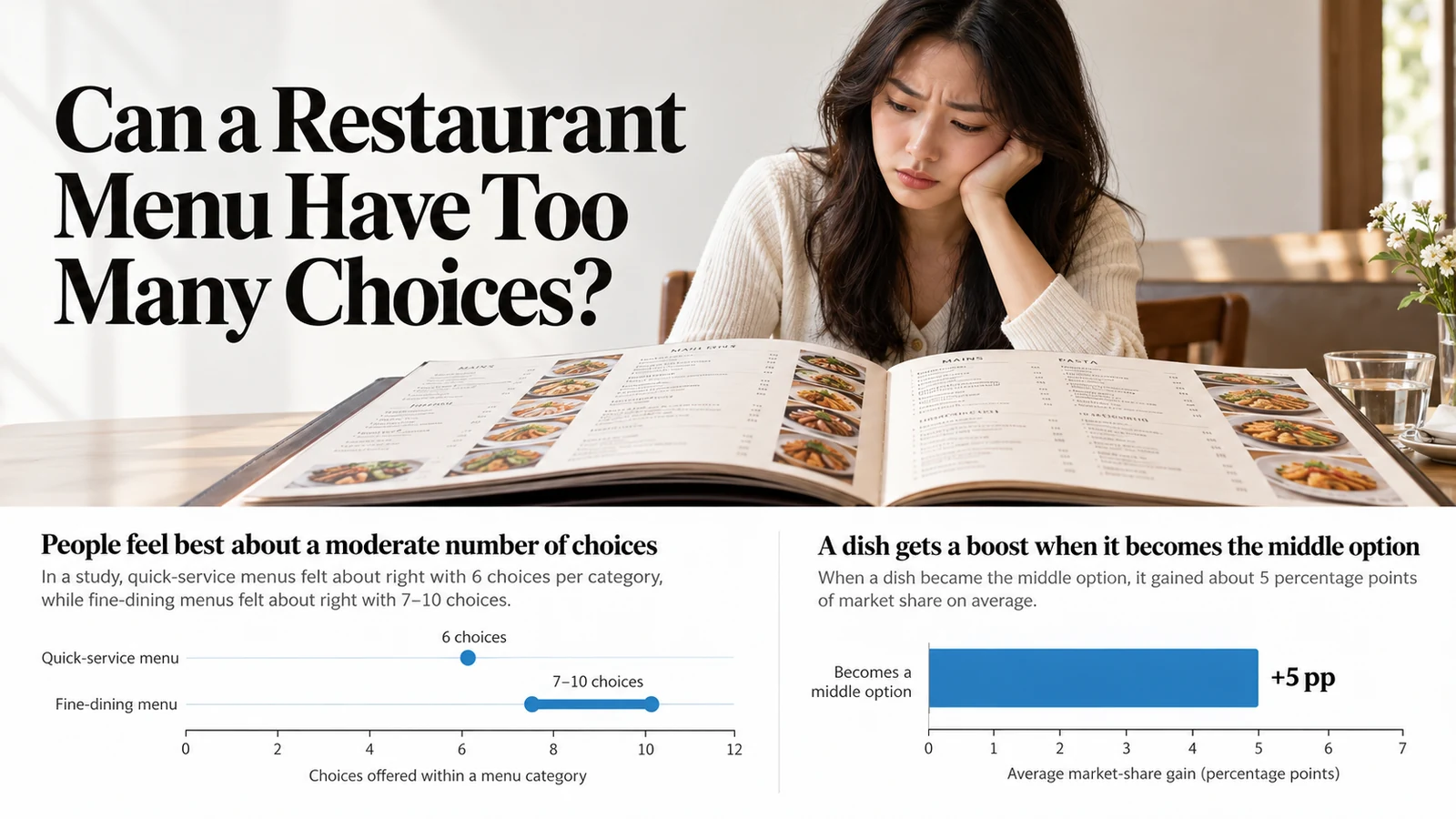
Short answer: yes, a restaurant menu can create too much choice, but the number of dishes alone does not tell you when that happens. Research on choice overload finds that large assortments become more difficult when options are hard to compare, customers are uncertain about what they want, the decision itself is complicated, or people want to minimise effort. Restaurant-specific evidence also shows that format matters: one study found about six choices per category felt appropriate in quick service and roughly seven to ten in fine dining, but that was a perception study, not a universal menu law.
I don't think the problem is simply the length of the menu
Imagine a menu with forty dishes. They are separated into categories you immediately understand: noodles, rice, chicken, fish. You already know you want noodles, so most of the menu disappears before you compare anything seriously.
Now imagine a menu with twelve dishes. Every name is unfamiliar. The descriptions are vague, three dishes cost almost the same, and you cannot tell which one is spicy or meant for sharing. The second menu is shorter, but I would expect it to feel harder.
A major meta-analysis helps explain why. Chernev, Böckenholt and Goodman reviewed 99 observations involving 7,202 participants. More options did not automatically produce overload. The effect became more likely when the choice set was complex, the task was difficult, people were uncertain about their preferences, or they were motivated to minimise effort.2
That is much more useful than “large menus are bad.” A regular customer who knows exactly what they want can move through a long menu quickly. Put the same person in a cuisine they have never tried and eight options may require more thought than forty familiar ones.
The internet really wants there to be a perfect number
Restaurant advice often claims customers can only handle seven choices, or five to seven, or seven plus or minus two. It sounds scientific because it gives owners a number to copy.
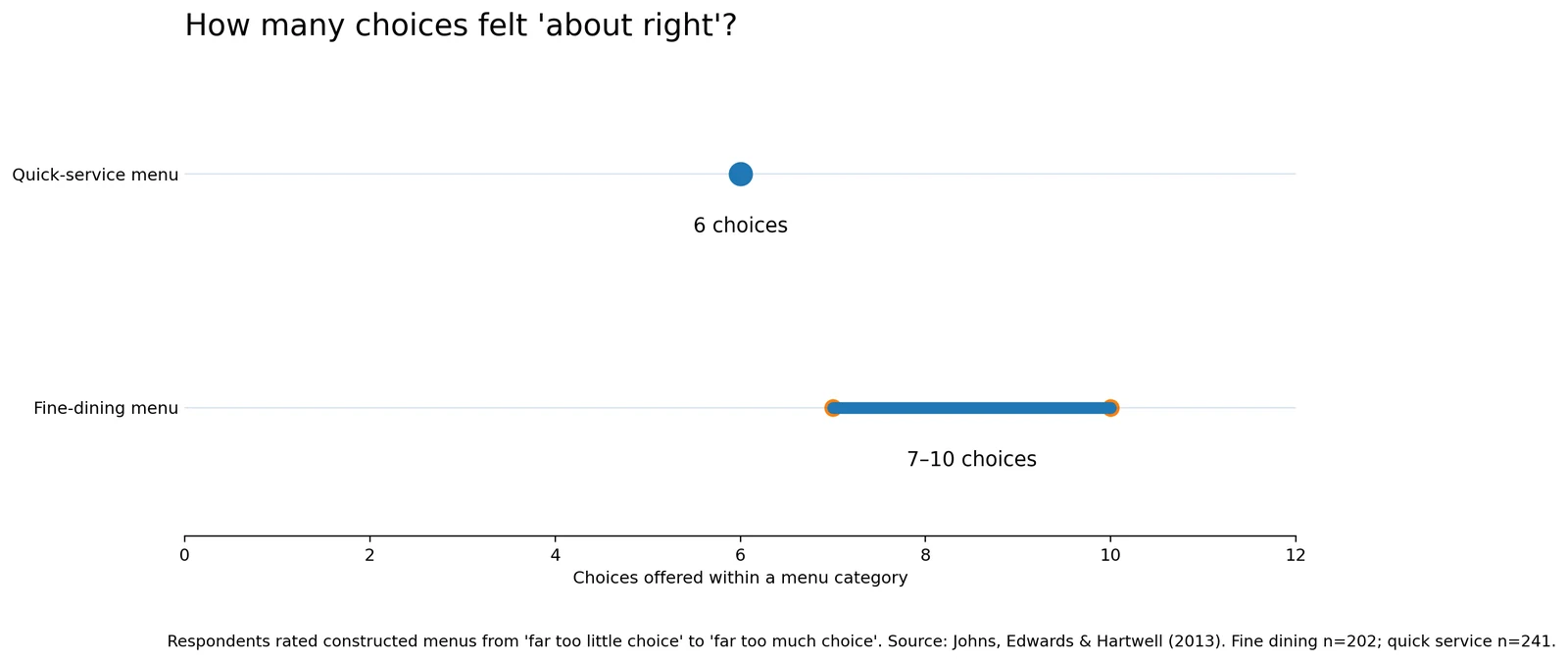
A restaurant-specific study does give us numbers, but not in that way. Nick Johns, John Edwards and Heather Hartwell created sets of quick-service and fine-dining menus that differed in the number of choices under each category. At university open days, 202 people evaluated the fine-dining menus and 241 evaluated the quick-service menus. They rated whether each menu offered too little choice, about the right amount or too much.1
View the study values
| Menu format | Perceived “about right” range | Sample |
|---|---|---|
| Quick service | 6 choices per category | n=241 |
| Fine dining | 7–10 choices per category | n=202 |
The perceived sweet spot was six choices per category for quick service and about seven to ten for fine dining. That is interesting. It is not a commandment. Participants were judging constructed menus, not spending real money in hundreds of restaurants, and the two formats produced different answers anyway.
“Never put more than seven dishes on a menu” collapses all of that into a rule the study never established.
More choice can help right up until comparison becomes the hard part
Restaurants add dishes for good reasons. Customers have different tastes, budgets, dietary restrictions and reasons for eating out. A group containing a vegetarian, a picky child and somebody who wants steak may genuinely benefit from breadth.
The modern choice-overload literature does not argue that variety itself is bad. The harder question is when the extra option adds less value than the extra work required to compare it.2
A diner who knows “I want beef noodles” has already done most of the filtering. A diner thinking “I don't know what this restaurant is famous for and everything looks unfamiliar” has not. The second person needs the menu to do more work.
A bar experiment shows how information can rescue a large choice set
One of the more useful choice-overload studies happened in a real bar. Trey Malone and Jayson Lusk manipulated the number of craft beers on a menu and also changed the decision aids customers received. One version was a basic menu, another highlighted a special, and another added Beer Advocate scores.5
With the control menu, the researchers found evidence of an excessive-choice effect. When the menu included useful ratings, the pattern changed enough that the effect reversed. Their interpretation was that reducing search cost, the effort required to work out what to buy, can change how a large assortment behaves.5
Twenty-five unfamiliar beers remain twenty-five options. But twenty-five options organised with information that helps you eliminate twenty of them is a different decision.
Customers do not read menus like spreadsheets
A menu might contain fifty items, but customers do not give each item equal attention. They scan, pause, return to something, skip whole sections, compare two dishes and eventually stop searching.
An eye-tracking study with 180 consumers compared three restaurant menu formats on a tablet: a basic menu, a descriptive menu and a menu containing additional nutrition-infographic information. In the basic and descriptive conditions, longer visual fixation on a dish was associated with a greater probability that the dish was eventually chosen.6
That does not prove that making somebody stare at a dish will cause them to order it. Preference can drive attention as well as the other way around. What the study makes visible is the process: customers encounter the menu selectively.
Menu structure therefore changes which comparisons are easy to make, even before we start arguing about boxes, photographs or typography.
When diners are rushed, they deliberately process less
Now put the menu in front of somebody at 12.45pm who needs to be back in the office at 1.30.
An experiment on food decision-making under time pressure found that participants accumulated less product information, spent less time encoding information and made decisions more quickly when time was constrained. The faster process did not necessarily make their choices less internally consistent. People adapted by using less information.4
A menu that feels enjoyable on Saturday night can therefore become irritating during weekday lunch. The customer has not suddenly become less interested in food; the value of their attention changed.
The dishes around an option can change the option itself
Suppose a menu has steaks at RM38, RM52 and RM68. Now the restaurant adds an RM88 steak.
The RM68 steak did not change. Same recipe, same price. Psychologically, though, it moved. It used to sit at the expensive end. Now it is an intermediate option.
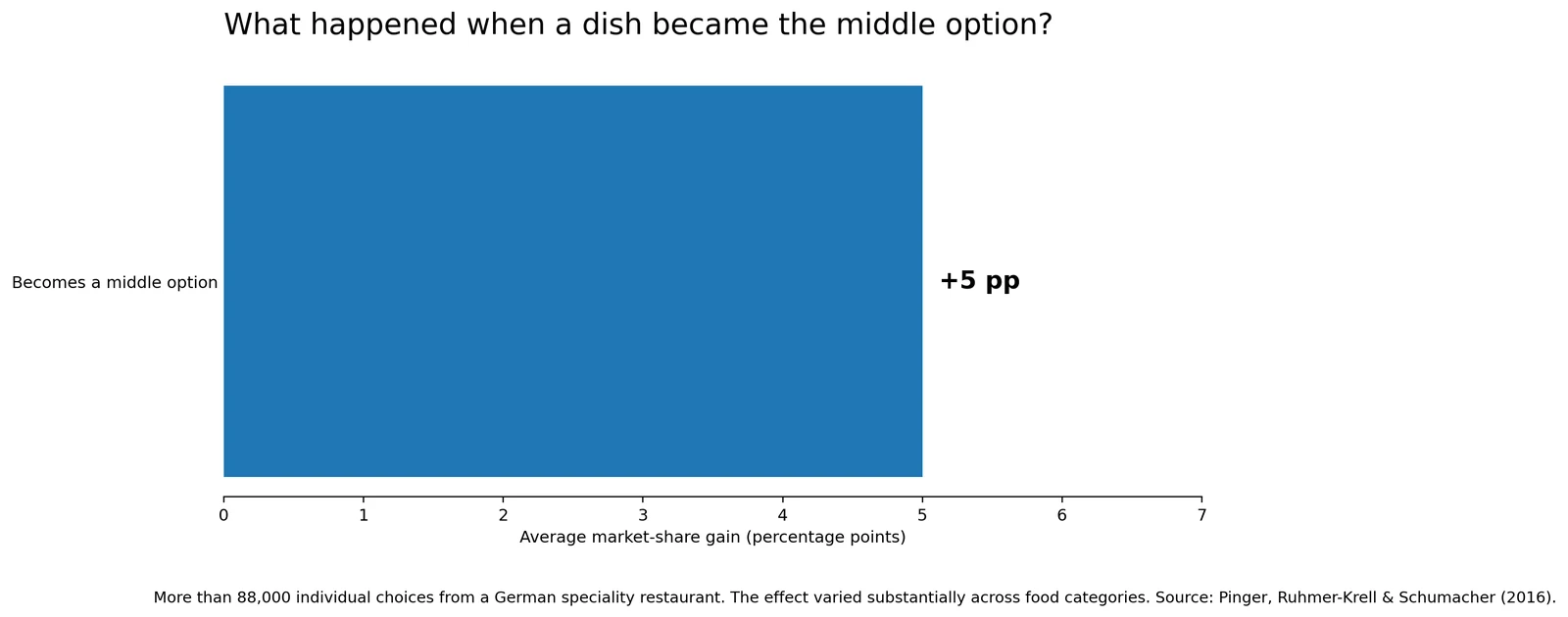
Pia Pinger, Isabel Ruhmer-Krell and Heiner Schumacher studied this using cashier data from a German speciality restaurant over seven years. The dataset contained more than 88,000 individual choices, and menu revisions repeatedly moved dishes between extreme and intermediate positions.3
View the field result
| Observed menu change | Average market-share change | Dataset |
|---|---|---|
| Option becomes a compromise / middle option | +5 percentage points | >88,000 individual choices over seven years |
On average, an option that became a compromise gained about five percentage points of market share. The effect was not equally strong in every category, which is exactly why it should not be turned into “always add an expensive decoy.”3
The more useful point is that customers do not judge menu items in isolation. The surrounding choice set changes the comparison.
Descriptions can reduce uncertainty, but extra words are not automatically useful
Restaurants often respond to uncertainty by adding adjectives. “Premium.” “Hand-crafted.” “Chef-inspired.” Eventually everything sounds as though it has won an award nobody can find.
There is evidence that wording matters. A six-week cafeteria field experiment involving 140 customers found that dishes given more evocative descriptive names were rated as more appealing and tastier than regularly named versions of the same foods.7
More recent work is useful because it asks what the words are doing. A 2024 menu-description study recruited roughly 1,500 participants and used choice-based conjoint analysis. The authors argue that customers use menu wording partly to reduce ordering risk because they cannot inspect or taste the product before deciding.8
“Charcoal-grilled chicken thigh, fermented chilli, garlic rice” gives me information I can use. “An unforgettable celebration of flavours” mainly proves that somebody found the adjective button.
Maybe menu overload is really uncertainty overload
I do not think customers are necessarily frightened by large menus. Malaysians have survived mamak menus that could probably be submitted as novels.
The harder problem is abundance without an easy way to eliminate options. Thirty familiar dishes can be comfortable. Ten unfamiliar dishes can be exhausting. Forty dishes arranged into categories you understand can be manageable. Twelve dishes with vague descriptions and no obvious differences can feel like work.
The meta-analysis points in the same direction: complexity, preference uncertainty, task difficulty and a desire to minimise effort help determine when large assortments become problematic.2
Menu size is easy to count. Decision difficulty is not.
I would not cut a menu until I knew how customers were using it
If I owned a restaurant with eighty dishes, I would not remove fifty because somebody told me about choice overload. I would first want to know which sections customers ignore, where first-time diners ask staff for help, which dishes are often confused with one another and which apparently low-volume items serve a small but important group.
I would also watch how long ordering takes and listen to the questions staff answer repeatedly. “What's the difference between these two?” is menu research happening for free.
A large menu may need pruning. It may instead need a clearer first decision: noodles or rice, light or rich, sharing or individual, familiar or adventurous. One menu can contain several smaller menus if the structure helps customers narrow the field.
The menu should not require somebody to understand the kitchen's internal logic before they can eat.
What the research does not prove
Choice overload became famous because the simple version is extremely shareable: give people too many options and they freeze. The evidence is less tidy. Later reviews found substantial variation, which is why modern research focuses on the conditions under which overload appears rather than treating it as automatic.2
The restaurant-menu study did not find a universal commercial optimum. It measured perceptions of constructed menus.1 The craft-beer field experiment involved beverages in one bar, not a complete dinner.5 The compromise-effect field study is unusually valuable because it uses real orders, but the strength of the effect varied by category.3 The eye-tracking study shows a relationship between attention and choice in specific menu formats, not a simple causal rule.6
There is no scientifically established number of dishes that every restaurant should obey.
The practical question is more annoying, because it cannot be solved by copying a number: how much work does your menu make the customer do?
The problem starts when choosing becomes harder than eating
Menus often become records of everything a restaurant has ever decided not to remove. A new dish works, so it stays. A regular likes an old dish, so that stays. Another category is added because competitors have one. Years of internal decisions eventually land in the customer's hands as one laminated object.
Then the waiter arrives.
“Ready to order?”
You have read forty-seven things. You remember four. The person beside you says, “I'm getting the chicken.”
You close the menu.
“Same.”
Research notes & sourcesView sources
Sources and context
- Johns, N., Edwards, J. S. A., & Hartwell, H. J. (2013). Menu Choice: Satisfaction or Overload? Journal of Culinary Science & Technology, 11(3), 275–285. DOI ↗
- Chernev, A., Böckenholt, U., & Goodman, J. (2015). Choice overload: A conceptual review and meta-analysis. Journal of Consumer Psychology, 25(2), 333–358. DOI ↗
- Pinger, P., Ruhmer-Krell, I., & Schumacher, H. (2016). The compromise effect in action: Lessons from a restaurant's menu. Journal of Economic Behavior & Organization, 128, 14–34. DOI ↗
- Huseynov, S., & Palma, M. A. (2021). Food decision-making under time pressure. Food Quality and Preference, 88, 104072. DOI ↗
- Malone, T., & Lusk, J. L. (2017). The excessive choice effect meets the market: A field experiment on craft beer choice. Journal of Behavioral and Experimental Economics, 67, 8–13. DOI ↗
- Mora, M., Romeo-Arroyo, E., Chaya, C., Gayoso, L., Larrañaga-Ayastuy, E., & Vázquez-Araújo, L. (2023). Eating with the eyes? Tracking food choice in restaurant's menu. Food Quality and Preference, 110, 104956. DOI ↗
- Wansink, B., van Ittersum, K., & Painter, J. E. (2005). How descriptive food names bias sensory perceptions in restaurants. Food Quality and Preference, 16(5), 393–400. DOI ↗
- Behnke, C., Jung, S. (Sangwon), & Bai, Y. (Mabel) (2024). Writing restaurant menu descriptions: The influence of word choice on consumer behavior. International Journal of Hospitality Management, 123, 103923. DOI ↗
The studies above use different methods: constructed-menu ratings, meta-analysis, field purchase data, eye tracking and controlled choice experiments. ORBIT uses them to understand mechanisms, not to claim one universal menu formula.
Your menu is part of the decision.
ORBIT looks at the choices, signals and friction around your restaurant before you decide what to change.