Why Can One Bad Moment Ruin the Memory of a Good Meal?
What diners actually remember, and why the peak-end rule is less simple than it sounds.

A meal can go well for ninety minutes and still leave behind one very specific memory.
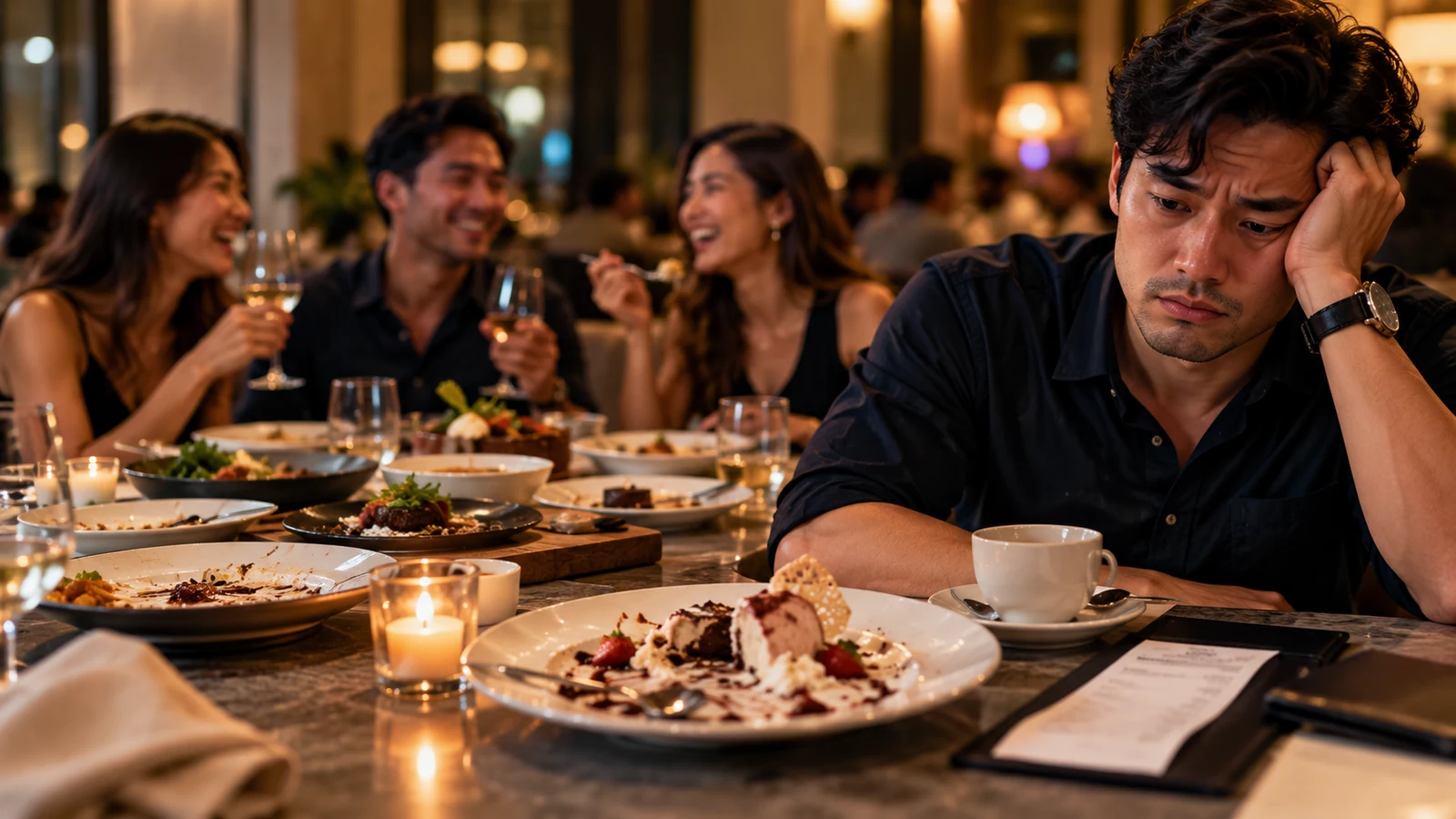
The steak was good. The side dish was better than expected. Everyone at the table had a decent time. Then dessert took thirty-five minutes, arrived half-melted, and the bill took another fifteen. Ask about the dinner the next day and the story may no longer be about the steak.
Restaurants have a familiar piece of advice for this: finish strongly, create a memorable peak, make the last interaction count. Psychology has a famous explanation called the peak-end rule, the idea that memory can overweight an intense moment and the ending rather than averaging every minute equally.
Food research makes that story much less tidy. Some meal studies find peaks and endings matter. Others find almost no peak-end effect at all. One real-world study found something more uncomfortable: the worst eating experience predicted what people later remembered, while the best and final experiences did not.
Short answer: diners do not remember a meal by averaging every moment equally, but there is no universal rule saying the final moment determines the experience. In one real-world study of 2,733 eating occasions, the worst eating occasion predicted remembered eating happiness immediately and four weeks later. A separate 23-course restaurant study found positive peaks and the final dish mattered. Other meal research found little evidence for peak or end effects. Memory is selective, and which moments survive depends on the meal, the person and the context.
The meal you experienced is not exactly the meal you remember
Memory feels like playback, but it is closer to reconstruction. When somebody asks how Friday's dinner was, you do not replay every minute and calculate an average. You rebuild the experience from the pieces that remain available.
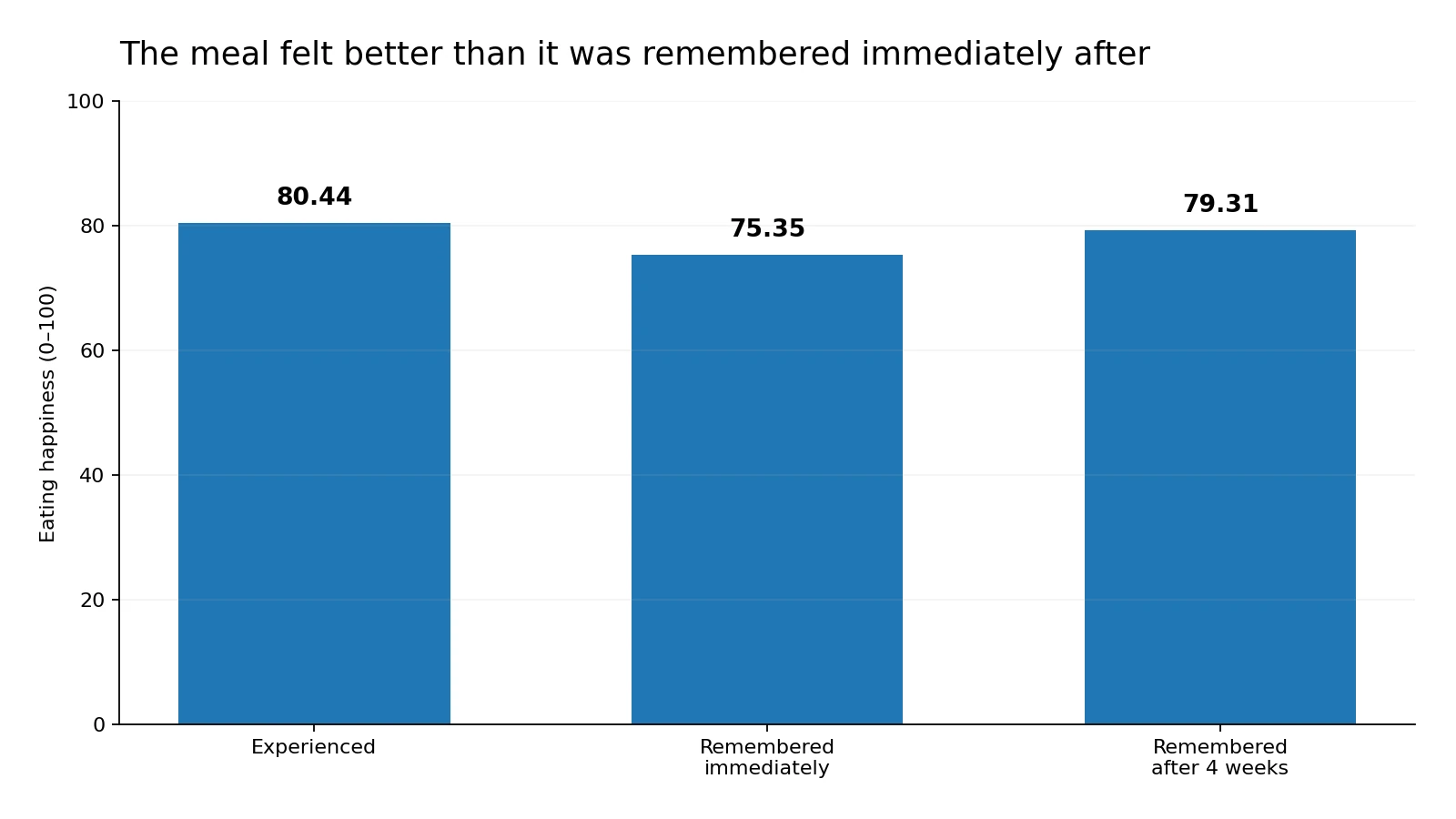
A 2021 PLOS ONE study tested that gap in everyday eating. 103 participants used smartphones to record every eating occasion for eight consecutive days, producing 2,733 real eating occasions. They rated eating happiness in the moment, then rated the same period immediately afterward and again four weeks later.1
View the study values
| Measure | Mean eating happiness |
|---|---|
| Experienced in the moment | 80.44 |
| Remembered immediately after | 75.35 |
| Remembered four weeks later | 79.31 |
The interesting part is not just that memory moved. It is what predicted the memory.
The worst eating occasion mattered more than the best one
The researchers identified each participant's best eating occasion, worst eating occasion and final eating occasion. The best experience sounds like an obvious candidate to dominate memory. It did not. The final one did not either.
The worst eating occasion significantly predicted remembered eating happiness immediately after the study, with a standardized coefficient of β = .41. Four weeks later, it was still significant at β = .39. The best and final eating occasions were not significant predictors in those models.1
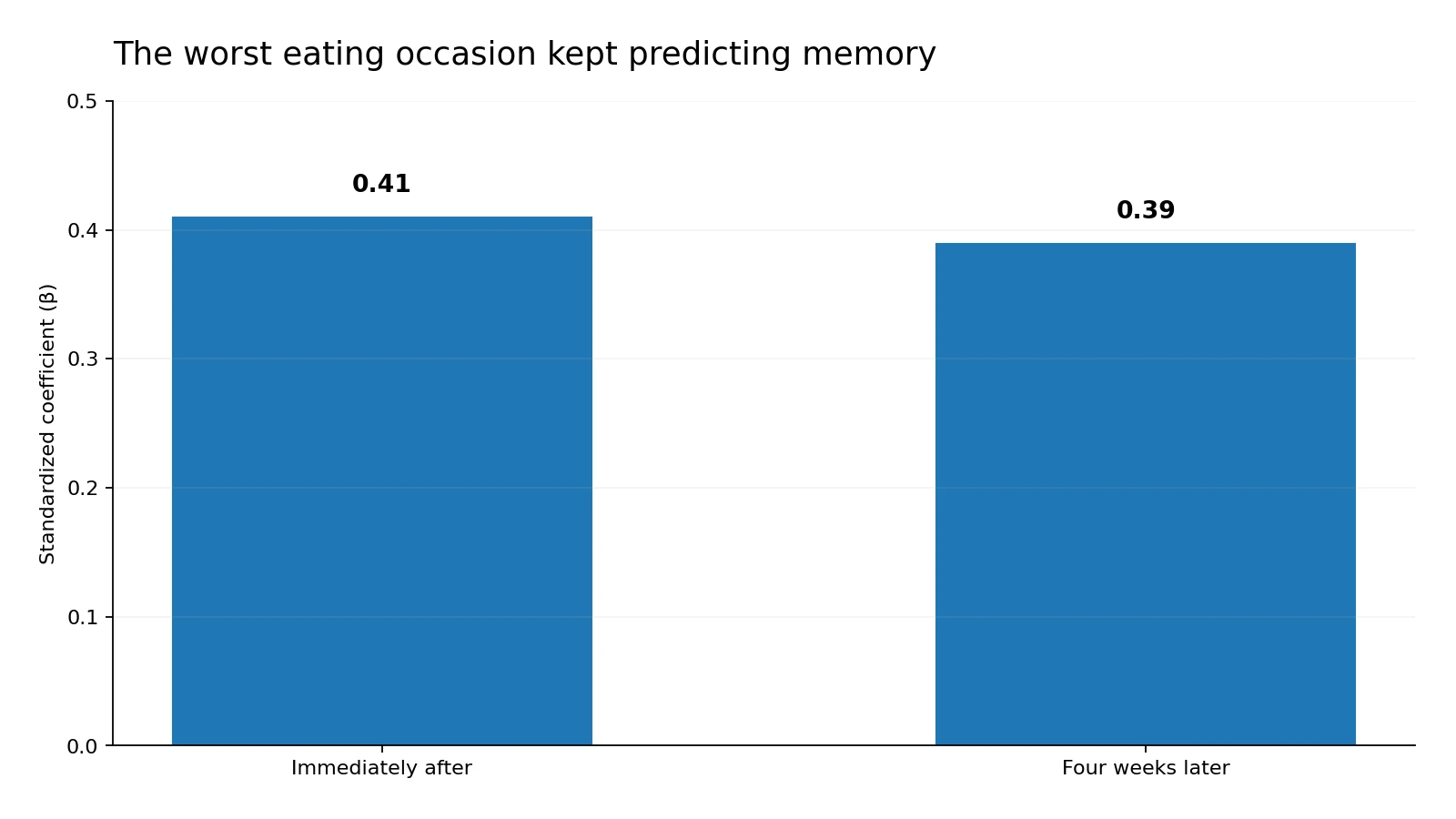
View the regression values
| Recall point | Worst eating occasion | Best eating occasion | Final eating occasion |
|---|---|---|---|
| Immediately after | β = .41, p < .001 | Not significant | Not significant |
| Four weeks later | β = .39, p < .001 | Not significant | Not significant |
This does not mean one bad dish mathematically erases twenty good ones. The study covered eight days of meals and snacks rather than a single restaurant dinner. But it does show that a negative eating experience can remain unusually available when people later summarize what happened.
Then a 23-course restaurant meal produced a different answer
Now change the setting completely. Instead of everyday eating, put people in a top restaurant and serve them twenty-three courses.
Researchers studied 80 guests, seated in groups of four, through a 23-course meal. Diners rated individual dishes and then evaluated the whole meal immediately afterward and again three months later.2
Here the pattern looked much more like the classic peak-end story. Better immediate overall evaluations were predicted by the number of positive peaks in dish-by-dish ratings and by a positive rating of the final dish. Those factors also remained relevant to the evaluation three months later, alongside the number of negative troughs.2
Positive peaks and the final dish predicted the immediate overall evaluation. Peaks, the final dish and negative troughs also mattered to the longer-term evaluation.
Maybe endings matter more when the meal has a clear ending
The difference between those two studies is useful. A 23-course top-gastronomy meal is designed as an event. People are paying attention, courses arrive in a deliberate sequence, and there is an obvious final dish.
A casual dinner is messier. One person finishes first, somebody orders another drink, another person gets takeaway, and the bill may arrive while half the table is still talking. Where exactly does the experience end?
That makes me cautious about advice such as “always end on a high note.” An ending probably has more psychological meaning when the customer experiences the meal as a coherent episode with a clear finish.
An older meal study found almost no peak-end effect
In 2007, Elizabeth Rode, Paul Rozin and Paula Durlach compared experienced and remembered pleasure across three meal studies, including actual meals and an imagined meal. They tested the favourite dish, first dish, final dish, rising or falling liking, and the amount of time spent eating a component.3
They found no consistent evidence for peak, primacy or recency effects. The favourite dish did not reliably dominate memory, and neither did the final dish. There was some weaker evidence that meals improving over time were remembered more positively than meals that declined.3
That result is important because it directly resists the neat version of the peak-end rule. Food memories do not obey one simple formula.
More of the best dish may not buy much more memory
The same 2007 work produced one of the stranger findings in this area: duration neglect. Increasing the duration or exposure to a favourite component had surprisingly little effect on how the meal was remembered.3
That creates a useful distinction for restaurants. More food can change value, fullness and satisfaction, but memory may not simply add up every extra second of pleasure. A small excellent component can leave a large footprint without needing to become a huge portion.
There is still evidence that a good ending can help
Another experiment found an end effect, but only for some people. In a 2011 study, 104 participants ate the same yoghurt. Half experienced a more pleasant ending, while the control group had a blander ending. Among participants low in dietary restraint, the pleasant-ending group later remembered the yoghurt as more enjoyable even though their online enjoyment during eating was similar.4
A second study in the same paper gave 46 participants a five-item lunch. For low-restrained eaters, remembered enjoyment was predicted by the most liked item. Neither pattern appeared in the high-restraint group.4
So endings and peaks can matter. They just do not matter equally for everybody or every kind of meal.
Service adds another memory layer that food studies do not capture
A restaurant meal includes arrival, seating, ordering, waiting, staff interaction, payment and departure. The food can be remembered one way while the service creates its own peak or trough.
A 2024 field study of 5,497 hotel stays found that first impressions, peak impressions and final interactions with frontline staff all significantly influenced satisfaction with the overall service experience. First impressions were particularly important, and became more influential as the delay before evaluation increased.5
A hotel is not a restaurant, so this is service evidence rather than restaurant evidence. But it is a useful reminder that a dining memory can be shaped by somebody solving a problem, somebody ignoring a table, or an awkward final payment interaction even when the food itself was good.
A spectacular moment is not insurance
Restaurants understandably try to manufacture memorable peaks: tableside flame, dramatic desserts, giant cheese pulls, birthday songs, dry ice. Those moments can work, and the 23-course study gives us some reason to take positive peaks seriously.
What the research does not justify is treating one “wow” moment as protection against everything else. In the everyday-eating study, the best eating occasion did not significantly predict later memory while the worst one did.1
The restaurant does not get to assume the peak automatically wins.
The quiet failures may be more dangerous than the spectacular successes
Think about the parts of a restaurant experience that rarely appear in marketing photographs: the table was sticky, one dish arrived twenty minutes after everyone else finished, a request had to be repeated twice, or the customer had to stand at the counter to find somebody willing to take payment.
None of those moments is interesting enough for Instagram. They are exactly the kind of detail that can become the story someone tells later. The restaurant may remember serving nine dishes correctly. The guest remembers the one person who sat without food.
Memory changes with time too
The 2021 diary study produced another result that makes the subject less tidy. Immediately after the eight-day period, participants remembered their eating happiness as lower than they had rated it in the moment. Four weeks later, the average delayed-memory score had moved back up and was no longer significantly different from the original in-the-moment average.1
Yet the worst eating occasion still predicted delayed memory. The average memory changed, while a particular negative feature remained influential. Memory is not frozen when the customer leaves the restaurant.
The people at the table become part of the meal memory
The 23-course study found high consistency in dish ratings among guests seated together in groups of four. The researchers interpreted that pattern as evidence that commensality, the social act of eating together, was relevant to the experience.2
That complicates restaurant memory further. If a table is having a brilliant night socially, the food enters one emotional context. If two people are arguing, the same dish enters another. Restaurants cannot control most of that, but it helps explain why identical food can produce different memories.
I would look for sharp drops before trying to create bigger peaks
If I were diagnosing a restaurant, I would not start with “What memorable moment should we create?” I would first look for the places where the experience suddenly gets worse.
When does frustration spike? Which complaints make customers feel forgotten rather than merely dissatisfied? Does service slow at the exact point people are trying to leave? Are there dishes that consistently disappoint after a run of stronger courses? Which failures appear in reviews with unusually emotional language?
Those questions are less glamorous than designing another theatrical dessert, but the evidence gives them a stronger foundation. Low-frequency, high-emotion failures can be rare enough to barely move the average while still becoming the defining memory for the person who experienced them.
What the research does not prove
The 2021 study did not examine one restaurant meal. Participants logged meals and snacks across eight days, and the sample was predominantly female university students. Its finding that the worst eating occasion predicted recall should not be turned into a universal restaurant coefficient.1
The 2018 restaurant study involved only 80 guests and an unusual 23-course top-gastronomy meal. That is very different from a normal casual dinner.2 The 2007 meal studies found duration neglect but little evidence for the classic peak-end pattern, which directly shows the effect is not consistently reproduced across food experiences.3
The 2011 experiments suggest peak and end effects can occur, but they also differed according to participants' dietary restraint.4 The 2024 service study involved hotel stays, not restaurants, and should be treated as adjacent service evidence rather than restaurant-specific proof.5
There is no research-backed formula saying that fixing the last five minutes makes customers remember the entire meal positively.
A restaurant is eventually remembered as a much smaller thing
A long dinner contains hundreds of moments: walking in, finding the table, reading the menu, waiting, the first bite, somebody laughing, a dish you barely noticed, another dish everyone talked about, dessert, the bill and the walk back to the car.
Most of it disappears. What survives can carry far more weight than its duration suggests.
The useful lesson is not to manufacture one perfect moment. It is to be careful which moment becomes the story.
Research notes & sourcesView sources
Sources and context
- Villinger, K., Wahl, D. R., Schupp, H. T., & Renner, B. (2021). Memorable meals: The memory-experience gap in day-to-day experiences. PLOS ONE, 16(3), e0249190. 103 participants recorded 2,733 eating occasions across eight days. DOI ↗
- Muñoz, F., Hildebrandt, A., Schacht, A., Stürmer, B., Bröcker, F., Martín-Loeches, M., & Sommer, W. (2018). What makes the hedonic experience of a meal in a top restaurant special and retrievable in the long term? Appetite, 125, 454–465. 80 guests consumed a 23-course meal and were evaluated immediately and three months later. DOI ↗
- Rode, E., Rozin, P., & Durlach, P. (2007). Experienced and remembered pleasure for meals: Duration neglect but minimal peak, end (recency) or primacy effects. Appetite, 49(1), 18–29. DOI ↗
- Robinson, E., Blissett, J., & Higgs, S. (2011). Peak and end effects on remembered enjoyment of eating in low and high restrained eaters. Appetite, 57(1), 207–212. Study 1 involved 104 participants; Study 2 involved 46. DOI ↗
- McCullough, H., Padgett, D., Han, S., Lee, K., Martin, D. S., & Bourdeau, B. L. (2024). First impressions vs. The Peak-End Rule: Episodic evaluations in a service experience and the moderating effect of retrospective delay. Journal of Business Research, 185, 114899. Field data covered 5,497 hotel stays over five years. DOI ↗
Memory research in eating is mixed. ORBIT treats peak effects, end effects, negative peaks, duration neglect and service-sequence effects as context-dependent mechanisms rather than one universal rule.
Understand which moments customers carry with them.
ORBIT looks beyond averages to find the moments, friction and outside signals that can shape how customers remember and choose your restaurant.