Five Guys’ 2026 BOGO Drew Huge Crowds. Then the Restaurants Ran Out.
A real 40th-anniversary deal, documented stockouts and ordering problems, and a four-day second chance.

A free burger sounds like a simple reason to celebrate. But giving away a second burger still requires someone to cook it, wrap it and hand it to a customer.
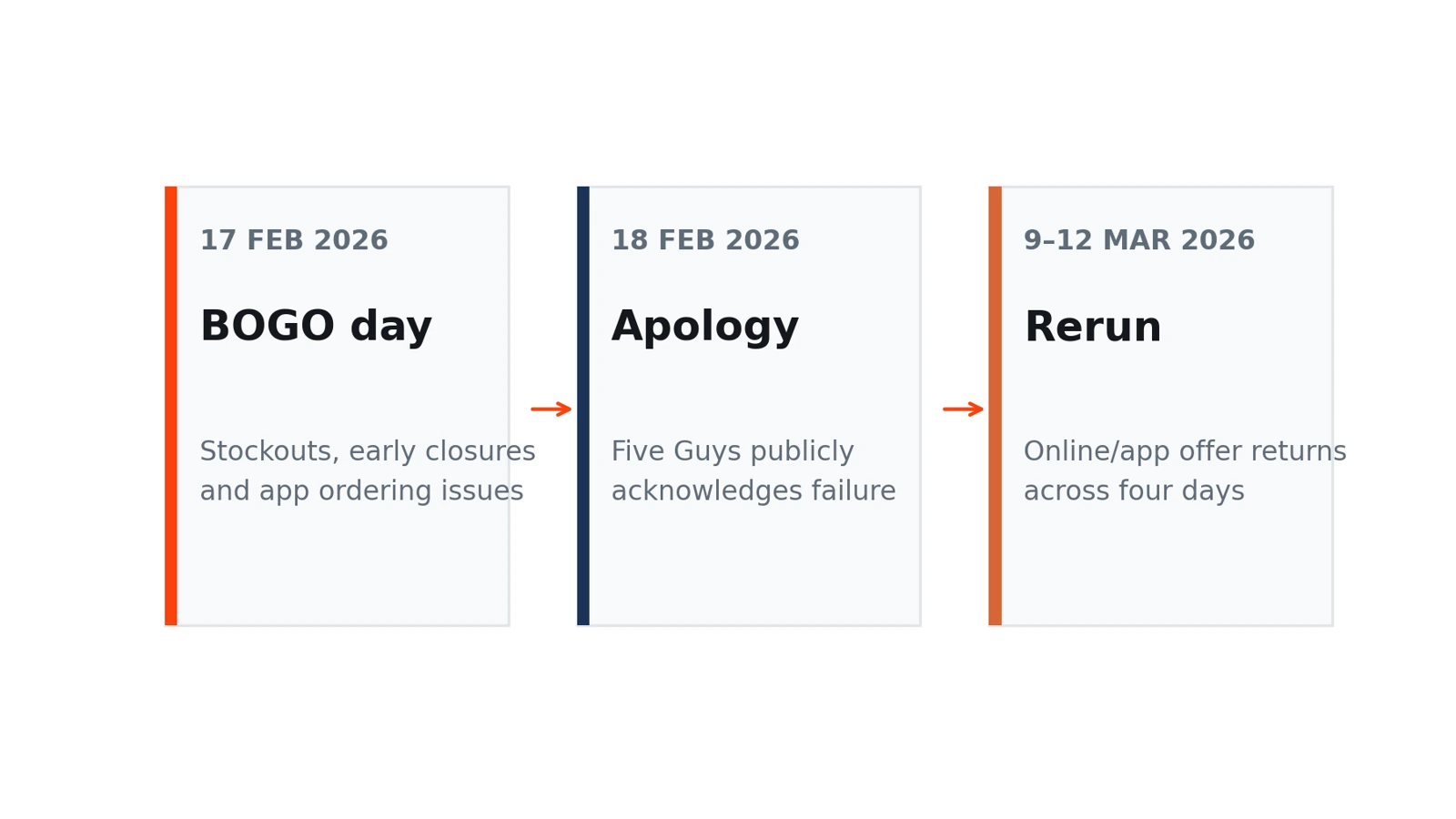
On 17 February 2026, Five Guys launched a birthday BOGO promotion. The response was larger than expected. Some restaurants ran out of supplies or closed early, and customers had trouble ordering online. Three weeks later, the brand offered a do-over. That sequence gives us a rare, openly acknowledged restaurant-promotion capacity failure.
What it does not give us is a financial result. The most important part of this story is how a powerful offer collided with the practical limits of restaurants that still had to make every burger.
Short answer: Five Guys confirmed that its 17 February 2026 BOGO promotion caused stockouts, early closures and ordering problems at some locations. It apologised on 18 February and ran a revised offer on 9–12 March. That proves the promotion exceeded operational expectations, not that it lost money.
What happened to Five Guys on 17 February 2026?
The offer was wonderfully uncomplicated: for its 40th birthday, Five Guys invited customers to buy a burger and receive another free. It should have been one of those pleasing anniversary moments where the restaurant thanks its fans, customers enjoy a deal, and everybody goes home full.
Instead, on 17 February 2026, the response exceeded what some restaurants were ready to handle. In a statement published the next day, Five Guys said that some locations ran out of products and closed early. It also acknowledged sporadic problems with online and app ordering that prevented some customers from redeeming the deal. Those are the company's own descriptions, not estimates based on viral queue photographs. Read Five Guys’ 18 February statement.
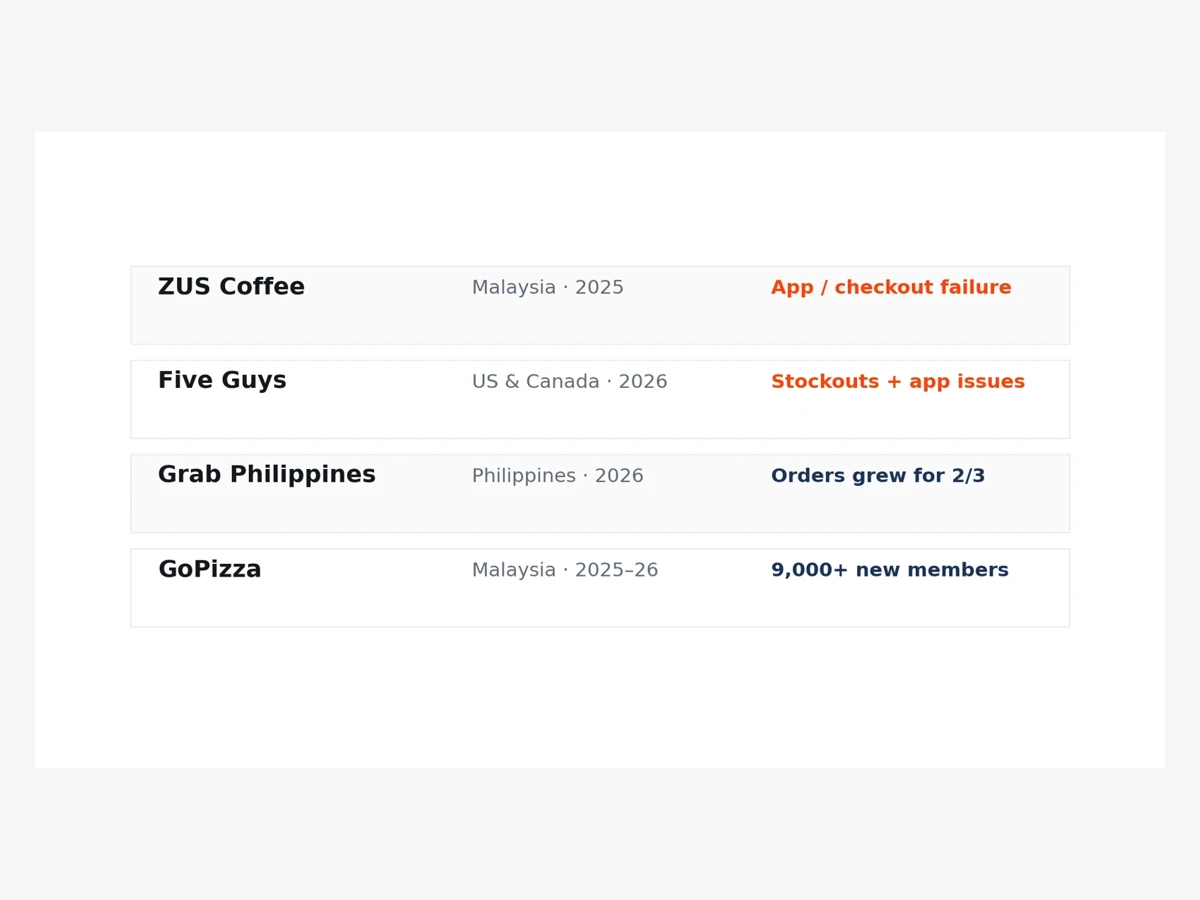
Notice the two things that went wrong: the digital order path and the physical ability to prepare burgers. ZUS Coffee's October 2025 promotion had already shown the damage a failing checkout could cause in Malaysia; Five Guys offers a different, broader capacity case. For a restaurant owner, the answer is not merely “buy better servers.” The entire path from demand to finished order must work. See the separate ZUS Coffee investigation.
Exactly what was the BOGO promotion?
BOGO means buy one, get one. The 17 February birthday offer concerned burgers. The follow-up announced for 9–12 March 2026 was more specific: purchase any burger at the normal menu price and receive one free burger of equal or lesser value, using the code FGAFTERPARTY. There was a limit of one redemption per reward code. The rerun was available through the Five Guys website or app at participating locations in the United States and Canada, not for in-store ordering. Official offer terms.
Those details matter commercially. BOGO is not automatically two identical burgers. Basket value, eligible items, where customers redeem and whether the voucher can be reused all change the economics and the operational load. The exact cost per redeemed order cannot be inferred from the publicly available offer terms alone.
The clever part of BOGO is that the customer immediately understands the appeal without calculating a percentage. The difficult part is that a single paid transaction may generate the production work of two burgers. At scale, even before accounting for fries and drinks, that can change kitchen throughput substantially.
Why a promotion can outgrow its restaurant
It helps to imagine an ordinary Saturday rush. The kitchen is staffed to prepare a predictable stream of burgers. Now a national BOGO message circulates. More people want to order, and each qualifying purchase can require an additional burger. Demand increases, but the number of grills, staff and fresh ingredients available at a location does not instantly double.
Five Guys explicitly acknowledged stockouts and early closures, alongside online-ordering problems. It did not publish a store-by-store capacity report, so we cannot say exactly which cause contributed most or that every location failed. Still, the distinction between order intake and fulfilment is a real operational finding supported by the incident.
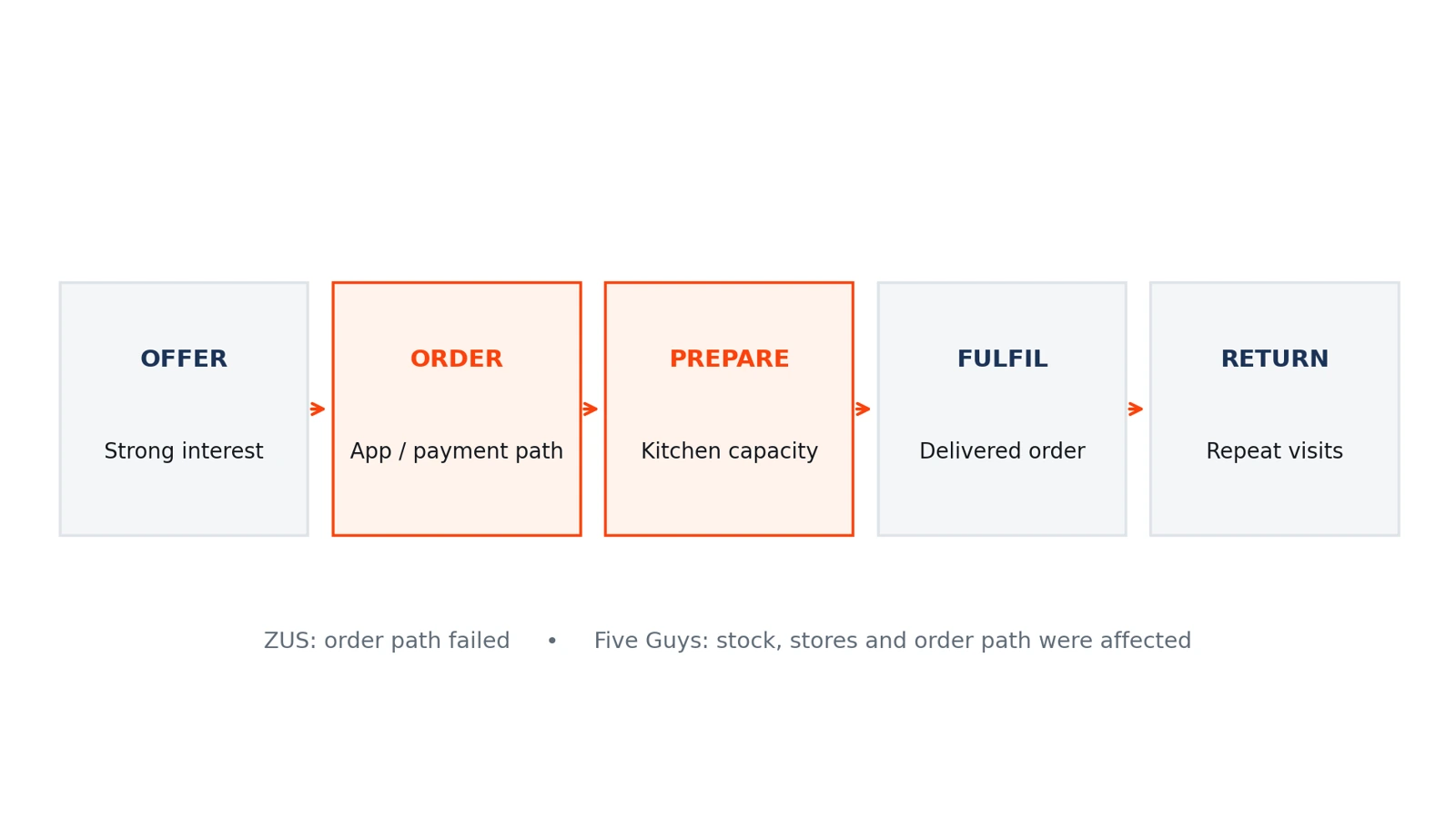
Why does this matter to owners? Because a promotion can appear to be overperforming on awareness while underperforming on completed service. If the checkout works but a kitchen cannot produce the extra food, the bottleneck simply moves further downstream.
The response is a second case study in itself
The morning after the failed promotion, Five Guys said it had let customers down, acknowledged the strain placed on employees, and promised a way to make things right. On 9 March it confirmed the return of BOGO across four days. It also said it would distribute approximately US$1.5 million in bonuses to store employees across its system. The company said crews had replenished supplies and made preparations for the follow-up. Five Guys, March 2026.
It is tempting to call the rerun a redemption success. We cannot. We know the company offered a second chance, explained the revised mechanics, and announced recognition for staff. We do not have a publicly disclosed number of successful March redemptions, a comparison of guest satisfaction, or the campaign's financial returns.
| Measure | Publicly documented | Not disclosed |
|---|---|---|
| Demand | Company said response exceeded expectations | Number of incremental customers |
| Operations | Some closures, product shortages and app issues | Percentage of stores or orders affected |
| Recovery | Four-day rerun and about US$1.5m in announced crew bonuses | Redeemed follow-up orders and satisfaction improvement |
| Money | Offer terms and crew bonus announcement | Sales, gross profit, refunds, cost per acquired customer |
What should a Malaysian F&B operator take from this?
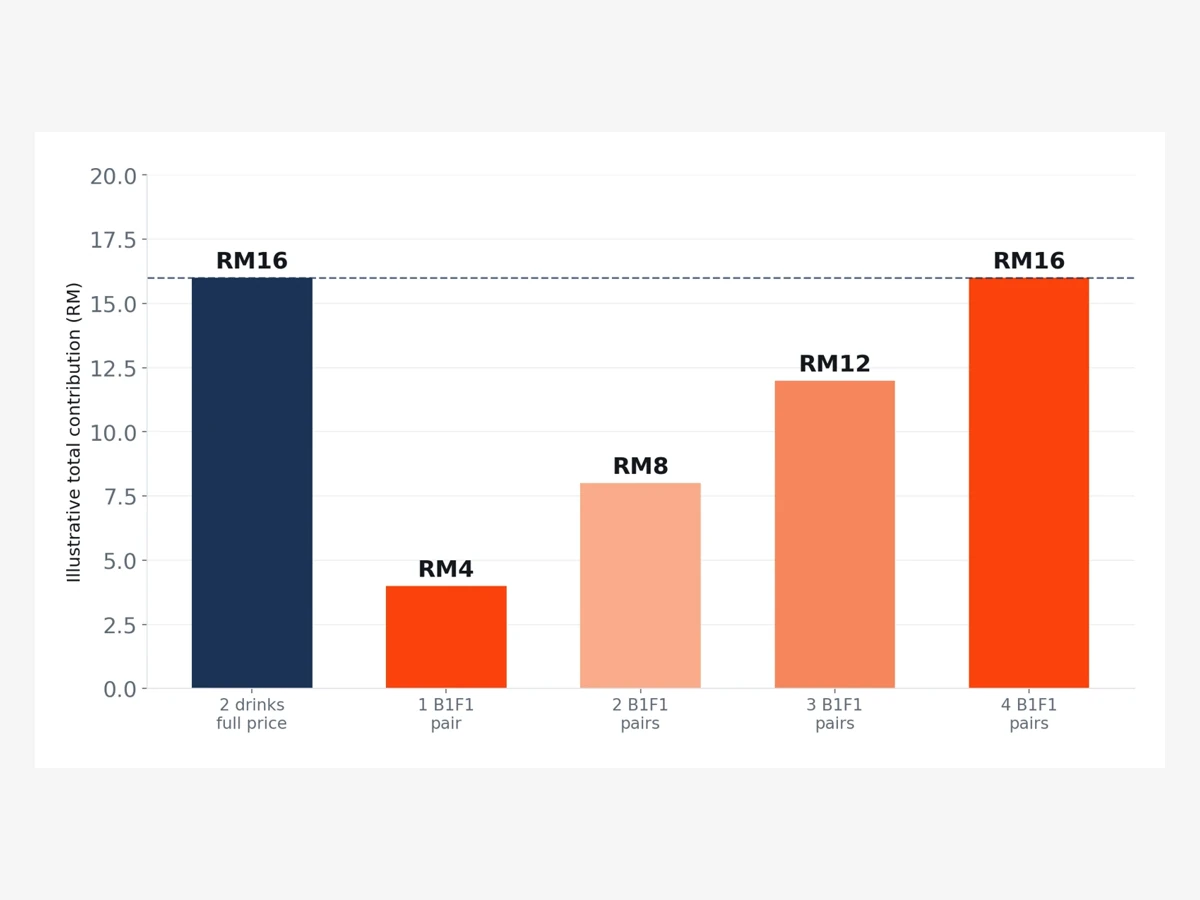
First, plan capacity in items per hour, not only expected transactions. B1F1 on two burgers or drinks can make item volume rise faster than bill count. Work with your kitchen or bar team before announcing the offer and establish the maximum order rate you can fulfil to standard.
Second, make eligibility and redemptions clear. The follow-up Five Guys offer had named dates, digital channels, code usage and participating-market rules. A small operator can similarly decide whether an offer applies at certain outlets, during quiet hours or while capacity remains.
Third, design the recovery before launch. Who will reconcile paid-but-failed transactions? How will customers know if their payment was accepted? Who has authority to issue a replacement offer? If your customers are already angry, improvising these details is expensive in both time and trust.
Finally, distinguish demand from profit. A national campaign that attracted a huge crowd is evidence of appetite for the deal, but not evidence that each additional customer was worth the food, labour and remediation costs. To examine those numbers directly, read our B1F1 profitability analysis.
Questions people ask about Five Guys BOGO
When did the Five Guys BOGO promotion fail?
The original 40th-anniversary offer took place on 17 February 2026. Five Guys published its apology on 18 February 2026.
Why did it fail?
Five Guys said some restaurants ran out of products or closed early and that ordering on its website/app experienced intermittent problems. The company did not publish a technical root-cause analysis assigning a single cause.
Did Five Guys run the BOGO promotion again?
Yes. It offered a four-day “After Party” promotion from 9 to 12 March 2026, for eligible app or website orders in participating US and Canadian locations.
Was the promotion financially unsuccessful?
Publicly available statements do not provide the campaign's profit or loss, so we cannot conclude that.
Sources, method and limitations
This article treats Five Guys' dated company statements as primary evidence for the incidents and its intended response. Company statements provide direct information about what it acknowledged; they are not an independent financial audit. ORBIT did not have internal store throughput, point-of-sale records, profitability or staff schedules.
- Five Guys, “We’re Sorry,” 18 February 2026 — original BOGO, acknowledged stockouts, early closures and ordering issues.
- Five Guys, “40th Birthday After Party,” 9 March 2026 — rerun dates and terms, inventory preparation and announced employee bonuses.
- Hype.my, ZUS Coffee apology, October 2025 — separate Malaysian ordering-failure comparison.
The real lesson: a great deal still needs a restaurant that can deliver it
Five Guys did not fail because the offer was too hard to understand. It struggled because customers wanted the offer at a scale the company said it had not anticipated. The most valuable campaign design question is therefore not only “Will customers show up?” It is “Can we serve every extra order well, and is serving it worth the cost?”
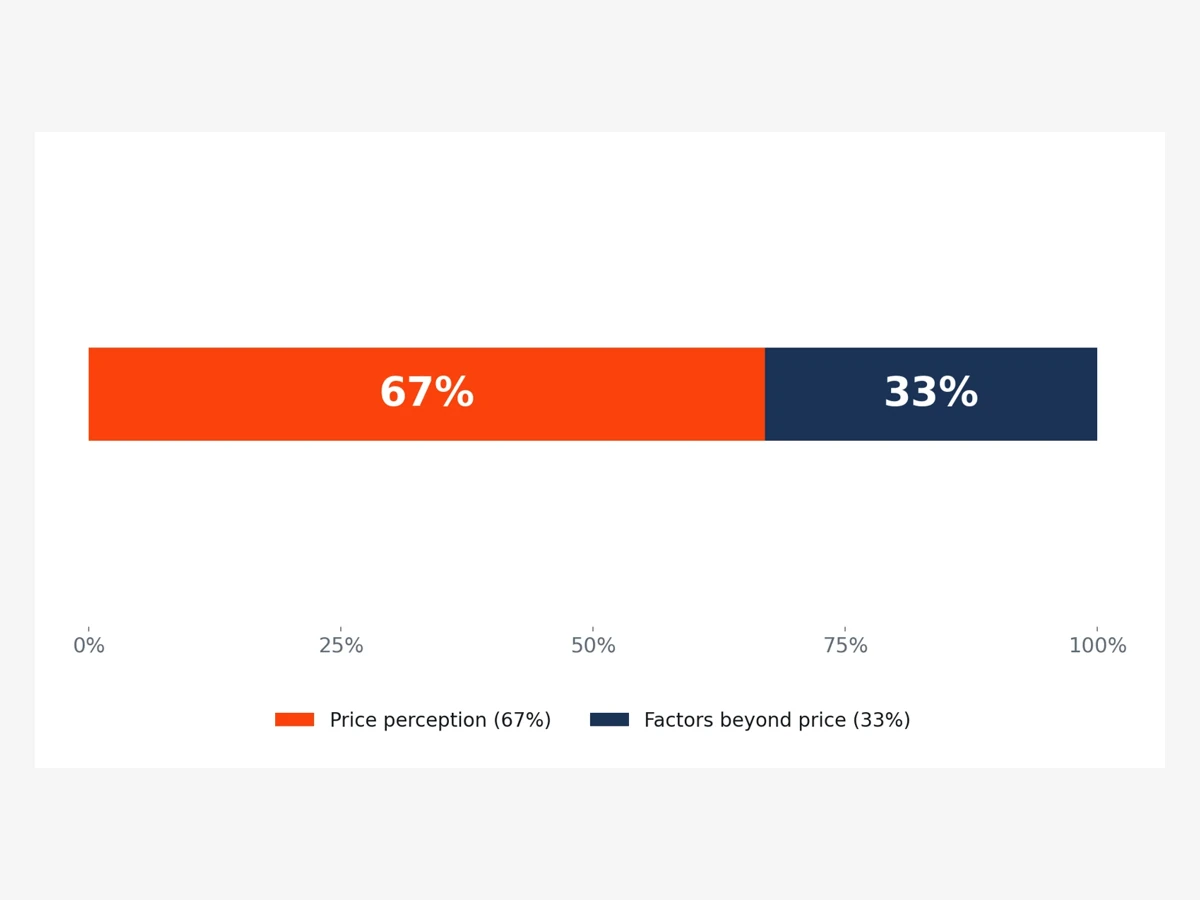
This case answers the operational half of that question. For the money half, use the B1F1 margin investigation. For how people value service versus price, see our 2026 price-and-experience research.
Know what changed before planning your next promotion.
Explore what customers say, what competitors are doing and what is happening around your restaurant before deciding where to spend.