Restaurant Promotions in 2025–2026: What Worked, What Failed and Why
Real success and failure cases, different outcomes, and the questions that matter after the vouchers expire.

One campaign brings 9,000 new members. Another doubles reported restaurant sales. A third runs out of burgers. Can they all be called successful?
Restaurant marketing reports are full of big numbers: impressions, orders, first-time members and queues out the door. Far fewer explain what actually changed for the restaurant after the campaign ended.
This is ORBIT’s research guide to several documented F&B campaigns in 2025–2026, separating what worked commercially, what failed operationally and what public data cannot tell us. Each topic links to its own deeper investigation so you can follow the question that matters to your business.
Short answer: Recent restaurant promotions produced real order growth, sales growth and membership acquisition. They also produced documented checkout and fulfilment failures at ZUS Coffee and Five Guys. The published cases do not provide enough profit and retention data to rank these campaigns by net financial return.
What did these promotions actually achieve?
The first thing that jumped out from the 2025–2026 reports is how differently companies use the word successful. A loyalty system can report new members. A delivery platform can report order growth. A restaurant can apologise for stockouts caused by an offer that attracted far more customers than expected. They are not interchangeable outcomes.
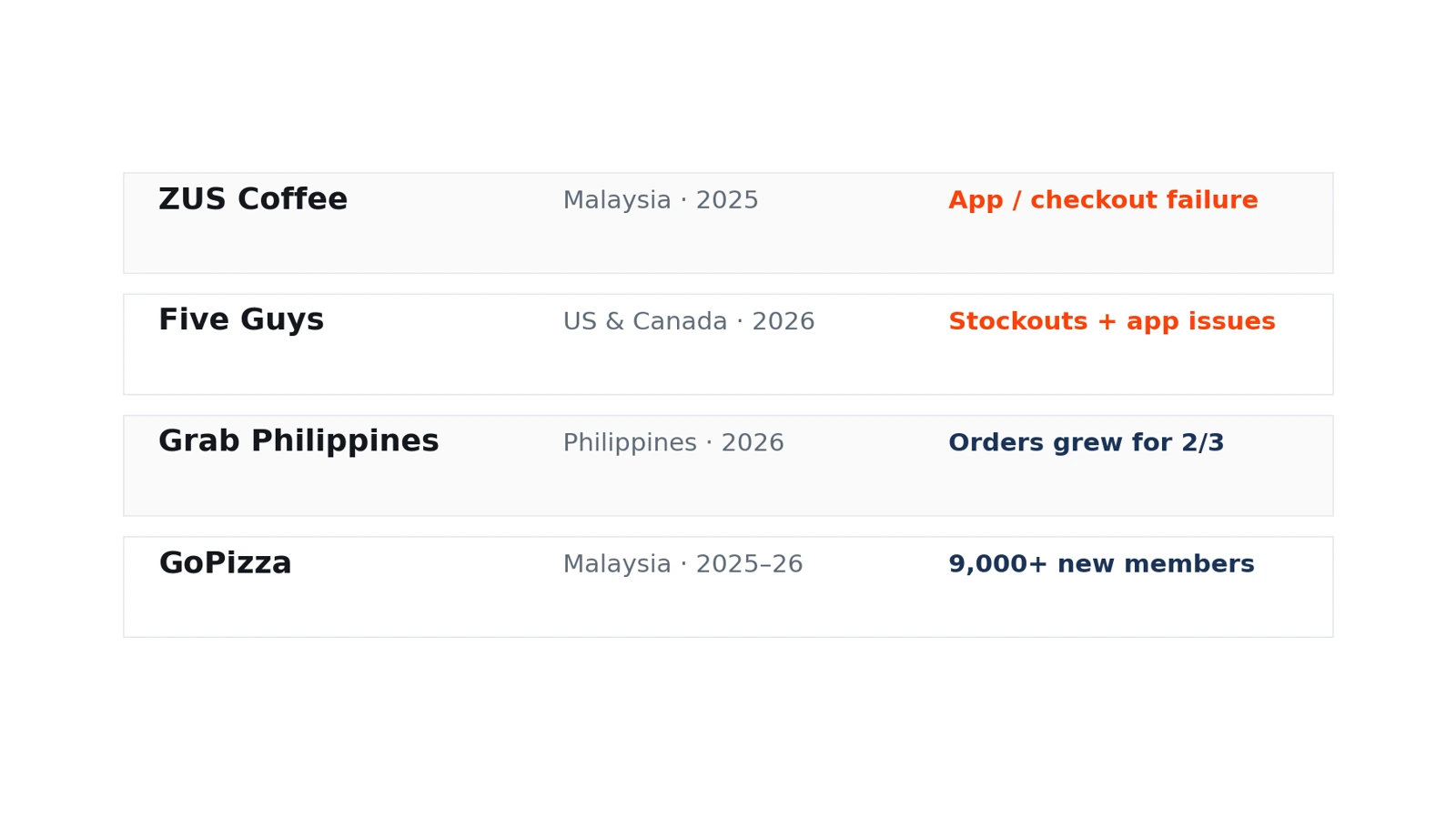
| Campaign | What was reported | What was not proved |
|---|---|---|
| ZUS Coffee, MY (2025) | App/payment failures during three-hour B1F1 and compensation promised | Campaign revenue, profit and retention |
| Five Guys (2026) | Some stores ran out of product or closed early; four-day rerun announced | Total lost sales or campaign loss |
| Grab PH (2026) | Two in three participating merchants increased orders | Store-by-store net profit |
| GoPizza MY (2025–26) | 9,000+ members recruited in 3½ months | Full-price repeat purchase rate |
What worked in 2025–2026—and what kind of success was it?
The strongest recent public success numbers in our research are about orders, sales and customer acquisition. In the Philippines, Grab fully funded selected merchants' consumer discounts and reported that two-thirds of those merchants recorded higher orders. In Malaysia, GoPizza and TamJai Mixian used straightforward entry rewards to grow loyalty sign-ups. Grab Thailand reported substantial order activity around its 60/40 promotion programme. Every one of those figures needs its own denominator and measurement window.
The evidence and commercial interpretation appear in the separate restaurant promotion success cases from 2025–2026. They demonstrate that some offers can drive measurable activity. They do not establish one promotion tactic as the best option for every restaurant.
When a promotion attracts customers but fails operationally
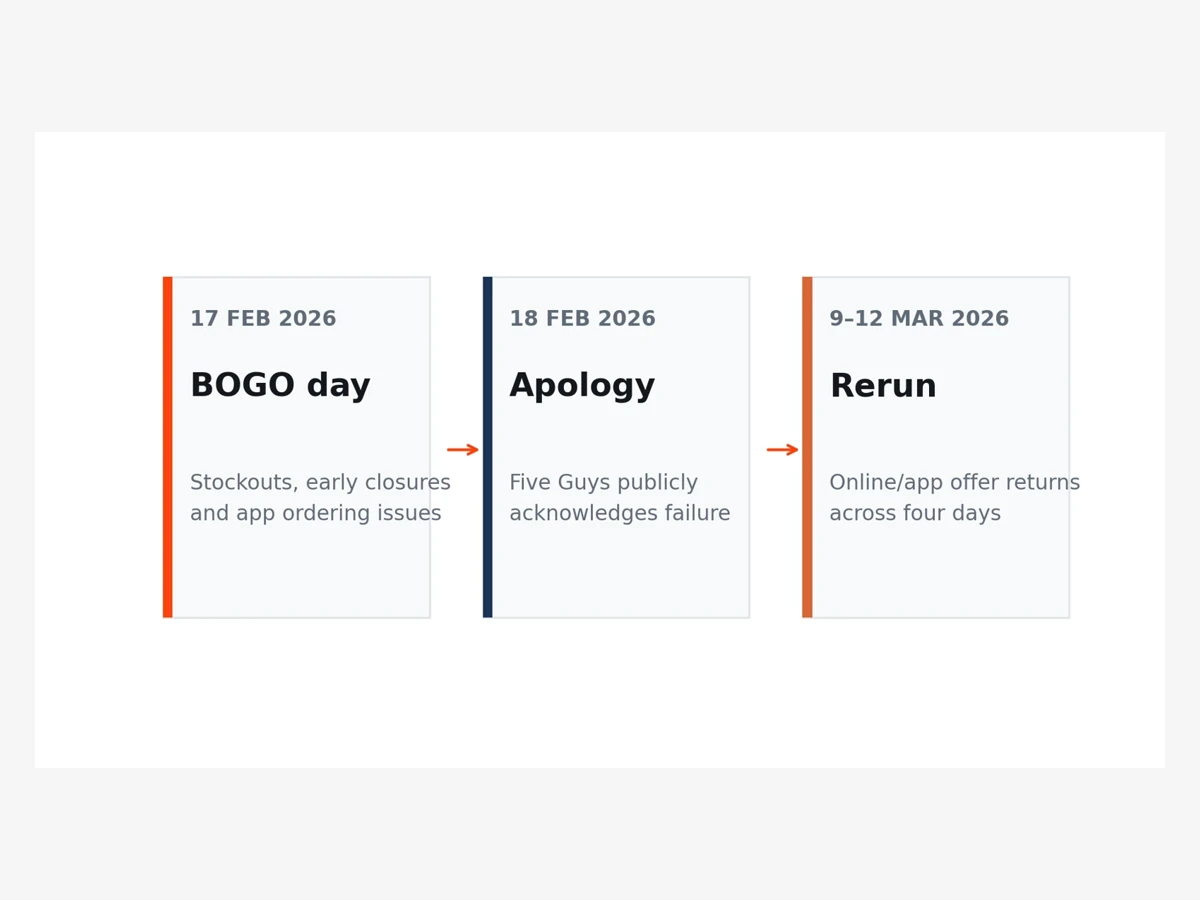
At ZUS Coffee in October 2025, a three-hour app-led B1F1 promotion met overwhelming demand and reported ordering failures. The brand apologised and announced refund and replacement-voucher plans. At Five Guys in February 2026, BOGO brought some stores product shortages and early closures as well as online-ordering problems. The brand ran a follow-up offer in March.
These are not examples of “nobody wanted the offer.” They are examples of the exact opposite: demand was high enough that customers did not always receive the experience promised. That kind of failure matters because awareness and operational reliability are both parts of a transaction.
Read the cases independently: ZUS Coffee's B1F1 and app breakdown focuses on the digital purchase path; Five Guys' BOGO failure and rerun examines store inventory and fulfilment capacity.
Do cheap prices actually beat restaurant experience?
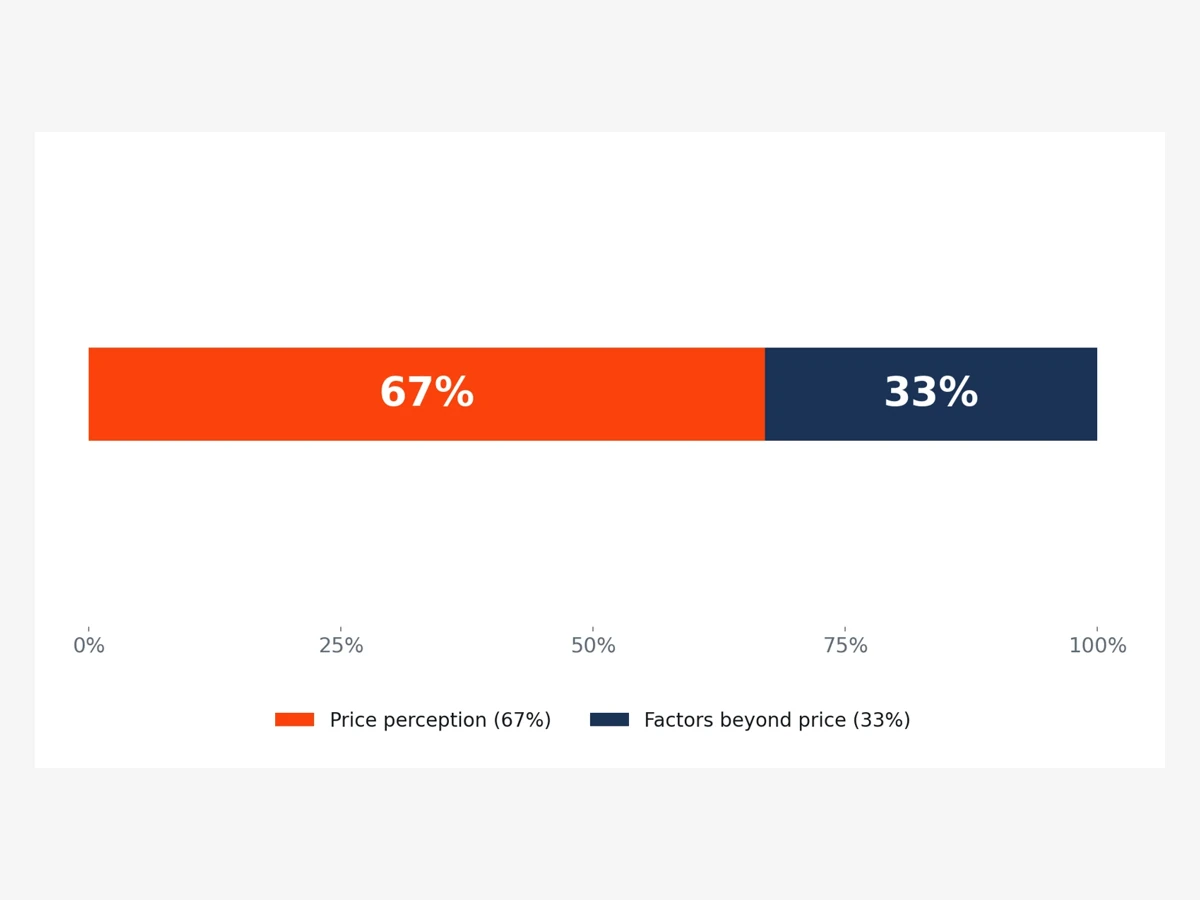
Deloitte's May 2026 research suggests that price perception explains a large share of perceived restaurant value, but not all of it. McKinsey's January 2026 work found that some diners saved money by using promotions or choosing cheaper menu items at restaurants they already preferred, while food quality remained central when diners felt a meal was not worth the money.
That result is far more useful than claiming that customers no longer care about experience. See the full price-versus-experience investigation, including research sample sizes and limitations.
Do discounted first visits become valuable repeat business?
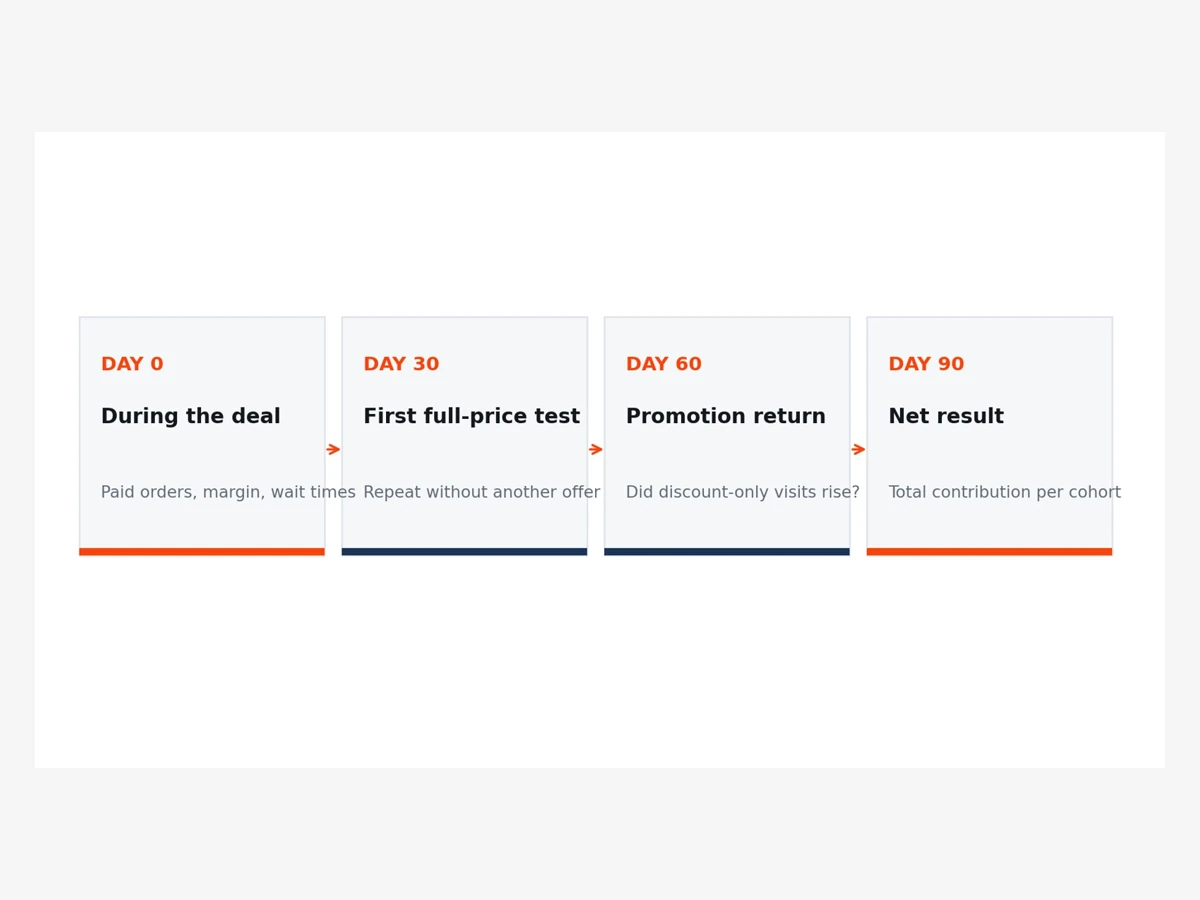
Many promotional reports stop measuring at sign-up, purchase or voucher redemption. A restaurant owner should keep watching after the offer expires. Did the customers return? Did they buy at normal prices? Did orders shift from another day rather than increase total demand? And what contribution did the cohort generate after discount costs?
Our discount loyalty investigation separates what 2026 research shows about value-seeking from what would require a business's own 30-, 60- and 90-day sales data.
How can a promotion raise orders and still weaken profit?
A discount reduces revenue per eligible item while ingredients, preparation and fulfilment still cost money. The size of that trade-off depends on variable costs, whether the platform funds the discount, how many sales are truly incremental and whether those customers come back.
Our B1F1 profitability analysis works through original RM examples and break-even calculations, clearly labelled as hypothetical rather than presented as secret brand P&L data.
Which article should a restaurant owner read first?
| Your immediate question | Start here |
|---|---|
| What happens when an app crashes? | ZUS Coffee’s 2025 B1F1 |
| What happens when stores run out of food? | Five Guys’ 2026 BOGO |
| Which campaigns reported growth? | Five 2025–2026 success cases |
| Does discounting outweigh bad service? | Price versus restaurant experience |
| Will deal seekers keep coming back? | Promotions versus loyal customers |
| What margin do I have left? | B1F1 contribution and break-even |
There is no one-size-fits-all promotion. Choose the article for the business problem you're actually facing.
Quick answers about restaurant promotions in Malaysia
What restaurant promotions worked in 2025–2026?
Published examples include platform-funded order boosts on Grab Philippines and introductory loyalty offers at GoPizza and TamJai Mixian Malaysia. Their reported outcomes were order growth or membership acquisition; profit was not directly disclosed.
Which restaurant promotions failed in 2025–2026?
ZUS Coffee's October 2025 B1F1 was associated with an ordering-app failure, while Five Guys' February 2026 BOGO led to reported stockouts, early closures and ordering problems. Those are documented operational failures, not proven financial losses.
Can discounts make customers ignore bad service?
2026 research does not support a blanket yes. Price influences perceived value, while quality, fulfilment and service still influence satisfaction and future intentions.
How do restaurants know whether a promotion made money?
Compare incremental contribution and subsequent full-price purchases with a credible baseline, subtracting discounts, platform fees, variable costs, extra labour and complaint recovery.
Research standards and source boundaries
We prioritised campaigns and studies published or occurring in 2025–2026. Named-brand outcomes originate from company statements, dated reporting or campaign partners' case studies and may favour favourable results. Academic and consultancy research generally involves different samples, markets and methods. We do not combine these results into a fabricated universal success rate.
- Hype.my, 23 October 2025 — ZUS app failure and recovery statement.
- Five Guys, 18 February 2026 and 9 March 2026 — original failure and rerun.
- Grab Philippines, 6 July 2026 — funded-discount order outcomes.
- Eber GoPizza Malaysia case study — membership acquisition.
- Deloitte, May 2026 and McKinsey, January 2026 — consumer price and value research.
A promotion is only as good as the business result it leaves behind
These case studies show why restaurant promotions deserve more than a “worked” or “failed” label. Some grew orders. Some recruited members. Others brought demand that restaurants could not fulfil smoothly. The unanswered question in most public announcements is the same: after the offer ended, was the restaurant better off?
That is the question worth asking before the next B1F1 banner goes up.
Know what changed before planning your next promotion.
Explore what customers say, what competitors are doing and what is happening around your restaurant before deciding where to spend.