ZUS Coffee’s B1F1 Promotion Crashed the App. Was It Really a Failure?
Inside the three-hour Malaysian coffee promotion that drove overwhelming demand, interrupted orders and raised a bigger question about promotional profit.

For three hours, the deal was simple: buy one coffee, get another free. Ordering it was not quite so simple.
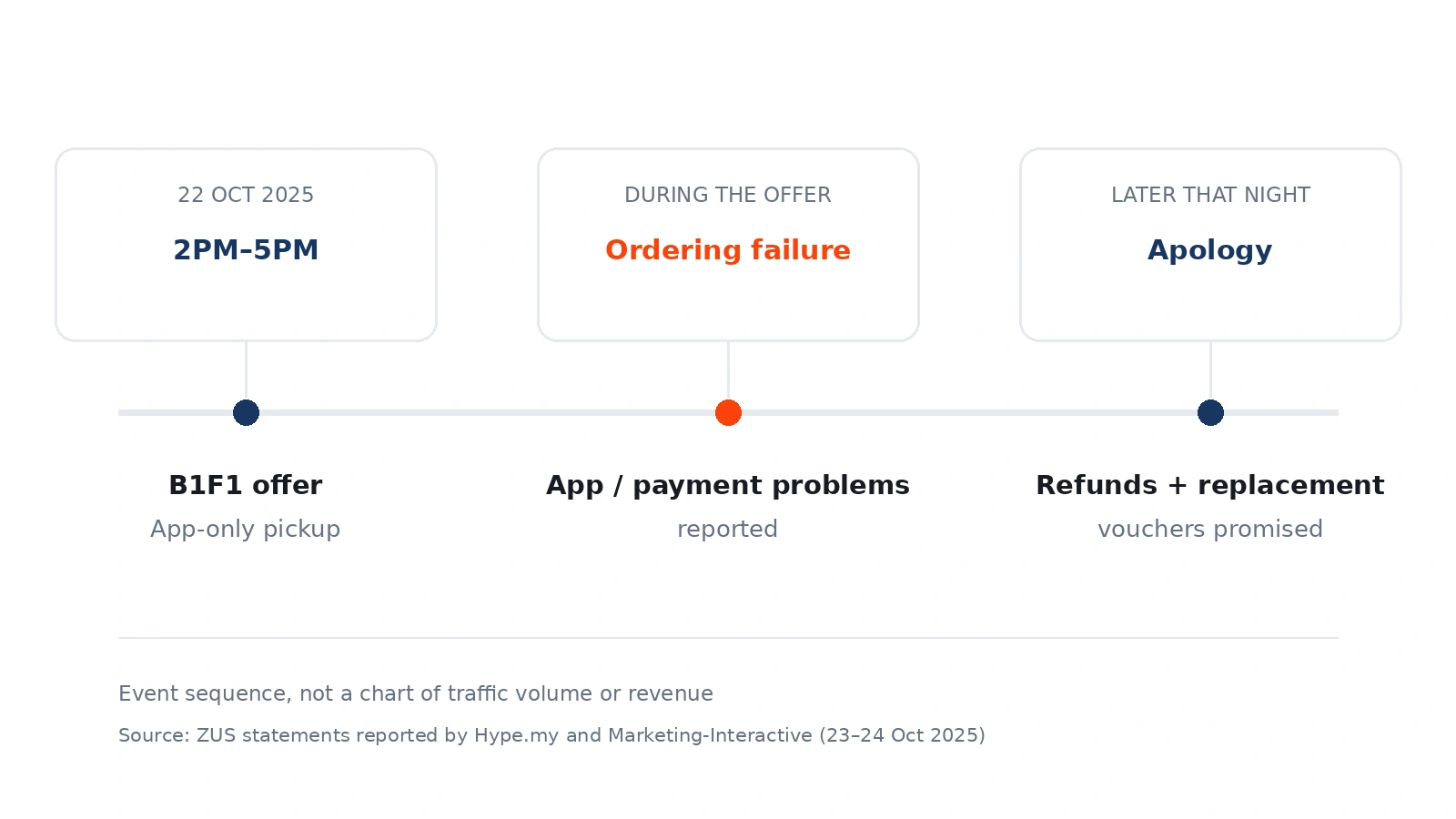
On 22 October 2025, ZUS Coffee celebrated its 1,000th outlet with a Buy 1 Free 1 offer. The app became a bottleneck. Some customers could not check out, and the company later promised refunds and replacement vouchers. The internet had plenty to say about it.
But the interesting business question isn't whether the app crashed. We know it did. It's what happens when a promotion creates more purchase intent than the ordering system can handle. How many sales does that cost? Does a discount like this still make money? And what should another Malaysian café learn from the episode?
Short answer: ZUS Coffee's 22 October 2025 B1F1 promotion generated overwhelming demand and a publicly acknowledged ordering-app failure. The company announced refunds for payment issues and replacement vouchers for affected customers. The event is evidence of an operational failure, not proof of an unprofitable campaign. ZUS did not publicly disclose the completed orders, incremental revenue, campaign profit or repeat-purchase outcomes needed to make that judgement.
What actually happened during ZUS Coffee's October 2025 B1F1 promotion?
The occasion was a milestone: ZUS Coffee's 1,000th outlet. On 22 October 2025, the Malaysian coffee chain promoted a three-hour Buy 1 Free 1 deal for handcrafted drinks. It ran from 2pm to 5pm and sent customers through the ZUS app for pickup orders. Promotional material circulated online with the redemption code 1KOUTLETB1F1. Marketing-Interactive reported the offer and the subsequent app outage; a same-day public discussion recorded the time window, code and pickup restriction.
There was another reason people were paying attention. ZUS had published a playful “We're closing” announcement about pausing for the outlet milestone. Readers who kept swiping discovered that it was not a permanent closure. Most outlets would instead close early on 23 October, with exceptions for selected locations. The brand followed this attention-grabbing reveal with the B1F1 offer. It was a strong combination of curiosity, a recognisable Malaysian brand and a reason to act that afternoon. [1]
But the checkout was the weak point. Reporting from Hype.my described customers encountering failures when attempting to place or pay for orders. ZUS publicly acknowledged that it had underestimated incoming traffic. Later that night it apologised, said payment-issue refunds would be processed and promised replacement B1F1 vouchers for customers unable to log in during the promotion. [2]
The distinction is important: the public record documents a surge, an ordering failure and a recovery promise. It does not disclose the number of successful purchases, the number of failed sessions or the campaign's profit.
Why was this particular offer so powerful?
Imagine someone looking at the app at 4.45pm. The person wasn't deciding whether coffee was worth trying one day. There were fifteen minutes left to get two drinks for the price of one, and a friend was already asking if they could order together. Waiting until tomorrow meant losing the deal.
That is an effective piece of promotion design. But it also concentrates behaviour.
| Campaign component | Why it helps marketing | What it can make harder |
|---|---|---|
| Buy 1 Free 1 | An instantly understood value proposition; friends can split an order | More drinks per qualifying transaction, with a lower price per cup |
| Only three hours | A clear deadline encourages immediate action | Customers arrive in the same time window instead of spreading out |
| App-only pickup | Encourages account-based digital orders and measurable redemptions | Puts the order on a particular checkout path that must handle the spike |
| 1,000th-outlet celebration | Provides a story people can share beyond the discount | May attract more demand than a routine weekday promotion |
The problem is not that any one element was unreasonable. Each has an obvious marketing purpose. The risk comes from stacking them together: a popular offer, a loud milestone, a short deadline and one digital path to checkout.
We should not claim that we know the internal cause of the outage. The public articles do not provide ZUS's server logs, payment-processing records or load-test results. The observable lesson is narrower and more useful: a campaign can increase purchase intent faster than its ordering system can turn that intent into completed transactions.
The bottleneck was between wanting coffee and buying coffee
A typical promotion report is organised around reach: how many people saw the post, clicked the link or opened the app. The hard part comes after that.
For an app-led coffee promotion, a customer has to move through several separate stages: discover the offer, open the app, select a store, add eligible drinks, apply the voucher, complete payment, collect the drinks and perhaps return another day. A breakdown at checkout means earlier interest does not become a confirmed sale.
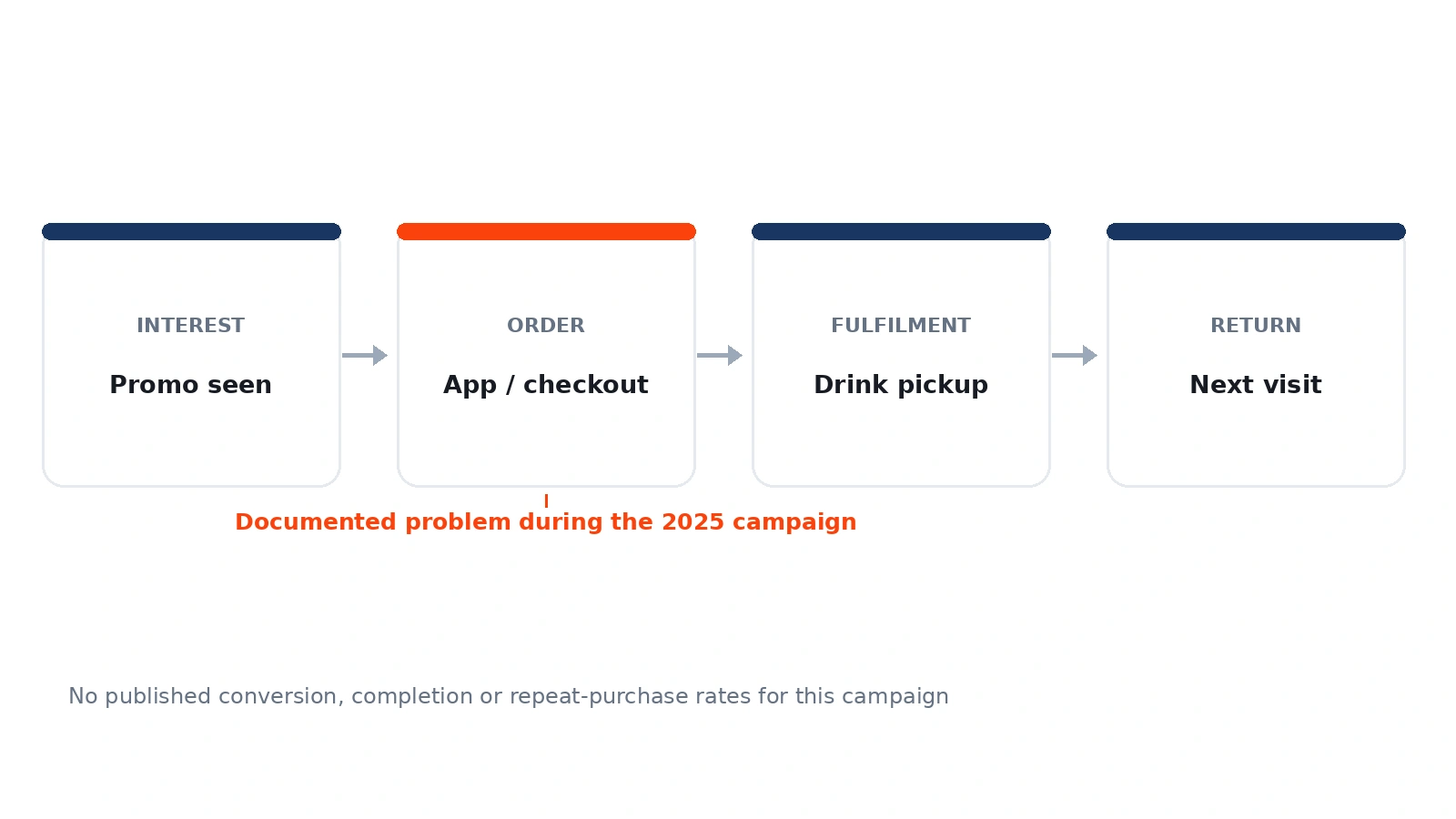
There are at least two different capacity problems in a promotion like this. The first is digital capacity: how many customers can browse, apply a code and check out at once? The second is store capacity: how many drinks can a location prepare correctly in an hour, even when every order gets through?
For this campaign, the first failure is documented; we should not automatically assume the second happened at every branch. A store might have had spare barista capacity while its customers could not check out. Another might have faced a queue. Without branch-level operational data, treating the two as the same problem would be guesswork.
This is why “the promotion broke the internet” makes a better social caption than a business diagnosis. An owner needs to know which step was overloaded, how many paid orders were lost and how the recovery was handled.
So did ZUS Coffee's promotion work or fail?
It depends on the question. The campaign plainly had enough response to trigger an operational problem. ZUS's own acknowledgement supports that much. It does not mean the campaign was commercially profitable, and it certainly does not tell us how many customers kept buying coffee afterwards.
| Outcome | What we know | What remains unknown |
|---|---|---|
| Visibility and interest | Strong public attention; reported traffic overwhelmed the app | Unique visitors and incremental reach attributed to the deal |
| Order conversion | Some customers experienced checkout and payment failures | Completed, abandoned and duplicate transactions |
| Sales and revenue | A paid-drink promotion was offered | Incremental sales versus a normal Wednesday |
| Profit | Two qualifying drinks were available for the price of one | Actual drink costs, gross contribution, campaign cost and net profit |
| Recovery | Refunds and replacement vouchers were publicly promised | Total refunds paid, vouchers redeemed and eventual cost |
| Repeat customers | Compensation vouchers created another possible visit | How many people returned and purchased again at full price |
There's a particularly easy mistake here. App failures do not mean that every customer disappeared. Some may have returned once the app recovered; some may have ordered on another day; others may have given up. The public reports do not tell us the size of any group. A lost session is not automatically a lost customer, but it is still an interrupted purchase.
For marketing, this was a conspicuous demand moment. For operations, it was a conspicuous failure. For finance, the verdict is not publicly established.
The apology was also part of the campaign
ZUS responded publicly, acknowledged the traffic problem and announced two ways to make customers whole: refunds for payment issues and replacement B1F1 vouchers for people who couldn't access the offer. That matters because an error at checkout leaves customers with two worries: Did my money go through? and Am I about to lose the deal? The response addressed both. [2]
There is also an interesting second-order effect. A replacement voucher can turn a bad afternoon into another opportunity for a store visit. But the voucher is not free to the business. Someone must account for its redemption cost, any extra workload, and whether the customer would have visited anyway.
Some online reactions were forgiving; Marketing-Interactive and Hype.my describe comments expressing reassurance or satisfaction with the apology. That is a qualitative observation from selected social responses, not a brand-sentiment survey. We cannot calculate reputation recovery from a handful of comments.
Whether the promised vouchers were ultimately redeemed is another question. The announcements are evidence of intent to compensate, not a financial reconciliation of completed refunds or delivered vouchers.
Can Buy 1 Free 1 be profitable? Run the numbers before copying it
The promotion got people excited about free drinks. How expensive is that excitement?
Let's create a simple example. This is not ZUS Coffee's price, recipe cost or actual campaign result. Assume a café normally sells a drink for RM12. Ingredients, cup, lid and other per-drink variable costs come to RM4. Two drinks normally generate RM24 in sales and RM16 before rent, fixed wages and other fixed costs. Under an equal-price B1F1 offer, the same two drinks generate RM12 in sales but still incur RM8 in variable costs. Contribution drops to RM4.
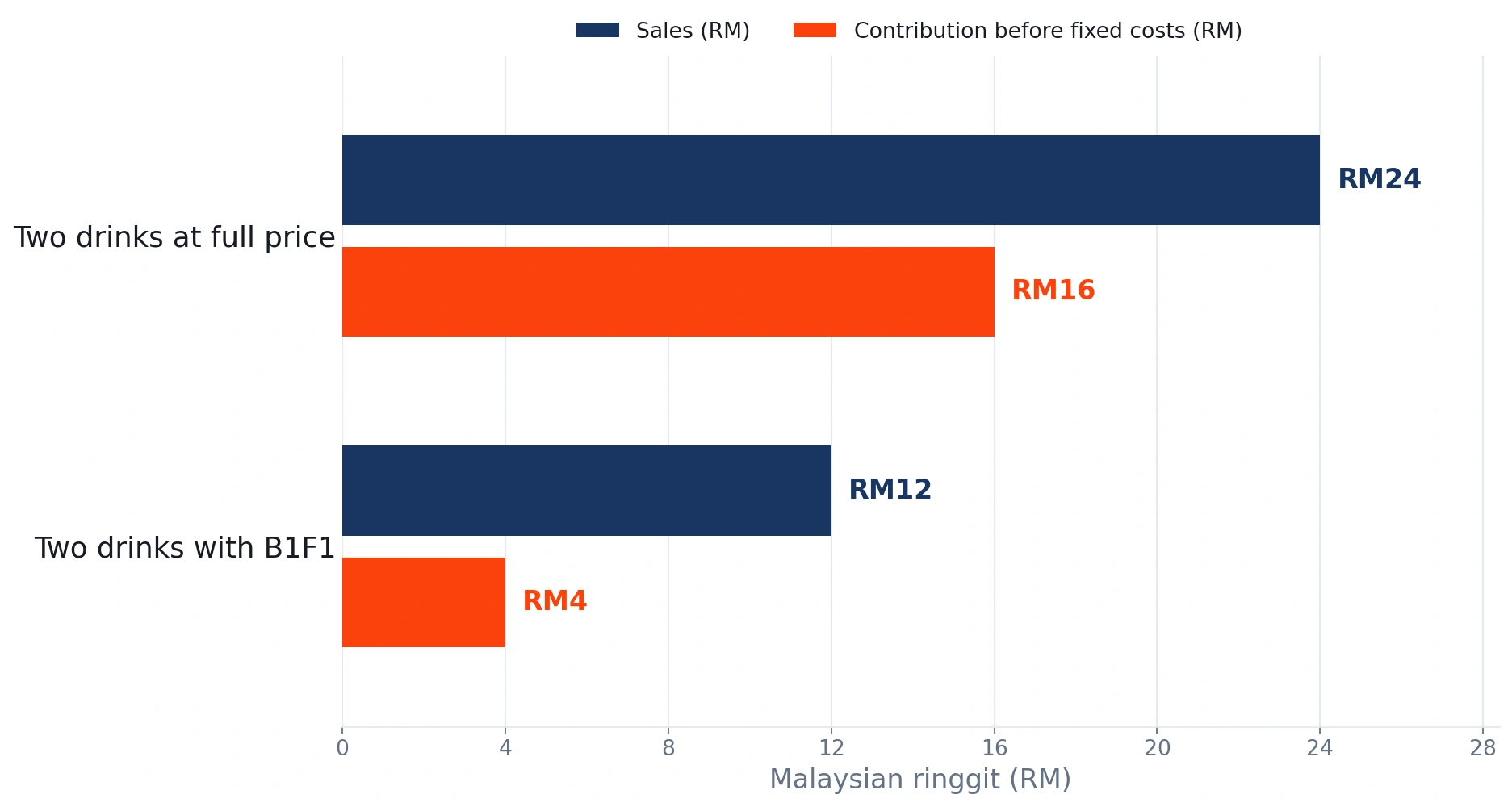
View the calculation as a table
| Two-drink order | Revenue | Variable cost | Contribution |
|---|---|---|---|
| Normal price | RM24 | RM8 | RM16 |
| B1F1 | RM12 | RM8 | RM4 |
At those example numbers, the café needs four B1F1 transactions, or eight drinks, to generate the same RM16 contribution as a single full-price two-drink transaction. That is a deliberately simplified same-basket comparison. In reality, customers might add pastries, buy higher-priced drinks, arrive with someone new or return later. On the other hand, an existing customer might use the offer for a purchase that would have happened at full price.
The most useful campaign number is therefore not cups sold. It is incremental contribution after discount and recovery costs, compared with a reasonable no-promotion baseline. For a real campaign, an owner would also need to consider cancellations, payment-processing charges, incremental labour and any repeat purchases attributable to the offer.
What could a restaurant do differently without losing the excitement?
It would be unfair to look at an October 2025 event and confidently prescribe a fix for ZUS without access to its operational data. But the incident gives smaller restaurants a useful planning exercise: how do you preserve urgency without sending everyone through the same bottleneck?
Stagger redemption. A voucher could be claimed during the three-hour promotion, but redeemed across several days. That splits the moment of attention from the physical fulfilment window. It also changes the commercial risk, because some vouchers may never be redeemed. The owner still needs a transparent expiry rule and a redemption forecast.
Set a capacity-aware limit. Capping redemptions per store, per time slot or per customer makes demand easier to plan. But customers should see the availability before they commit time or payment. A hidden cap that surprises people at checkout can generate a different kind of frustration.
Use a waiting room or reliable queue. If thousands of customers try to check out at once, a clearly explained queue may be better than repeated payment failures. The important part is that a customer knows whether they have an order. A spinning payment screen and an unexplained debit are a far worse experience than a transparent wait.
Test the entire path. A campaign test is not just whether a landing page loads. Simulate selecting an outlet, applying the code, calculating the price, paying, creating the order and sending it to the store. For a promotion that uses one app, any one of those steps can stop the purchase.
Decide the recovery policy before launch. Who authorises refunds? What happens if a payment succeeds but the order confirmation doesn't appear? Will customers get another voucher automatically? The afternoon of a failure is a difficult time to invent these answers.
These are potential alternatives, not evidence that any particular measure would have prevented ZUS's documented outage.
If this were your café, what should you actually measure?
A busy promotion can produce a beautiful screenshot and a disappointing weekly profit report. The easiest way to avoid confusing the two is to record the whole funnel before launching.
| Question | Metric to record | Why it matters |
|---|---|---|
| Did people want the offer? | Unique campaign visitors and qualified redemptions | Demand and interest, without assuming they paid |
| Did they complete the order? | Successful checkouts, payment errors, abandoned baskets | Shows digital lost opportunity and operational failure |
| Did you earn more? | Incremental contribution versus comparable non-promo days | Counts discount, variable costs and actual paid sales |
| Did operations hold? | Orders fulfilled on time, wait times, cancelled or refunded orders | Tests whether the extra demand was serviceable |
| Was the recovery expensive? | Refunds, credits, complaint volume, support hours | Captures costs that can arrive after the promotion ends |
| Did customers return? | 30-day repeat rate and full-price follow-up purchases | Separates a one-day spike from lasting demand |
The baseline needs care. A Wednesday promotion should be compared with appropriate Wednesdays and adjusted for school holidays, weather, store openings and other unusual events where possible. Otherwise, a café could attribute every extra order to the voucher when some of those customers were already planning to buy coffee.
For owners using delivery apps or third-party ordering systems, the same principle applies. Use platform reports where available, but reconcile completed orders and payouts with the business's own records rather than relying entirely on promotion dashboards.
Questions restaurant owners actually ask about B1F1 promotions
Did ZUS Coffee lose money because of the October 2025 app crash?
No publicly available campaign-specific profit or loss statement establishes that. The brand acknowledged the ordering problem and announced compensation. Without completed-order counts, margin, refund cost and later purchases, a loss figure would be speculation.
Does Buy 1 Free 1 always mean a 50% discount?
If two equally priced eligible drinks are purchased together and one is free, the effective price per drink is halved. If drinks have different prices or terms exclude certain items and modifiers, the effective discount depends on the offer rules. B1F1 is a promotion mechanic, not a fixed profit margin.
What is the biggest risk of a short B1F1 promotion?
Concentrated demand can exceed either checkout capacity or the store's ability to prepare orders. Those are separate risks. For ZUS in October 2025, the publicly documented issue was app and payment access during the campaign window.
Can an apology and replacement voucher save a promotion?
They can help resolve immediate disappointment and create another opportunity to serve the customer. Whether they fully restore trust or improve commercial outcomes needs to be measured; social-media reassurance alone cannot prove it.
Should a small Malaysian café copy ZUS's three-hour B1F1 format?
Only after checking its own drink contribution, payment capacity, production capacity and likely customer response. A narrower or staggered offer may generate less drama and still produce more profit. There is no evidence that the ZUS time window is a universal best practice.
Research method, sources and what we cannot conclude
This case study reconstructs the publicly reported 22 October 2025 promotion from contemporary reporting and dated public promotional discussion. We distinguish what the company said, what journalists reported, and what ORBIT calculated as an illustrative scenario. We did not obtain private ZUS analytics, financial statements, server logs, customer-level retention data or independent audit results.
Primary company statements were quoted in the reports below, but we have not independently verified the completion of every announced refund or replacement voucher. The observation that the app failed during the offer is supported; its precise technical root cause is not publicly established in these sources.
Reporting and source documents
- Marketing-Interactive, 24 October 2025: milestone communication, B1F1 window, app outage and public reaction.
- Hype.my, 23 October 2025: checkout problems, apology, planned payment refunds and replacement vouchers.
- Lowyat.NET community discussion, 22 October 2025: contemporaneous public record of the advertised 2pm–5pm app-pickup promotion and code. This is not an official performance report.
The unit-economics graphic is an original educational example using explicitly hypothetical RM12 and RM4 inputs. It is not a claim about ZUS Coffee's drink costs, sales, profitability, technology or internal decisions.
Read next: Five Guys’ 2026 BOGO breakdown shows what happens when demand overwhelms kitchens as well as ordering. Our promotion research guide compares the results across campaigns, while B1F1 economics examines contribution directly.
The promotion attracted demand. The unanswered question is how much demand became good business.
The most memorable line in this story is not the B1F1 offer. It is the fact that customers wanted a discounted coffee and, for some of them, could not finish buying it.
That is why this case deserves more than a “marketing fail” headline. It shows how a strong promotion and a poor purchase experience can occur on the same day. The owner who learns from it won't just ask whether a deal can go viral. They'll ask whether the restaurant can take the order, make the product, handle the exception and keep enough contribution for the campaign to be worth repeating.
That is a better definition of success than a crowded app screen.
Before running B1F1, know what you want to change.
Look at customer feedback, nearby competition and demand signals before deciding whether a discount is worth trying.