Are Buy 1 Free 1 Promotions Actually Profitable for Restaurants?
What a two-for-one offer really costs, how many extra orders you need, and why real cases rarely disclose profit.

Two drinks for the price of one may be a brilliant offer for customers. For the restaurant, it means the costs of both drinks are still real.
B1F1 looks like a simple sales tactic. But if customers receive twice as many items for one payment, a restaurant needs more than a busy shop to call the campaign successful.
We compared actual promotions reported in 2025–2026, then built original contribution calculations to explain the question most campaign announcements do not answer: after all the discounted items are prepared and handed over, what money is left?
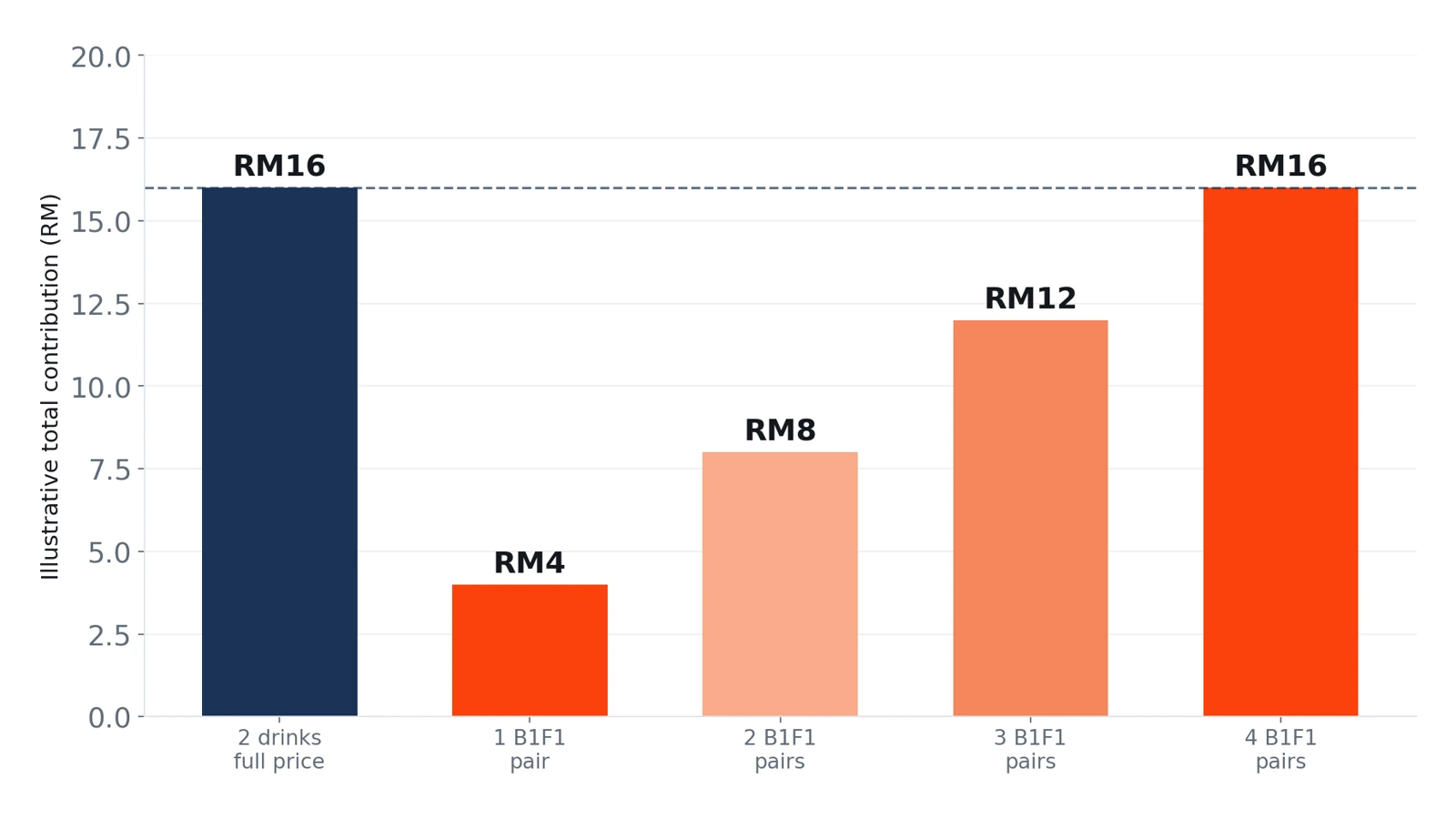
Short answer: B1F1 can be profitable when it creates enough incremental contribution, but doubling items sold does not prove it. For a hypothetical RM12 drink costing RM4 to produce, two full-price drinks provide RM16 contribution while a B1F1 pair provides RM4. The real test is incremental contribution, not coupon redemptions.
Why a B1F1 offer is not just a 50% headline
A customer sees Buy 1 Free 1 and thinks: brilliant, two drinks for the price of one. An owner sees the same deal and has a second calculation to make: both drinks still require ingredients, cups, preparation and perhaps additional payment or platform fees. The free item does not become free to produce.
Take a hypothetical RM12 drink with RM4 in variable cost per drink. The normal two-drink order makes RM24 revenue and RM8 total variable cost, or RM16 contribution. With B1F1, a customer pays RM12 for those two drinks, the costs still total RM8, and contribution falls to RM4. This is a simplified contribution calculation, before rent and fixed salaries; it is not an estimate of any named brand's margins.
Four B1F1 orders in that example would match the contribution of one full-price two-drink order, but would require preparing eight drinks instead of two. That illustrates the double pressure: lower contribution per pair and higher operational load per ringgit of contribution.
How much must order volume rise after a discount?
There is a useful general break-even calculation for a simple same-item discount. If the original contribution margin on sales is 40% and you give a 20% price discount, the remaining contribution before other incremental costs becomes 20% of the original selling price. The business therefore needs 100% more identical items just to keep the original contribution amount unchanged.
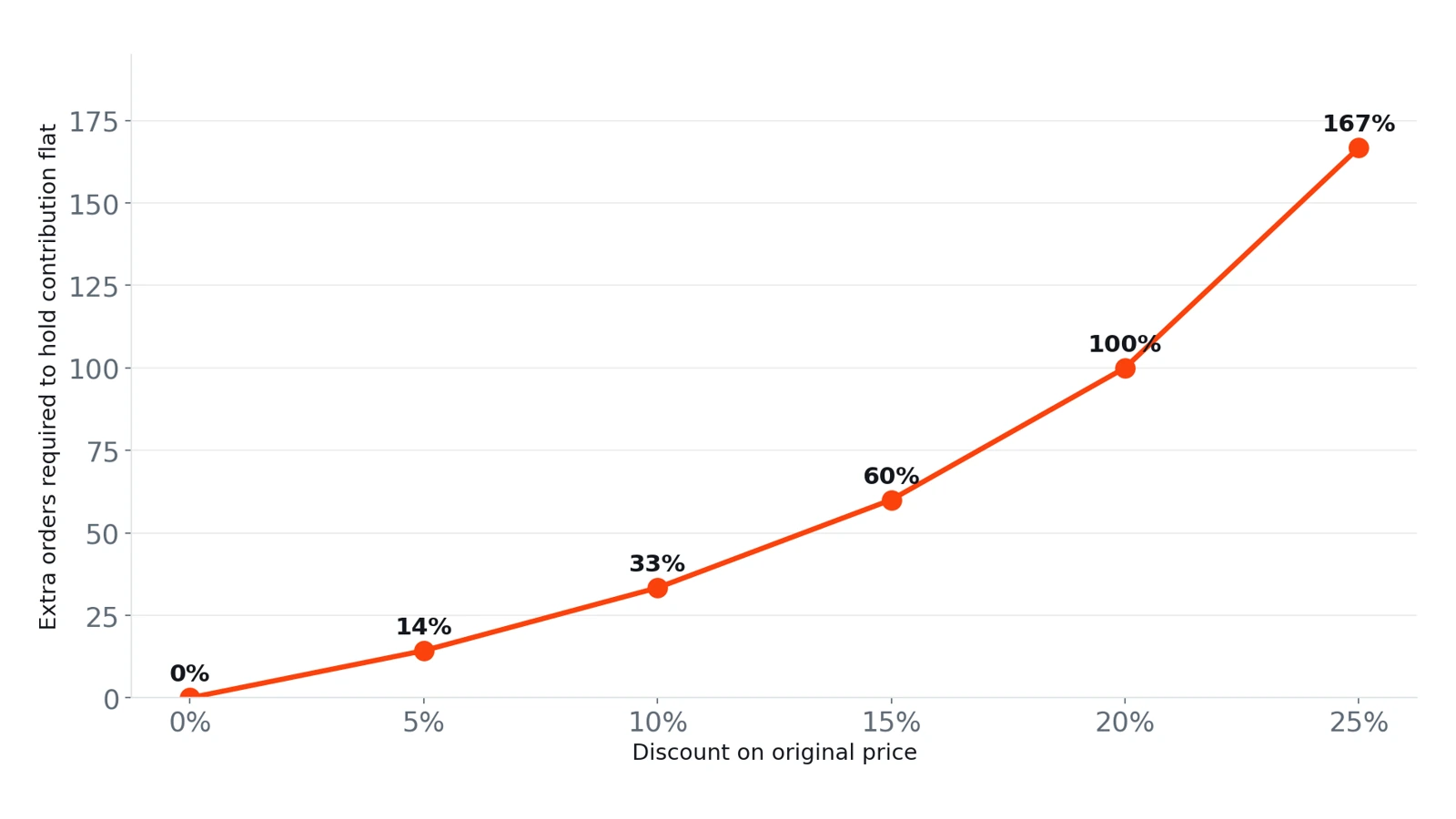
This is not a universal rule that a B1F1 always needs exactly 100% more orders. B1F1 can involve differently priced products, incremental customers, cross-selling and changes to average basket size. The chart is an owner-friendly sensitivity test for straightforward price reductions, not a forecast for a particular chain.
What real 2025–2026 promotions tell us about the money
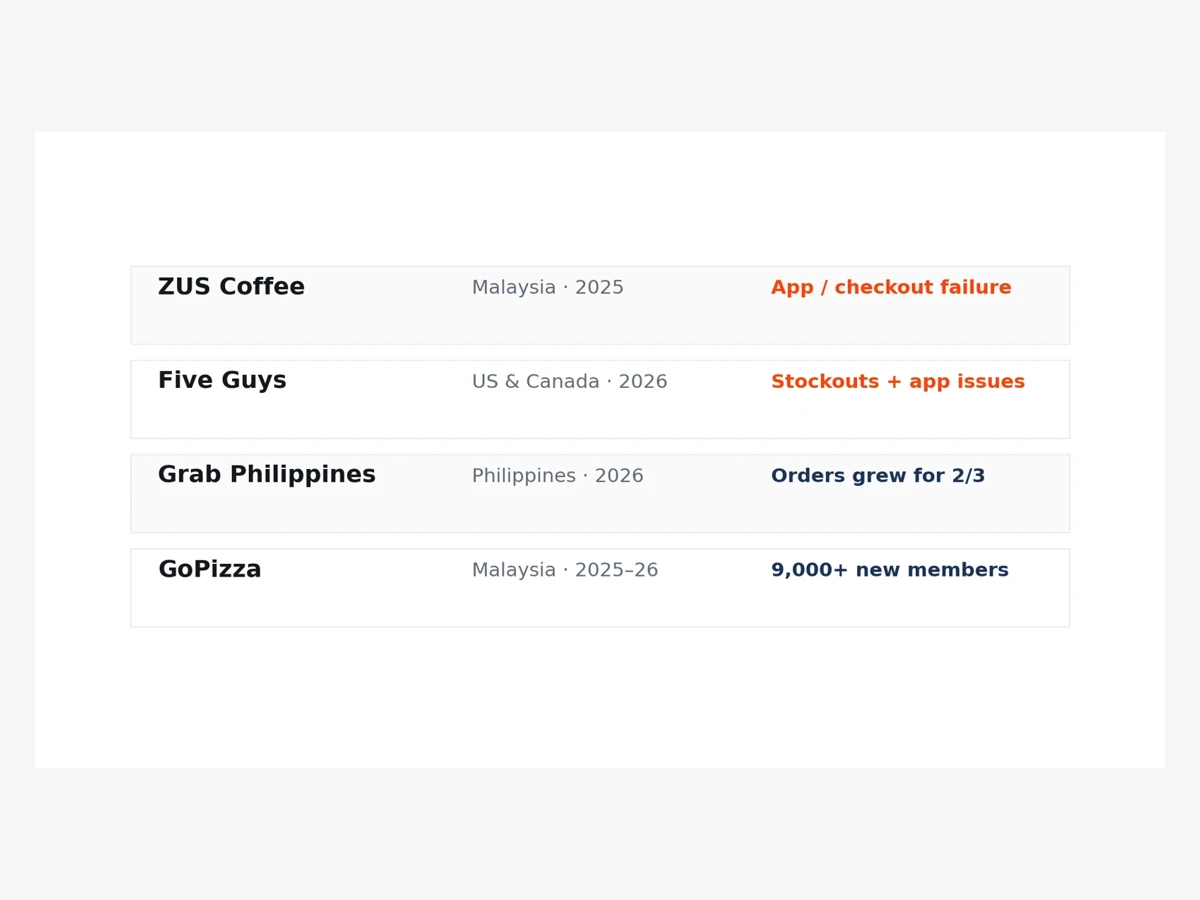
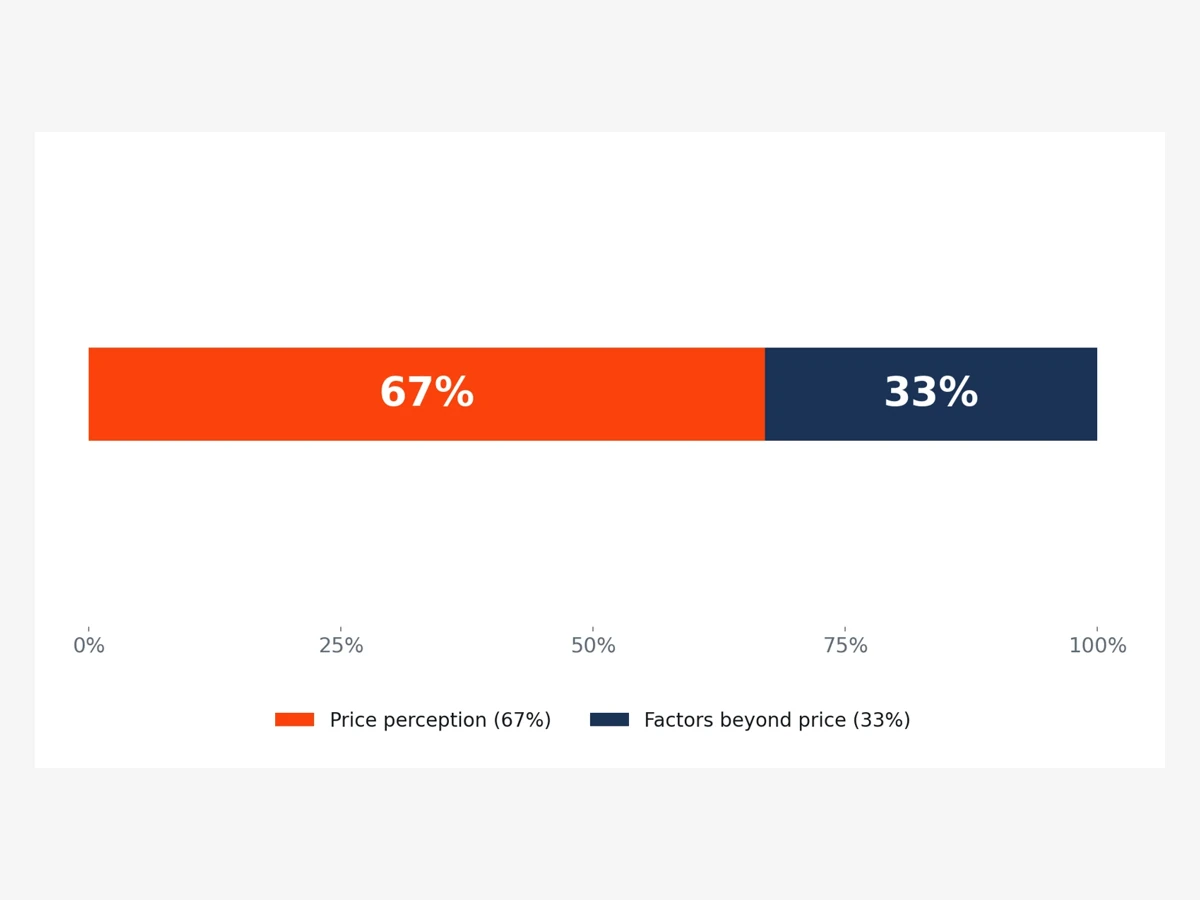
Two real cases show why you must ask who pays for the offer. In its July 2026 release, Grab Philippines said it fully funded consumer discounts for selected small restaurants. Two in three merchants recorded higher orders, and among merchants whose orders increased, volume rose around 30% on average. That is a meaningful order result, but Grab did not publish each outlet's net contribution. The funding arrangement matters: a platform-paid discount is not financially equivalent to an owner-funded one. Grab Philippines, July 2026.
In Malaysia, GoPizza advertised a RM5.99 welcome pizza versus a published RM9.90 regular price, with loyalty provider Eber reporting 9,000+ members in 3½ months. It is evidence of a successful member acquisition mechanism, not a public statement of profit per promotional pizza. Eber GoPizza case study.
| Real example | What improved in reporting | Profitability disclosed? |
|---|---|---|
| Grab PH 2026 | Order volume among participating merchants; platform funded consumer discounts | No store-level net profit |
| GoPizza MY 2025–26 | New loyalty members after RM5.99 introductory offer | No product-level promotional contribution |
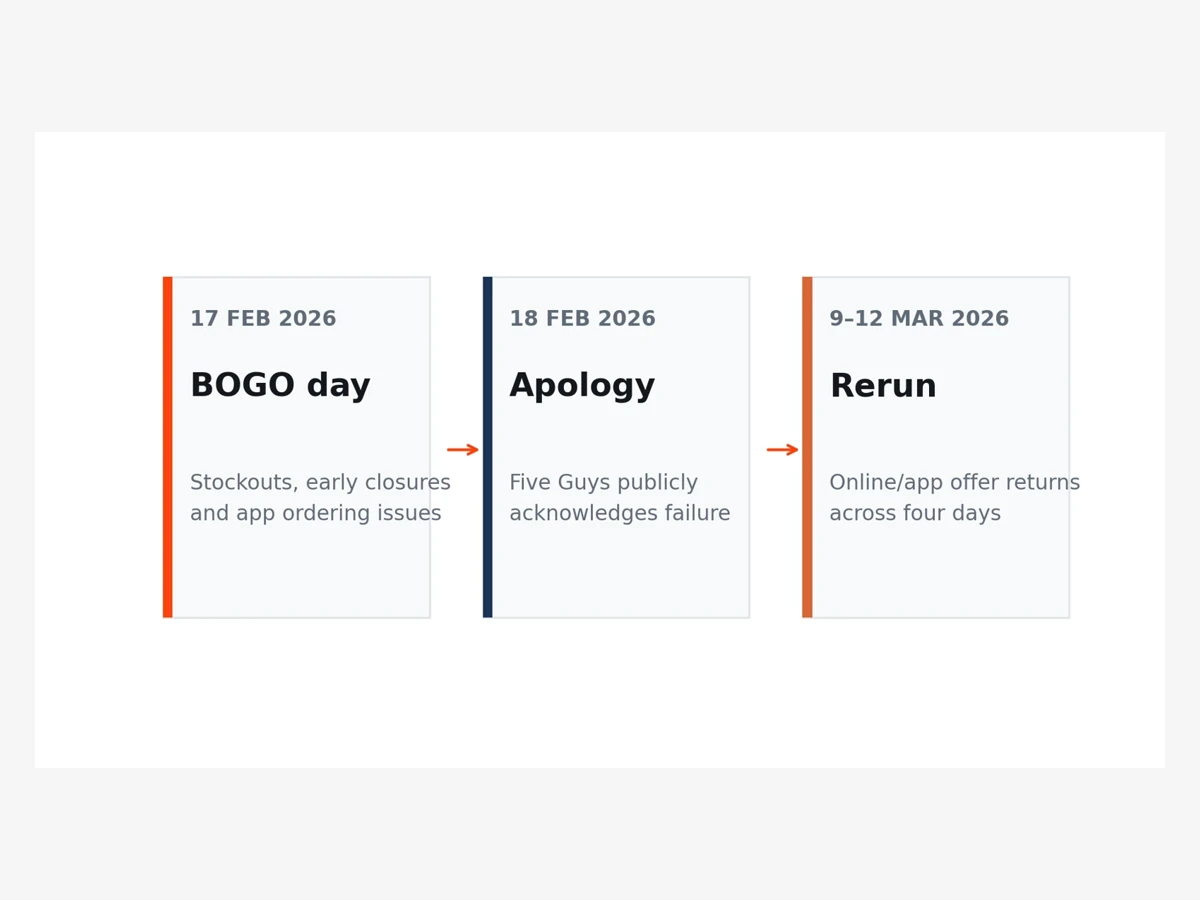
| Five Guys 2026 | Overwhelming interest; later four-day rerun | No campaign profit figure |
| ZUS MY 2025 | Strong response plus reported checkout problems | No campaign profit figure |
Our separate five-success-case article covers those campaigns in more detail. They must not be lined up as if one metric measures the same outcome as another.
The hidden problem: discounts on sales that would have happened anyway
Suppose 100 customers would have bought lunch at full price, but on promotion day 70 of them use the discount. The receipt system will record 70 successful redemptions. If there are also 30 genuine extra customers, it will show 100 redemptions. That is not the same as 100 incremental transactions. The example numbers are illustrative, used to explain cannibalisation, not drawn from any case study.
The owner must compare an appropriate no-promotion baseline and count new customers, returning customers, basket changes and variable-cost differences. For delivery offers, also reconcile the platform's discount contribution, commissions, payment fees and payout details. For dine-in, count extra staffing, product waste, queue-related cancellations and the cost of handling unhappy customers.
And if a B1F1 attracts people who later become full-price regulars, its value can extend beyond campaign day. That is a reasonable possibility—but it needs measured repeat orders, not just the hope that a stranger who came for a free burger will become loyal.
When can B1F1 be a sensible F&B retail tactic?
Potentially when it uses otherwise idle capacity, clears perishable but usable inventory, encourages sampling of a new product, increases a profitable add-on, or is funded partly by a partner. These are business mechanisms to test, not blanket recommendations.
If your goal is to introduce a new drink, a restricted new-customer offer may be easier to evaluate than a deal for every regular. If your rush hour is already full, putting the offer during a quieter time may reduce fulfilment risk. If the objective is two-person sharing, record whether recipients later make independent purchases at normal prices. Different goals need different success measures.
The ZUS Coffee and Five Guys incidents show the operational costs of demand concentration; the maths shows the financial cost of lower price per item. You need both views before running a high-volume promotion.
B1F1 profitability questions, answered
Is Buy 1 Free 1 always an effective 50% discount?
For two equally priced items and one free, yes, the effective price per unit is halved. Different item prices, qualifying limits or capped free-item values change the effective discount.
Does B1F1 increase restaurant sales?
It can increase orders or items sold. That does not automatically mean more revenue or contribution after costs, and the published 2025–2026 cases do not disclose a universal return.
How do I calculate a B1F1 break-even point?
Calculate what the customer actually pays for the pair, subtract both items' variable costs and applicable fees, then compare total incremental contribution with a comparable no-promotion baseline.
Can the promotion be profitable if the first transaction loses money?
Possibly if the campaign produces attributable future purchases with sufficient margin. But future visits must be measured and their attribution estimated rather than assumed.
Sources and method
The charts in this article are original arithmetic illustrations, not observations of any named chain's profits. The publicly reported campaign outcomes come from company or vendor sources and should be interpreted within their disclosed periods and metrics. No audited P&L or customer-level retention panel was supplied for those campaigns.
- Grab Philippines, 6 July 2026 — platform-funded discounts, share of merchants with order growth.
- Eber, GoPizza Malaysia case study — first-purchase offer and member sign-ups.
- Five Guys, 18 February 2026 — BOGO fulfilment problems.
- Hype.my, October 2025 — ZUS B1F1 checkout failure.
More orders are not the goal. More worthwhile orders are.
The right outcome is not the largest crowd or the most impressive redemption screenshot. It's the incremental contribution the campaign leaves behind, including the value of customers who return at sustainable prices. A bargain can create real business growth. But if every extra sale costs more to deliver than it brings in, volume alone is not a success story.
Know what changed before planning your next promotion.
Explore what customers say, what competitors are doing and what is happening around your restaurant before deciding where to spend.