Do Restaurant Discounts Build Loyalty, or Just Repeat Redemptions?
The data shows that diners look for deals. The harder question is whether they still buy when the deal disappears.

A café can have a very loyal group of voucher users. That is not always the same thing as having a very profitable group of regular customers.
Imagine you run B1F1 every second Friday. Each time, the shop gets busy, the voucher count looks healthy and the same customers appear in the queue. It feels like loyalty. But do they like the restaurant, or are they simply good at remembering the promotion calendar?
We went looking for a real answer in recent research and restaurant case studies. There are meaningful findings about how people seek value. There is also an important gap between what these reports disclose and the conclusion that discounts “train” customers to stop paying full price.
Short answer: 2026 research confirms that many consumers deliberately use deals and cheaper items to reduce restaurant spending, sometimes without switching their preferred brand. However, publicly reported promotions usually do not reveal full-price return rates, so repeat redemption is not proof of profitable loyalty or of discount dependence.
Are customers becoming loyal to restaurants or to discounts?
It is easy to confuse two different things: someone returning to your restaurant and someone waiting for your next promotion. Both appear as repeat visits. Only one tells you what the business can sell at its normal price.
McKinsey's 2026 restaurant analysis found that, among US consumers who planned to reduce restaurant spending, many preferred to spend less at their existing restaurant of choice through promotions, smaller orders or cheaper items, rather than simply switch to another restaurant. That is important: using discounts and liking a brand are not mutually exclusive. McKinsey, January 2026.
But it also creates a measurement problem. If the same customer buys every Friday at full price until a restaurant introduces a Friday coupon, the next month's coupon redemptions could look like a successful loyalty campaign. The business may simply be giving away margin on existing demand.
The measurable evidence is about value, not addiction
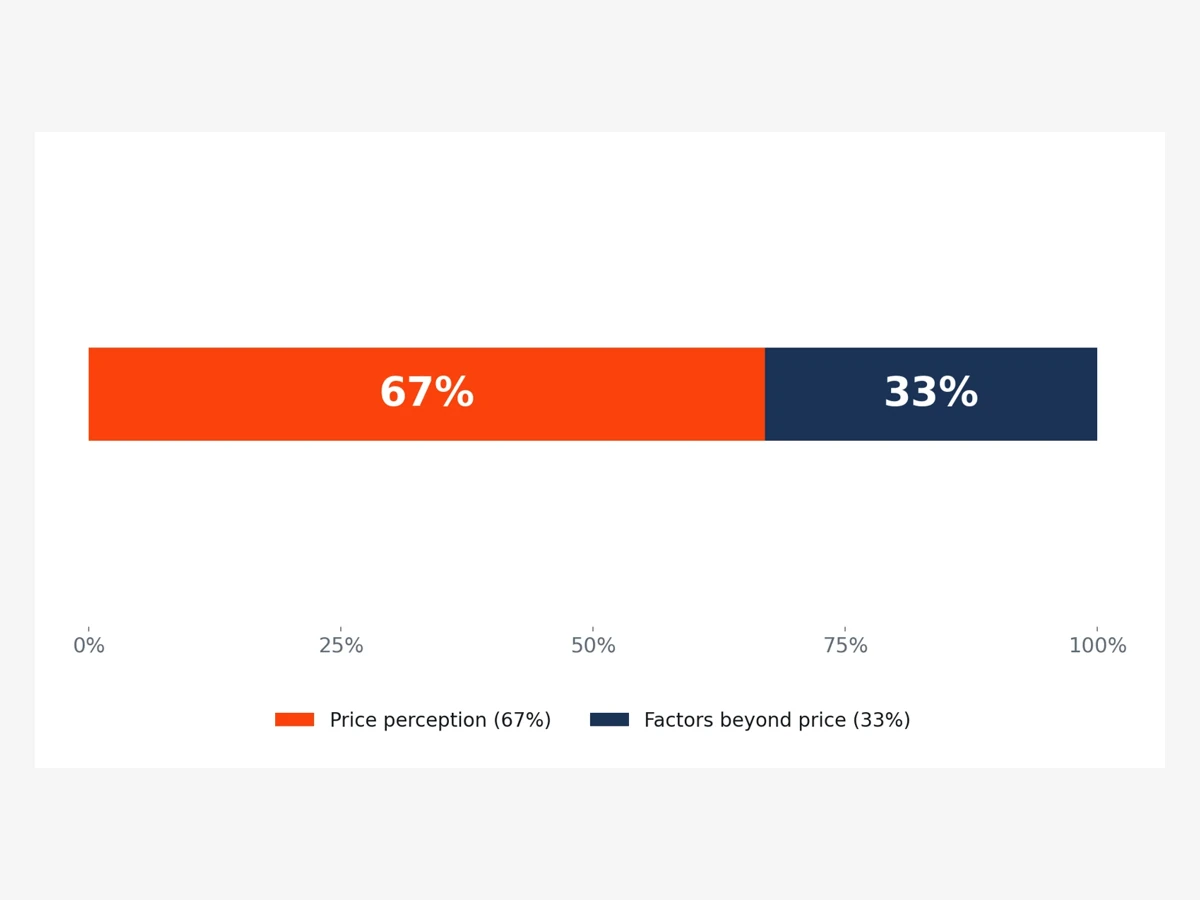
In a separate 2026 report, Deloitte described four in ten US consumers as exhibiting deal-driven, cost-conscious or trading-down behaviour. Its consumer loyalty analysis also found that up to 40% of a brand's perceived value can be driven by factors other than price, with the exact mix varying across industries. That does not establish psychological “discount addiction”; it shows both the appeal of deals and the value of non-price loyalty. Deloitte’s 2026 loyalty study.
Another recent field-study finding complicates the idea that more promotional choice is always better. A May 2026 Journal of Business Research study involving two field experiments and a preregistered online study found that offering consumers a menu mixing fixed and chance-based discounts reduced purchase incidence compared with a single promotional scheme. The experiments were not about restaurant loyalty, so we should not copy their numerical effects onto cafés, but the result is a warning against assuming more offers always mean more sales. Journal of Business Research, 2026.
In other words: customers may be actively looking for a deal without being disloyal, and a complicated discount strategy can perform worse than a simpler one. The causal question—whether repeated restaurant vouchers teach people to stop paying full price—requires longitudinal transaction data that the headline surveys do not provide.
The 90-day question most promotion dashboards leave unanswered
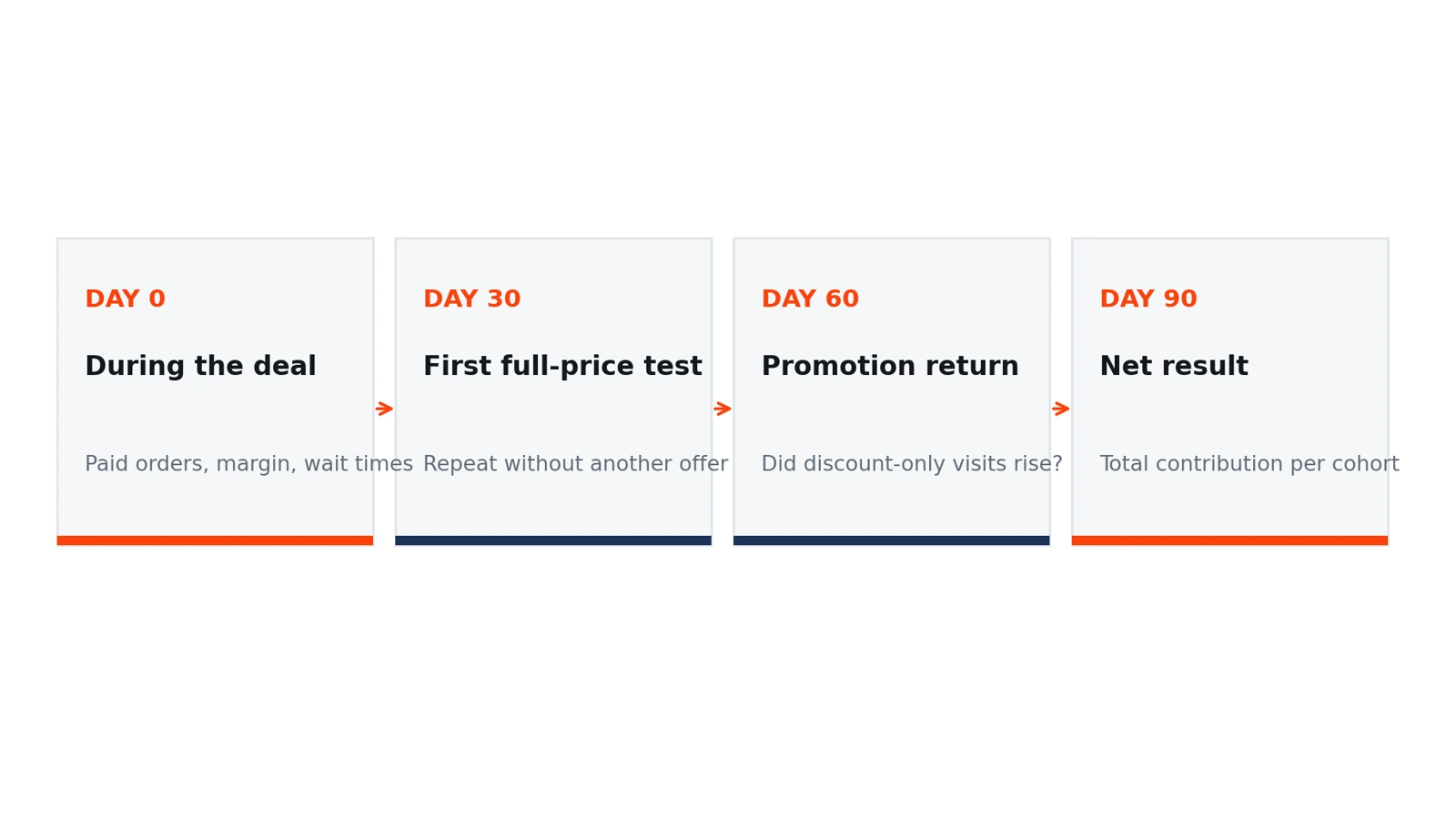
Imagine your restaurant runs a B1F1 campaign on day one. The dashboard shows a beautiful redemption chart. Then what? What does the customer do when the voucher disappears? The answer often requires following the same eligible customers across several weeks, not just counting receipts during the original event.
| When | What to measure | Question answered |
|---|---|---|
| Campaign week | Offer redemptions, completed orders and contribution | Did the campaign make immediate money? |
| Days 8–30 | Full-price repeat rate among promoted customers | Did anyone return without another deal? |
| Days 31–60 | Redemption overlap with a second campaign | Are the same customers only buying on discount days? |
| Days 61–90 | Cohort contribution after all discounts and costs | Was the cohort worth acquiring? |
This timeline is not an assertion that customers become promotion-dependent after 30, 60 or 90 days. It is a measurement proposal that could detect that pattern if it occurs. Control groups and a comparable baseline are important because rainy days, public holidays and menu changes can shift restaurant demand without any voucher.
What the recent real-world promotion cases do and do not tell us
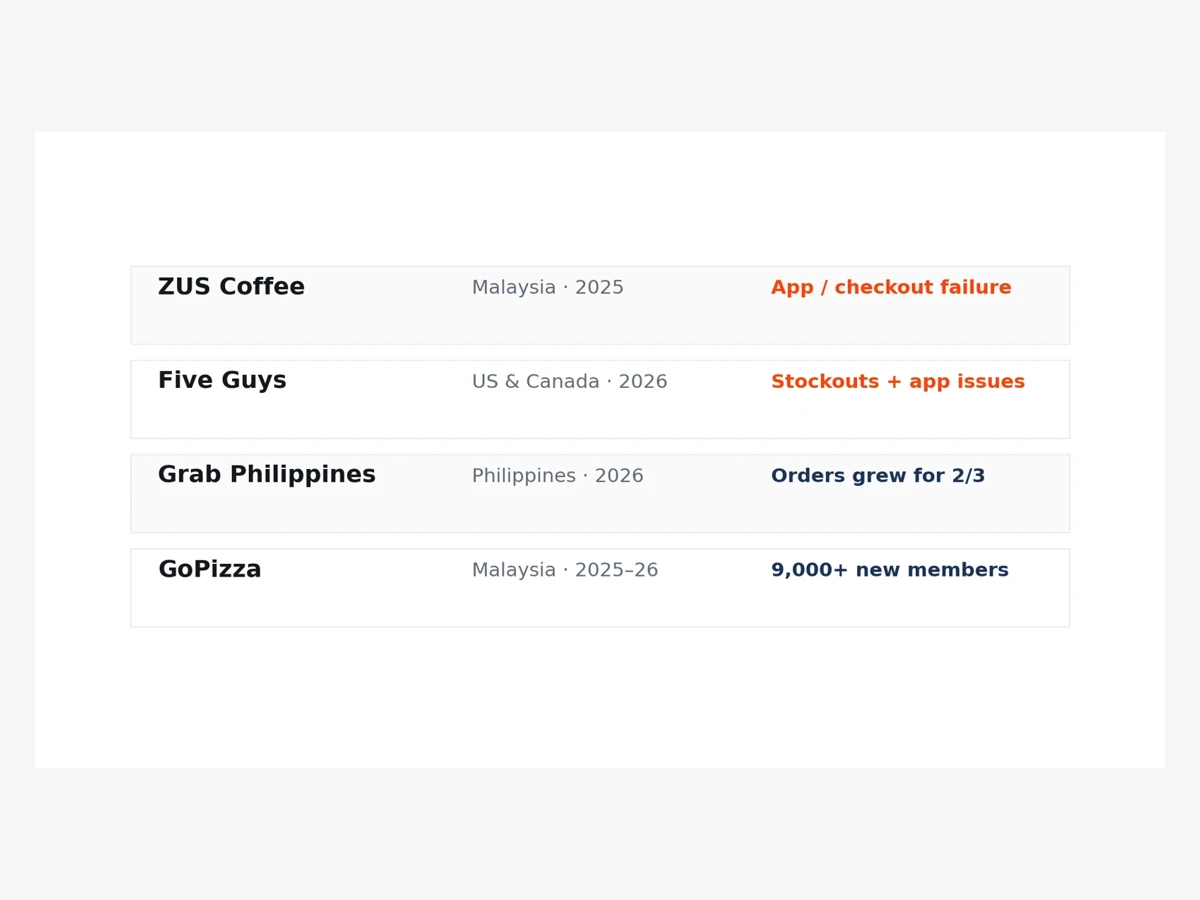
GoPizza's Malaysia loyalty launch reportedly recruited more than 9,000 members in 3½ months with a RM5.99 introductory offer, according to loyalty-technology provider Eber. TamJai Mixian reported more than 3,000 new members in one month after changing its first-bowl reward to RM5.90. Both are compelling acquisition results, analysed separately in our success-case study.
Neither vendor case publicly establishes what percentage of those newly recruited members later returned at full price. That is not proof the loyalty programmes failed. It means that membership growth and full-price retention are different metrics. We should not claim that a large member count equals profitable regulars without follow-up sales and cost data.
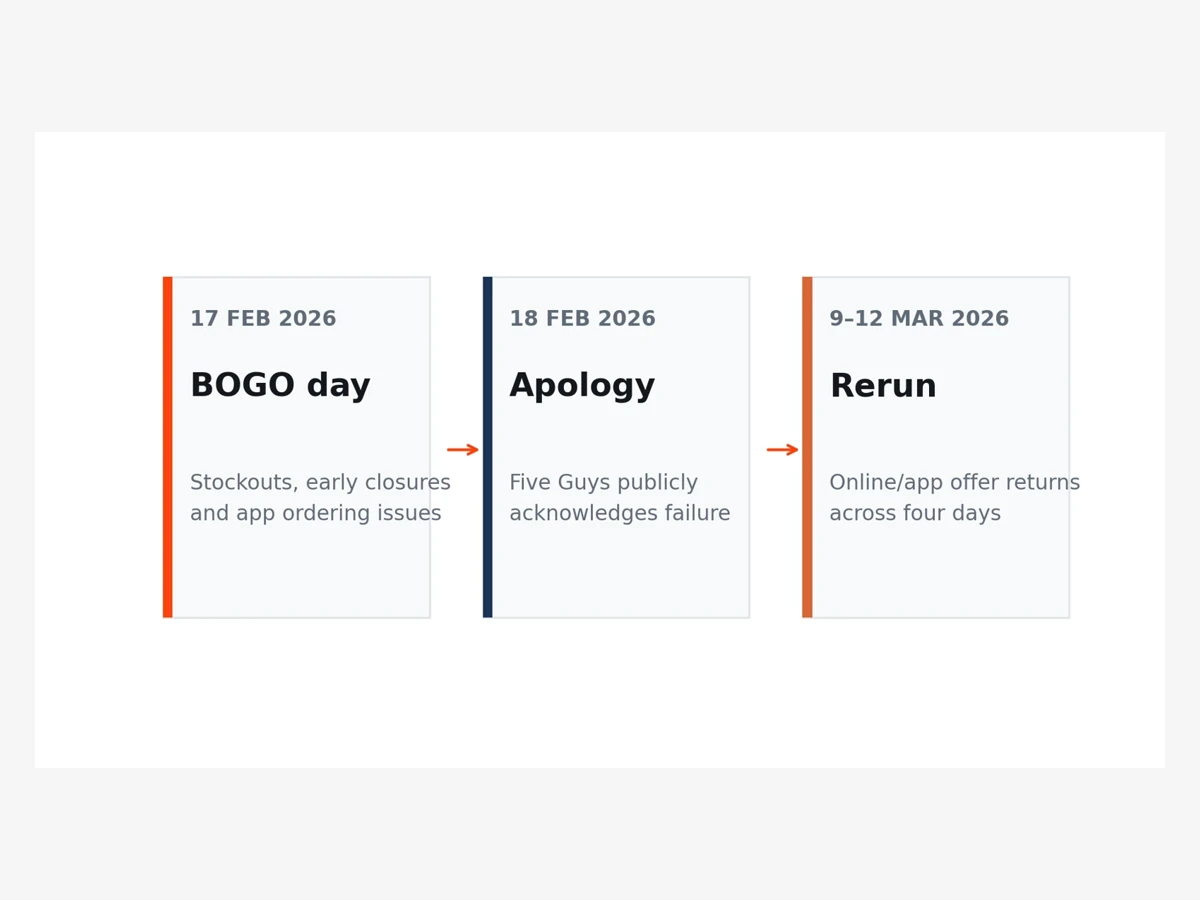
ZUS Coffee and Five Guys provide the operational side of the same question. Their campaigns attracted major attention and documented customer-service friction. They did not release customer-level 90-day follow-up data, so we cannot say whether disappointed bargain seekers stayed or left.
What is the trade-off if customers return only during promotions?
Suppose a café can make RM8 contribution on an ordinary full-price item, but only RM3 on a discounted item. A customer who buys four times at RM3 generates RM12 before fixed costs; someone who buys two times at RM8 generates RM16. These are illustrative figures, not observed data from ZUS or GoPizza. They demonstrate why visit frequency without margin can deceive.
There is also the cost of timing. If customers learn the calendar of offers, some may postpone purchases they would otherwise have made. But a new discount might also attract customers who would never have purchased at full price. The net result depends on the balance of those groups. Counting voucher redemptions alone cannot separate them.
Before repeating a campaign, ask the business question in money terms: did the extra full-price and discounted transactions generate more incremental contribution than the coupons, acquisition effort, incremental labour and fulfilment costs consumed?
To see how price cuts change the required order growth mathematically, read our B1F1 break-even analysis.
Questions owners ask about discount-driven customers
Do customers wait for a restaurant to offer discounts again?
Some likely do, and 2026 surveys show active promotion seeking. But the public evidence reviewed here does not quantify the percentage that postpones purchases at a specific restaurant; that requires behavioural sales records.
Can an introductory offer create genuine loyal customers?
Yes, it may. But published member sign-ups and first-order counts are not evidence of eventual full-price retention.
Should I stop discounts completely?
No universal rule follows from the evidence. Targeted offers that produce incremental contribution can be worthwhile; broad discounts may subsidise existing demand. Test the outcome.
What is the most useful repeat-customer number?
One useful starting point is 30- or 90-day contribution per new customer, separating full-price and discounted orders, and comparing with a matched non-promoted cohort where practical.
Research method, evidence boundaries and sources
This is a synthesis of 2025–2026 restaurant-industry research and published vendor case studies, not an original longitudinal customer experiment. The proposed time windows and example RM values are educational. There is no disclosed controlled experiment linking the Five Guys or ZUS promotions to 90-day retention in the sources below.
- McKinsey, 8 January 2026 — how cost-conscious US diners trade down within restaurants.
- Deloitte, 12 January 2026 — deal seekers, loyalty programme research and non-price value.
- Journal of Business Research, May 2026 — experimental evidence that more promotion formats can reduce purchase incidence in other retail contexts.
- Eber, GoPizza Malaysia case study and Eber, TamJai Mixian case study — reported membership acquisition, not verified 90-day customer profit.
Count the customers who return when the deal is gone
A promotion can create an entertaining spike on the dashboard. The harder and more valuable result appears several weeks later, when the original offer is no longer available. If customers still choose you at a sensible margin, the promotion may have done more than sell cheap food. If they only return for the next voucher, you need to know the cost of that behaviour before celebrating another record redemption day.
Know what changed before planning your next promotion.
Explore what customers say, what competitors are doing and what is happening around your restaurant before deciding where to spend.